
Recombinant Rat DDR1 protein (rFc Tag)
Species
Rat
Purity
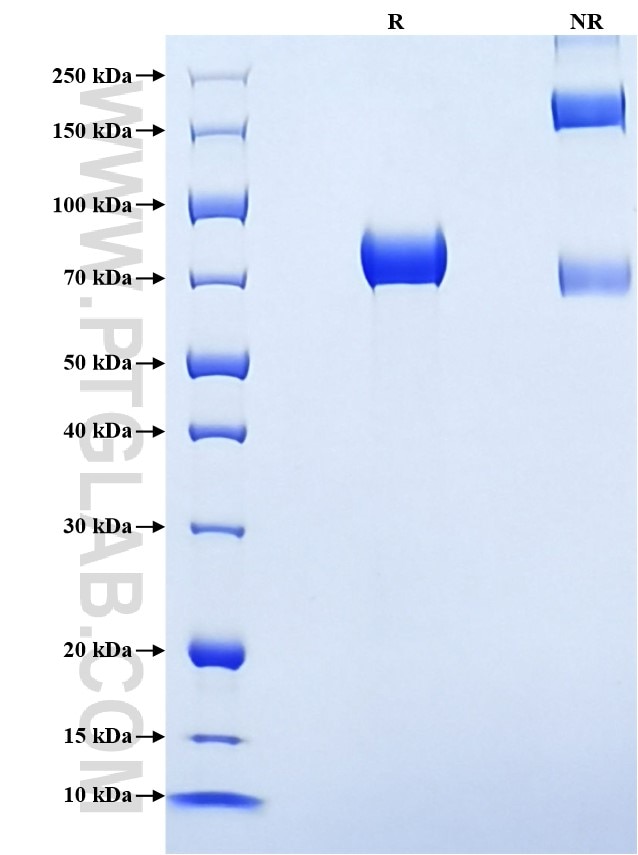
>90 %, SDS-PAGE
Tag
rFc Tag
Activity
not tested
Cat no : Eg3226
Validation Data Gallery
Product Information
| Purity | >90 %, SDS-PAGE |
| Endotoxin | <0.1 EU/μg protein, LAL method |
| Activity |
Not tested |
| Expression | HEK293-derived Rat DDR1 protein Asp22-Thr413 (Accession# A6KT95) with a rabbit IgG Fc tag at the C-terminus. |
| GeneID | 25678 |
| Accession | A6KT95 |
| PredictedSize | 69.9 kDa |
| SDS-PAGE | 70-85 kDa, reducing (R) conditions |
| Formulation | Lyophilized from 0.22 μm filtered solution in PBS, pH 7.4. Normally 5% trehalose and 5% mannitol are added as protectants before lyophilization. |
| Reconstitution | Briefly centrifuge the tube before opening. Reconstitute at 0.1-0.5 mg/mL in sterile water. |
| Storage Conditions |
It is recommended that the protein be aliquoted for optimal storage. Avoid repeated freeze-thaw cycles.
|
| Shipping | The product is shipped at ambient temperature. Upon receipt, store it immediately at the recommended temperature. |
Background
Discoidin Domain Receptor 1 (DDR1) is a receptor tyrosine kinase that is activated by fibrillar collagens, playing a pivotal role in cellular functions such as proliferation, differentiation, invasion, migration, survival, matrix remodeling, and cytokine expression. DDR1 is predominantly found in epithelial and smooth muscle cells, and its expression is mainly limited to epithelial cells located in several organs, including skin, kidney, liver, and lung. DDR1 has been implicated in a wide range of human diseases, including various types of cancer, fibrosis (such as liver/kidney/pulmonary fibrosis), inflammation, and atherosclerosis. High expression or mutation of DDR1 is associated with many cancers.
References:
1. Liu M. et al. (2024). Eur J Med Chem. 268:116291.
2. Moll S. et al. (2019). Biochim Biophys Acta Mol Cell Res. 1866(11):118474.
3. Hou G. et al. (2002). Circ Res. 90(11):1147-1149.