

Product Information
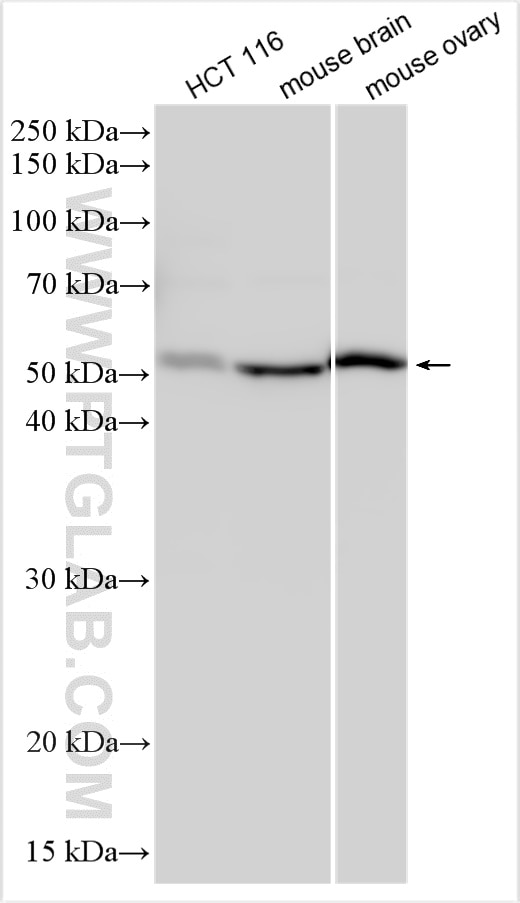
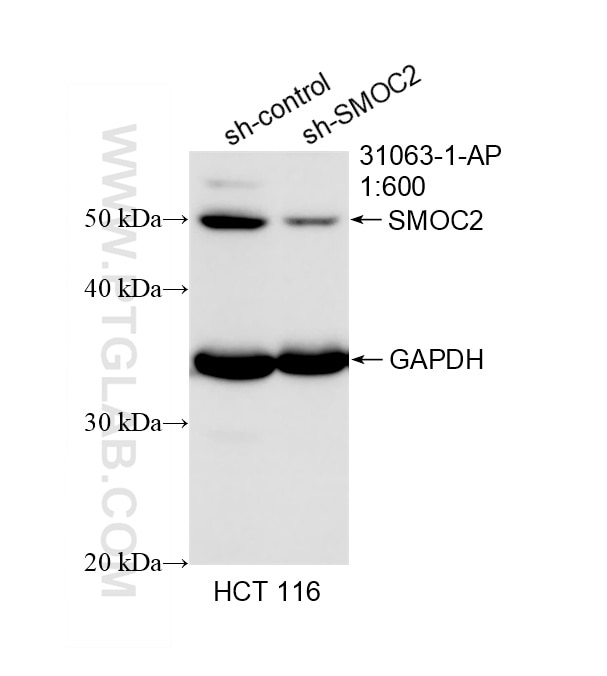
31063-1-PBS targets SMOC2 in WB, Indirect ELISA applications and shows reactivity with human, mouse samples.
| Tested Reactivity | human, mouse |
| Host / Isotype | Rabbit / IgG |
| Class | Polyclonal |
| Type | Antibody |
| Immunogen |
CatNo: Ag34966 Product name: Recombinant human SMOC2 protein Source: e coli.-derived, PGEX-4T Tag: GST Domain: 22-230 aa of BC047583 Sequence: QKFSALTFLRVDQDKDKDCSLDCAGSPQKPLCASDGRTFLSRCEFQRAKCKDPQLEIAYRGNCKDVSRCVAERKYTQEQARKEFQQVFIPECNDDGTYSQVQCHSYTGYCWCVTPNGRPISGTAVAHKTPRCPGSVNEKLPQREGTGKTDDAAAPALETQPQGDEEDIASRYPTLWTEQVKSRQNKTNKNSVSSCDQEHQSALEEAKQP Predict reactive species |
| Full Name | SPARC related modular calcium binding 2 |
| Calculated Molecular Weight | 50 kDa |
| Observed Molecular Weight | 49-50 kDa |
| GenBank Accession Number | BC047583 |
| Gene Symbol | SMOC2 |
| Gene ID (NCBI) | 64094 |
| RRID | AB_3669838 |
| Conjugate | Unconjugated |
| Form | Liquid |
| Purification Method | Antigen affinity Purification |
| UNIPROT ID | Q9H3U7 |
| Storage Buffer | PBS only, pH 7.3. |
| Storage Conditions | Store at -80°C. |
Background Information
Secreted modular calcium-binding protein 2 (SMOC2), which is a member of the secreted protein acidic and rich in cysteine (SPARC) family of matricellular proteins, interacts with matrix proteins, cell surface receptors, cytokines, proteasomes and other effector molecules to regulate cell-cell and cell-microenvironment communication (PMID: 36513634). It is expected to be located in extracellular space. The calculated molecular weight of SMOC2 is 50 kDa. In recent years, SMOC2 has been reported to be highly expressed in tumor tissues and to promote tumor migration, invasion and growth. In addition to its role in tumor progression, it also regulates wound healing, bone growth, fibrosis and embryogenesis (PMID: 36513634).



