

Tested Applications
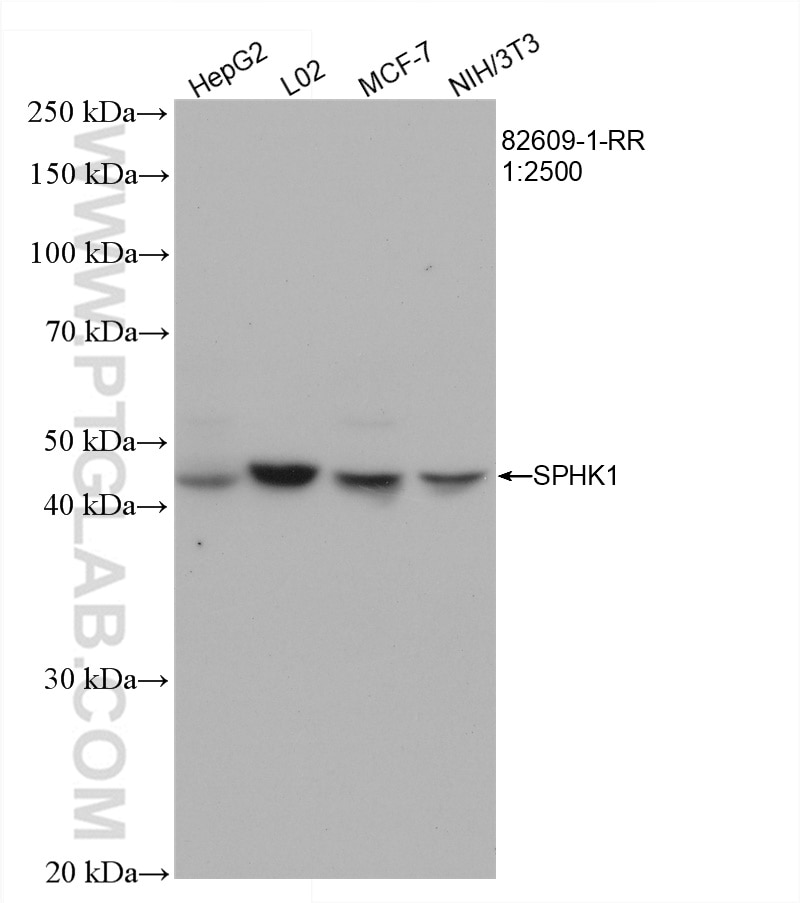
| Positive WB detected in | HepG2 cells, L02 cells, MCF-7 cells, NIH/3T3 cells |
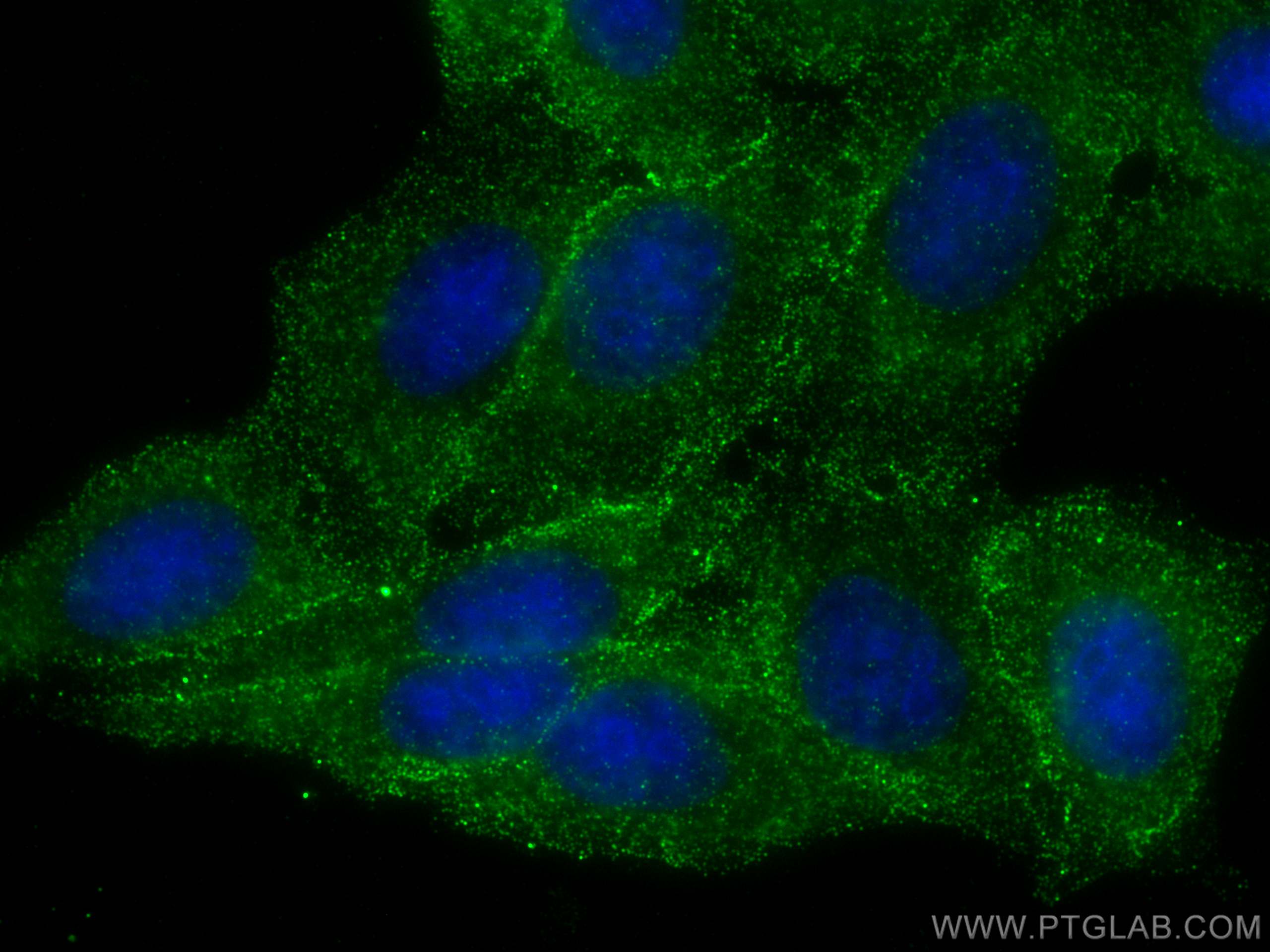
| Positive IF/ICC detected in | HepG2 cells |
Recommended dilution
| Application | Dilution |
|---|---|
| Western Blot (WB) | WB : 1:1000-1:5000 |
| Immunofluorescence (IF)/ICC | IF/ICC : 1:200-1:800 |
| It is recommended that this reagent should be titrated in each testing system to obtain optimal results. | |
| Sample-dependent, Check data in validation data gallery. | |
Product Information
82609-1-RR targets SPHK1 in WB, IF/ICC, ELISA applications and shows reactivity with human, mouse samples.
| Tested Reactivity | human, mouse |
| Cited Reactivity | human, mouse |
| Host / Isotype | Rabbit / IgG |
| Class | Recombinant |
| Type | Antibody |
| Immunogen |
CatNo: Ag1051 Product name: Recombinant human SPHK1 protein Source: e coli.-derived, PGEX-4T Tag: GST Domain: 85-384 aa of BC008040 Sequence: HEVVNGLMERPDWETAIQKPLCSLPAGSGNALAASLNHYAGYEQVTNEDLLTNCTLLLCRRLLSPMNLLSLHTASGLRLFSVLSLAWGFIADVDLESEKYRRLGEMRFTLGTFLLLAALRTYRGRLAYLPVGRVGSKTPASPVVVQQGPVDAHLVPLEEPVPSHWTVVPDEDFVLVLALLHSHLGSEMFAAPMGRCAAGVMHLFYVRAGVSRAMLLRLFLAMEKGRHMEYECPYLVYVPVVAFRLEPKDGKGVFAVDGELMVSEAVQGQVHPNYFWMVSGCVEPPPSWKPQQMPPPEEPL Predict reactive species |
| Full Name | sphingosine kinase 1 |
| Calculated Molecular Weight | 43 kDa |
| Observed Molecular Weight | 42 kDa |
| GenBank Accession Number | BC008040 |
| Gene Symbol | SPHK1 |
| Gene ID (NCBI) | 8877 |
| RRID | AB_3086491 |
| Conjugate | Unconjugated |
| Form | Liquid |
| Purification Method | Protein A purification |
| UNIPROT ID | Q9NYA1 |
| Storage Buffer | PBS with 0.02% sodium azide and 50% glycerol, pH 7.3. |
| Storage Conditions | Store at -20°C. Stable for one year after shipment. Aliquoting is unnecessary for -20oC storage. 20ul sizes contain 0.1% BSA. |
Background Information
SPHK(Sphingosine kinase 1) is also named as SPHK, SPK.It catalyzes the phosphorylation of sphingosine to form sphingosine 1-phosphate (SPP), a lipid mediator with both intra- and extracellular functions and is precariously perched at the balance point between progrowth and pro-death signalling in the cell.Endogenous SPHK1 purified from placenta has identical enzymatic characteristics, suggesting posttranslational modification does not effect functional properties(PMID:10947957).It has 2 isoforms produced by alternative splicing and can form the oligomeric structure(PMID:22335554).
Protocols
| Product Specific Protocols | |
|---|---|
| IF protocol for SPHK1 antibody 82609-1-RR | Download protocol |
| WB protocol for SPHK1 antibody 82609-1-RR | Download protocol |
| Standard Protocols | |
|---|---|
| Click here to view our Standard Protocols |
Publications
What published studies show
The SPHK1 Recombinant monoclonal antibody (2K12), catalog number 82609-1-RR, has 7 citations. These appear in journals including Sci China Life Sci, Phytother Res, Int Immunopharmacol, Biol Direct, BMC Cancer, J Ethnopharmacol, and Mechanobiol Med. The associated research fields span sphingolipid metabolism, tumor immunity, atherosclerosis, renal lipidomics, AML venetoclax resistance, vascular cognitive impairment, and osteogenesis. Applications cited include WB and IF in human and mouse samples.
| Species | Application | Title |
|---|---|---|
Sci China Life Sci SPHK1 deficiency promotes intestinal homeostasis by ameliorating ER stress-induced gastrointestinal injury during murine graft-versus-host disease. | ||
Phytother Res Bioactive Sphingolipids of Cordyceps sinensis Modulate Tumor Immunity Through the SphK1-Mediated Cer/S1P Axis. | ||
Int Immunopharmacol Isoginkgetin stabilizes atherosclerotic plaques by targeting NR4A2 to modulate the PPAR signaling pathway and reprogram ceramide metabolism, thereby inhibiting vascular smooth muscle cell phenotypic transformation. | ||
Biol Direct Dapagliflozin induces renal lipidomic remodeling and systemic metabolic improvement. | ||
BMC Cancer ASAH1-mediated sphingolipid metabolic reprogramming in venetoclax resistance of AML: beyond the monocytic phenotypes. | ||
J Ethnopharmacol Jiawei Dingzhi Wan ameliorates chronic cerebral hypoperfusion-induced vascular cognitive impairment by modulating ACER2 and S1P-mediated microvascular angiogenesis and aortic vasoconstriction. |




