
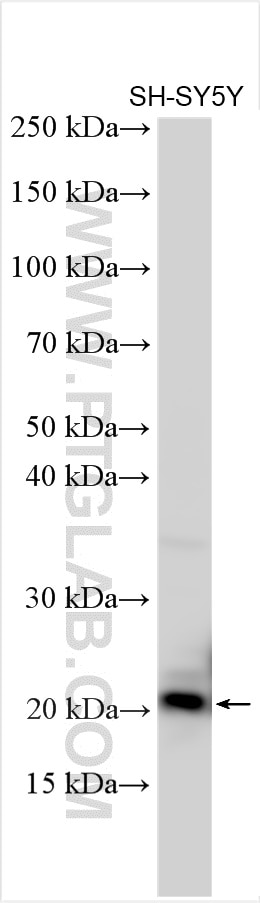
Product Information
11311-1-PBS targets STMN3 in WB, Indirect ELISA applications and shows reactivity with human, mouse, rat samples.
| Tested Reactivity | human, mouse, rat |
| Host / Isotype | Rabbit / IgG |
| Class | Polyclonal |
| Type | Antibody |
| Immunogen |
CatNo: Ag1853 Product name: Recombinant human STMN3 protein Source: e coli.-derived, PGEX-4T Tag: GST Domain: 1-180 aa of BC009381 Sequence: MASTISAYKEKMKELSVLSLICSCFYTQPHPNTVYQYGDMEVKQLDKRASGQSFEVILKSPSDLSPESPMLSSPPKKKDTSLEELQKRLEAAEERRKTQEAQVLKQLAERREHEREVLHKALEENNNFSRQAEEKLNYKMELSKEIREAHLAALRERLREKELHAAEVRRNKEQREEMSG Predict reactive species |
| Full Name | stathmin-like 3 |
| Calculated Molecular Weight | 21 kDa |
| Observed Molecular Weight | 21-25 kDa |
| GenBank Accession Number | BC009381 |
| Gene Symbol | STMN3 |
| Gene ID (NCBI) | 50861 |
| RRID | AB_2197399 |
| Conjugate | Unconjugated |
| Form | Liquid |
| Purification Method | Antigen affinity purification |
| UNIPROT ID | Q9NZ72 |
| Storage Buffer | PBS only, pH 7.3. |
| Storage Conditions | Store at -80°C. |
Background Information
Stathmin family phosphoproteins participate in the control of microtubule dynamics and have been proposed to be involved in the control of neuronal differentiation. Neuron specific Stathmin-3 (STMN3) is a novel STAT3 (signal transducer and activator of transcription 3) interacting protein. STAT3 is a key contributor to cancer cell migration and invasion. STMN3 exhibits microtubule-destabilizing activity, which is antagonized by STAT3. SCG10 is a widely studied and recognized neuronal differentiation marker, STMN3 is a SCG10-like protein (SCLIP) and is present from the earliest stages of hippocampal neuron differentiation in culture at vesicle-like structures following dynamic microtubules. RNAi mediated inhibition of this gene resulted in increased axonal branching.


