


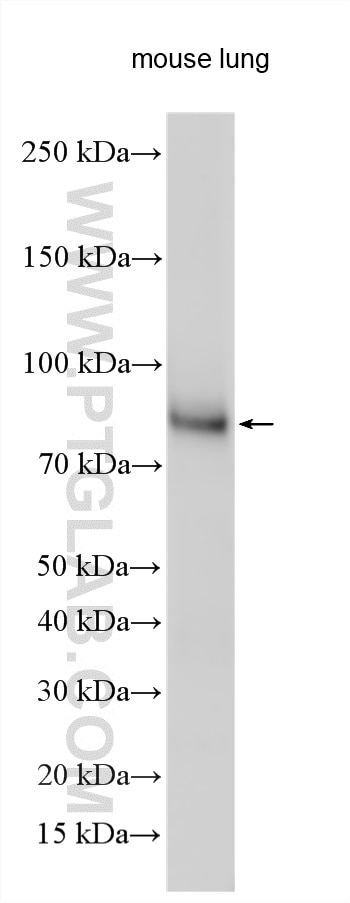



Tested Applications
| Positive WB detected in | A549 cells, BxPC-3 cells, human placenta tissue, mouse lung tissue, SW 1990 cells, human kidney tissue, rat kidney tissue |
| Positive IHC detected in | human kidney tissue, mouse kidney tissue, rat kidney tissue Note: suggested antigen retrieval with TE buffer pH 9.0; (*) Alternatively, antigen retrieval may be performed with citrate buffer pH 6.0 |
| Positive IF/ICC detected in | MCF-7 cells |
Recommended dilution
| Application | Dilution |
|---|---|
| Western Blot (WB) | WB : 1:500-1:3000 |
| Immunohistochemistry (IHC) | IHC : 1:200-1:800 |
| Immunofluorescence (IF)/ICC | IF/ICC : 1:200-1:800 |
| It is recommended that this reagent should be titrated in each testing system to obtain optimal results. | |
| Sample-dependent, Check data in validation data gallery. | |
Product Information
16930-1-AP targets TBX2 in WB, IHC, IF/ICC, ELISA applications and shows reactivity with human samples.
| Tested Reactivity | human |
| Cited Reactivity | human |
| Host / Isotype | Rabbit / IgG |
| Class | Polyclonal |
| Type | Antibody |
| Immunogen |
CatNo: Ag10393 Product name: Recombinant human TBX2 protein Source: e coli.-derived, PGEX-4T Tag: GST Domain: 1-349 aa of BC052566 Sequence: MAYHPFHAPRPADFPMSAFLAAAQPSFFPALALPPGALAKPLPDPGLAGAAAAAAAAAAAAEAGLHVSALGPHPPAAHLRSLKSLEPEDEVEDDPKVTLEAKELWDQFHKLGTEMVITKSGRRMFPPFKVRVSGLDKKAKYILLMDIVAADDCRYKFHNSRWMVAGKADPEMPKRMYIHPDSPATGEQWMAKPVAFHKLKLTNNISDKHGFTILNSMHKYQPRFHIVRANDILKLPYSTFRTYVFPETDFIAVTAYQNDKITQLKIDNNPFAKGFRDTGNGRREKRKQLTLPSLRLYEEHCKPERDGAESDASSCDPPPAREPPTSPGAAPSPLRLHRARAEEKSCAAD Predict reactive species |
| Full Name | T-box 2 |
| Calculated Molecular Weight | 702 aa, 74 kDa |
| Observed Molecular Weight | 74 kDa |
| GenBank Accession Number | BC052566 |
| Gene Symbol | TBX2 |
| Gene ID (NCBI) | 6909 |
| RRID | AB_2200526 |
| Conjugate | Unconjugated |
| Form | Liquid |
| Purification Method | Antigen affinity purification |
| UNIPROT ID | Q13207 |
| Storage Buffer | PBS with 0.02% sodium azide and 50% glycerol, pH 7.3. |
| Storage Conditions | Store at -20°C. Stable for one year after shipment. Aliquoting is unnecessary for -20oC storage. 20ul sizes contain 0.1% BSA. |
Background Information
TBX2 is a member of the T-box transcription factor gene family, and is expressed in a variety of tissues and organs during embryogenesis. Loss of Tbx2 function is therefore not sufficient to upregulate expression of p19ARF, p16INK4a, p15INK4b or p21 in 9.5-10.5 dpc mouse embryos, nor can the Tbx2tm1Pa/Tbx2tm1Pa phenotype be attributed to an excess of p53 (PMID: 35508658, 15459098). TBX2 is overexpressed in several cancers including melanoma, small cell lung carcinoma, breast, pancreatic, liver, and bladder cancers and can suppress senescence, a cellular process, which serves as a barrier to cancer development (PMID: 15781639).
Protocols
| Product Specific Protocols | |
|---|---|
| IF protocol for TBX2 antibody 16930-1-AP | Download protocol |
| IHC protocol for TBX2 antibody 16930-1-AP | Download protocol |
| WB protocol for TBX2 antibody 16930-1-AP | Download protocol |
| Standard Protocols | |
|---|---|
| Click here to view our Standard Protocols |
Publications
What published studies show
The TBX2 Polyclonal antibody (Cat# 16930-1-AP) has 4 published citations. These appear in Int J Mol Sci, Front Chem, Sci Rep, and Reprod Sci. The research fields span polyomavirus DNA replication, oncogenic transcription factor targeting, cell senescence in recurrent spontaneous abortion, and ovarian carcinoma diagnosis and prognosis. All citations used human samples with applications including WB, IF, and IHC.
| Species | Application | Title |
|---|---|---|
Int J Mol Sci Proteomics Analysis of the Polyomavirus DNA Replication Initiation Complex Reveals Novel Functional Phosphorylated Residues and Associated Proteins | ||
Front Chem Targeting the Oncogenic TBX2 Transcription Factor With Chromomycins.
| ||
Sci Rep Identification and validation of cell senescence genes in recurrent spontaneous abortion via multiple bioinformatics algorithms. | ||
Reprod Sci The Role of Four New Biochemical Markers in the Diagnosis and Prognosis of Ovarian Carcinoma. |





