

Product Information
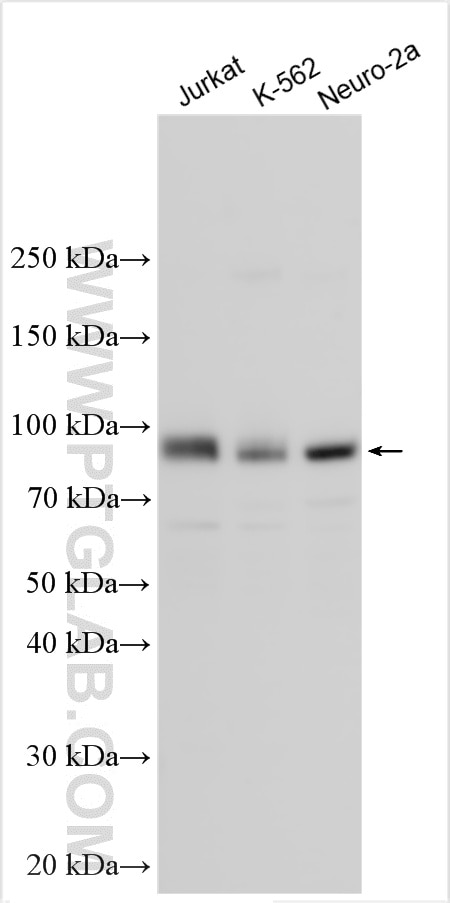
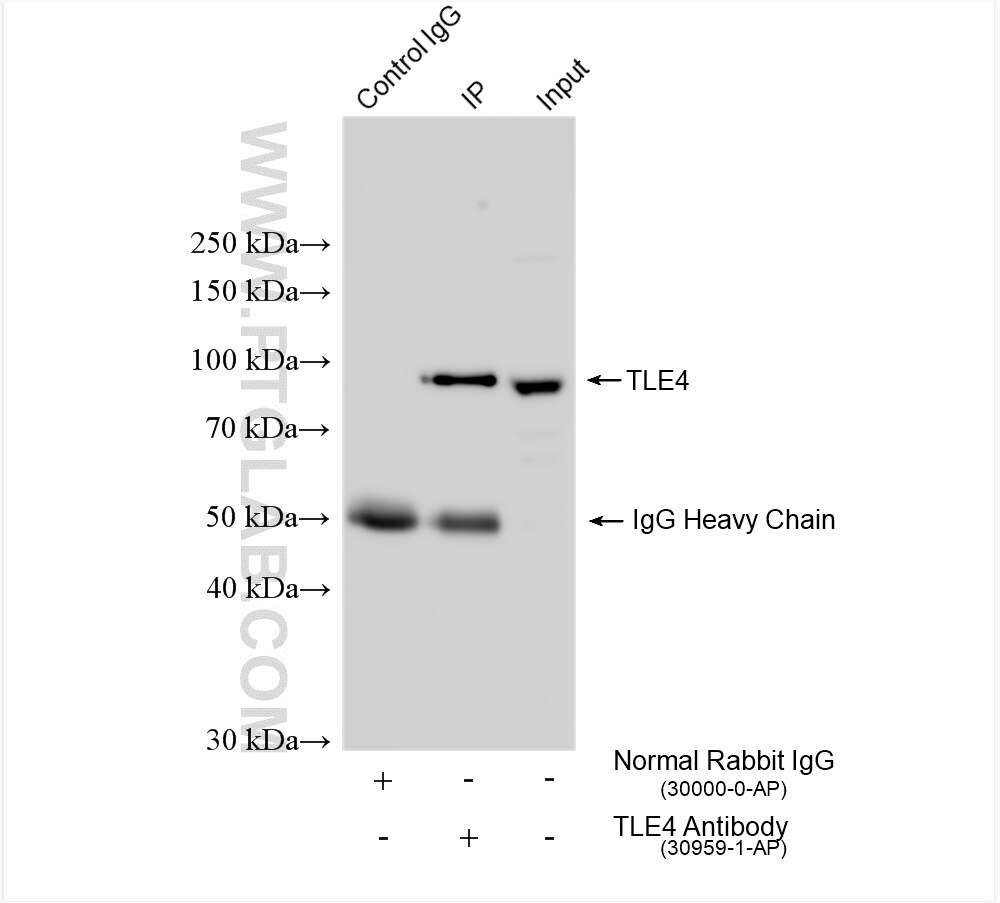
30959-1-PBS targets TLE4 in WB, IP, Indirect ELISA applications and shows reactivity with human, mouse samples.
| Tested Reactivity | human, mouse |
| Host / Isotype | Rabbit / IgG |
| Class | Polyclonal |
| Type | Antibody |
| Immunogen |
CatNo: Ag34006 Product name: Recombinant human TLE4 protein Source: e coli.-derived, PET28a Tag: 6*His Domain: 279-408 aa of BC059405 Sequence: LDKTRLLKKDAPISPASIASSSSTPSSKSKELSLKRDMGKLSETRLSEDEQCTLGLQRWFCRLWFMNEKSTTPVSKSNTPTPRTDAPTPGSNSTPGLRPVPGKPPGVDPLASSLRTPMAVPCPYPTPFGI Predict reactive species |
| Full Name | transducin-like enhancer of split 4 (E(sp1) homolog, Drosophila) |
| Calculated Molecular Weight | 84 kDa |
| Observed Molecular Weight | 76-88 kDa |
| GenBank Accession Number | BC059405 |
| Gene Symbol | TLE4 |
| Gene ID (NCBI) | 7091 |
| RRID | AB_3742381 |
| Conjugate | Unconjugated |
| Form | Liquid |
| Purification Method | Antigen affinity Purification |
| UNIPROT ID | Q04727 |
| Storage Buffer | PBS only, pH 7.3. |
| Storage Conditions | Store at -80°C. |
Background Information
TLE4 (Transducin-like enhancer protein 4), also known as GRG4. It is predicted to be located in the nucleus. Tle4 promotes acquisition of corticothalamic identity and blocks emergence of core characteristics of subcerebral/corticospinal projection neuron identity, including gene expression and connectivity. During the first post-natal week, when corticothalamic innervation is ongoing, Tle4 is required to stabilize corticothalamic neuron identity, limiting interference from differentiation programs of developmentally related neuron classes (PMID: 37561632). The molecular weight of TLE4 is 76 kDa.



