
Product Information
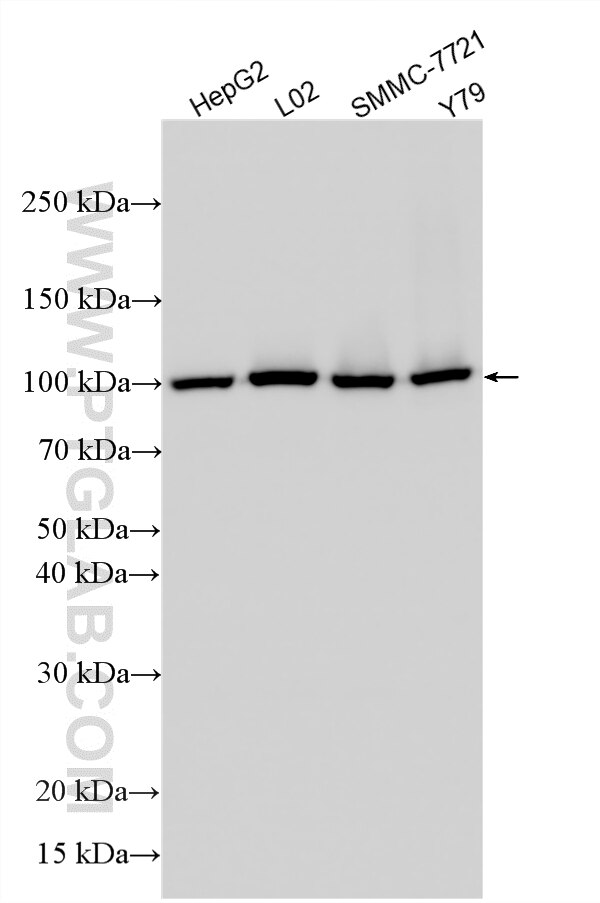
12577-1-PBS targets XPOT in WB, Indirect ELISA applications and shows reactivity with human samples.
| Tested Reactivity | human |
| Host / Isotype | Rabbit / IgG |
| Class | Polyclonal |
| Type | Antibody |
| Immunogen |
CatNo: Ag3256 Product name: Recombinant human XPOT protein Source: e coli.-derived, PGEX-4T Tag: GST Domain: 1-366 aa of BC020569 Sequence: MDEQALLGLNPNADSDFRQRALAYFEQLKISPDAWQVCAEALAQRTYSDDHVKFFCFQVLEHQVKYKYSELTTVQQQLIRETLISWLQAQMLNPQPEKTFIRNKAAQVFALLFVTEYLTKWPKFFFDILSVVDLNPRGVDLYLRILMAIDSELVDRDVVHTSEEARRNTLIKDTMREQCIPNLVESWYQILQNYQFTNSEVTCQCLEVVGAYVSWIDLSLIANDRFINMLLGHMSIEVLREEACDCLFEVVNKGMDPVDKMKLVESLCQVLQSAGFFSIDQEEDVDFLARFSKLVNGMGQSLIVSWSKLIKNGDIKNAQEALQAIETKVALMLQLLIHEDDDISSNIIGFCYDYLHILKQLTVLSD Predict reactive species |
| Full Name | exportin, tRNA (nuclear export receptor for tRNAs) |
| Calculated Molecular Weight | 962 aa, 110 kDa |
| Observed Molecular Weight | 100-110 kDa |
| GenBank Accession Number | BC020569 |
| Gene Symbol | XPOT |
| Gene ID (NCBI) | 11260 |
| RRID | AB_3741831 |
| Conjugate | Unconjugated |
| Form | Liquid |
| Purification Method | Antigen affinity purification |
| UNIPROT ID | O43592 |
| Storage Buffer | PBS only, pH 7.3. |
| Storage Conditions | Store at -80°C. |
Background Information
XPOT (also known as Exportin-T) is a key member of the karyopherin-β family of nuclear transport receptors, specifically responsible for the export of a critical class of small non-coding RNAs, transfer RNAs (tRNAs), from the nucleus to the cytoplasm. This process is essential for protein synthesis, as tRNAs must function in the cytoplasm to decode mRNA sequences and deliver amino acids to the growing polypeptide chain. XPOT recognizes mature tRNAs that have been properly processed and aminoacylated in the nucleus, loading them in a RanGTP-dependent manner. Upon translocation through the nuclear pore complex, the hydrolysis of RanGTP to RanGDP in the cytoplasm triggers the release of the tRNA cargo, thereby ensuring that only functional tRNAs are utilized for translation and maintaining the spatial separation of nuclear and cytoplasmic processes.


