

Tested Applications
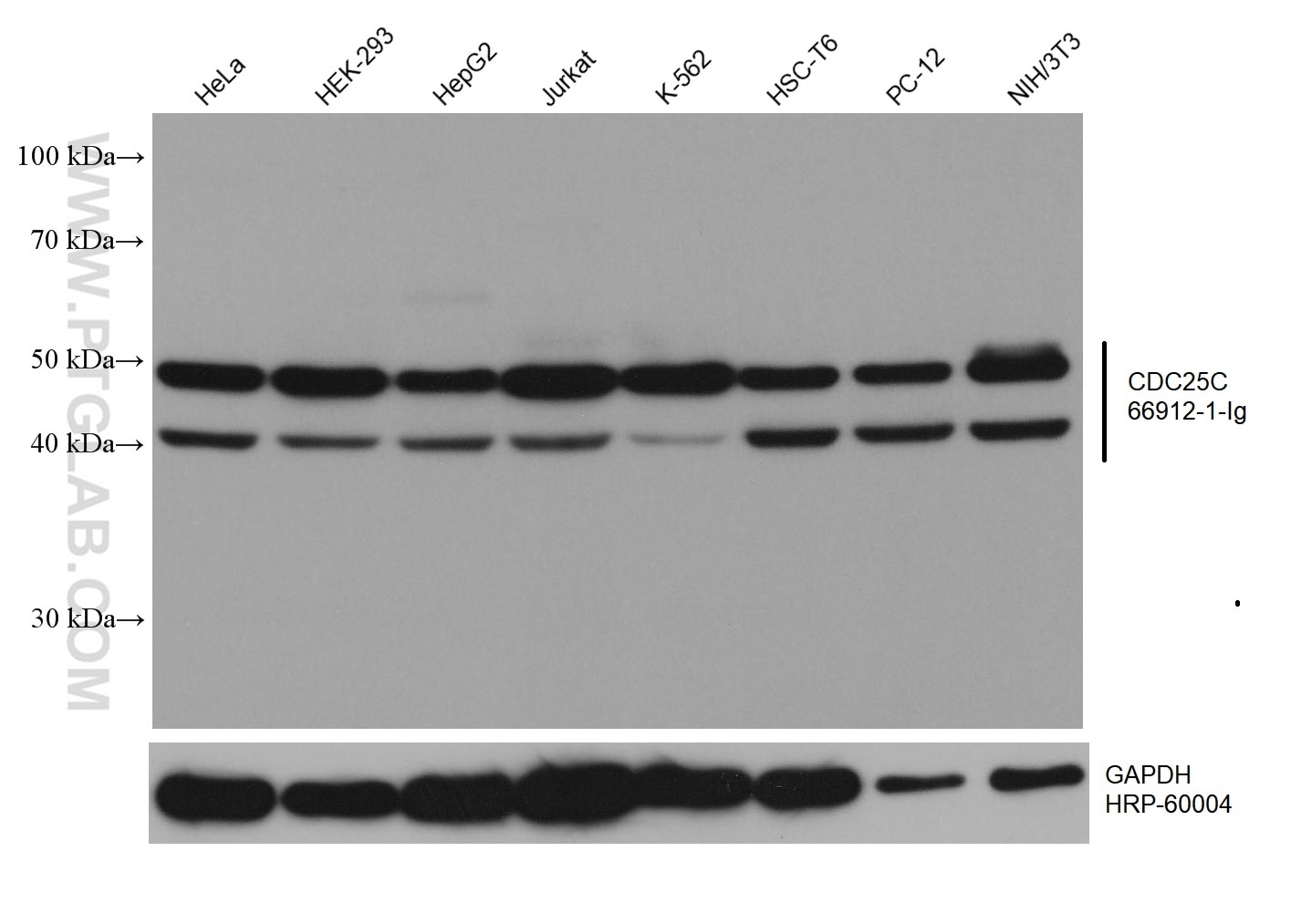
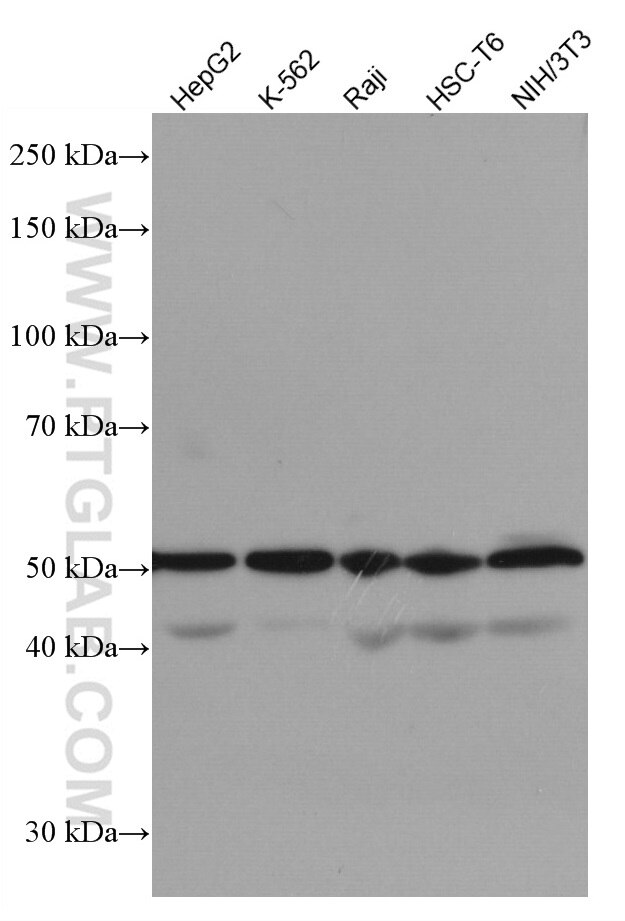
| Positive WB detected in | HeLa cells, HepG2 cells, HEK-293 cells, Jurkat cells, K-562 cells, HSC-T6 cells, PC-12 cells, NIH/3T3 cells, Raji cells |
Recommended dilution
| Application | Dilution |
|---|---|
| Western Blot (WB) | WB : 1:5000-1:50000 |
| It is recommended that this reagent should be titrated in each testing system to obtain optimal results. | |
| Sample-dependent, Check data in validation data gallery. | |
Product Information
66912-1-Ig targets CDC25C in WB, ELISA applications and shows reactivity with human, mouse, rat samples.
| Tested Reactivity | human, mouse, rat |
| Cited Reactivity | human, mouse |
| Host / Isotype | Mouse / IgG1 |
| Class | Monoclonal |
| Type | Antibody |
| Immunogen |
CatNo: Ag10240 Product name: Recombinant human CDC25C protein Source: e coli.-derived, PET28a Tag: 6*His Domain: 1-279 aa of BC019089 Sequence: MSTELFSSTREEGSSGSGPSFRSNQRKMLNLLLERDTSFTVCPDVPRTPVGKFLGDSANLSILSGGTPKCCLDLSNLSSGEITATQLTTSADLDETGHLDSSGLQEVHLAGMNHDQHLMKCSPAQLLCSTPNGLDRGHRKRDAMCSSSANKENDNGNLVDSEMKYLGSPITTVPKLDKNPNLGEDQAEEISDELMEFSLKDQEAKVSRSGLYRSPSMPENLNRPRLKQVEKFKDNTIPDKVKKKYFSGQGKLRKGLCLKKTVSLCDITITQMLEEDSNQ Predict reactive species |
| Full Name | cell division cycle 25 homolog C (S. pombe) |
| Calculated Molecular Weight | 473 aa, 53 kDa |
| Observed Molecular Weight | 46-53 kDa |
| GenBank Accession Number | BC019089 |
| Gene Symbol | CDC25C |
| Gene ID (NCBI) | 995 |
| RRID | AB_2882239 |
| Conjugate | Unconjugated |
| Form | Liquid |
| Purification Method | Protein G purification |
| UNIPROT ID | P30307 |
| Storage Buffer | PBS with 0.02% sodium azide and 50% glycerol, pH 7.3. |
| Storage Conditions | Store at -20°C. Stable for one year after shipment. Aliquoting is unnecessary for -20oC storage. 20ul sizes contain 0.1% BSA. |
Background Information
The cell division cycle 25 (CDC25) family of proteins are highly conserved dual specificity phosphatases that activate cyclin-dependent kinase (CDK) complexes, which in turn regulate progression through the cell division cycle. CDC25C (cell division cycle 25 homolog C) is one of the 3 isoforms of CDC25 in mammalian cells. It is present in the cytoplasm of asynchronously growing human cells (PMID:10330186). And it may be phosphorylated by its own substrate, an active cdc2-cyclin B complex, to create an autoactivation loop (PMID:7937793). It can be hyperphosphorylated to get the active form of 70 kDa (PMID:18296513). CDC25C has some isofroms with molecular mass of 46-53 kDa.
Protocols
| Product Specific Protocols | |
|---|---|
| WB protocol for CDC25C antibody 66912-1-Ig | Download protocol |
| Standard Protocols | |
|---|---|
| Click here to view our Standard Protocols |
Publications
What published studies show
The CDC25C Monoclonal antibody (2B6B12), catalog number 66912-1-Ig, has 11 citations. These appear in journals including J Adv Res, Pharmaceutics, Biochem Pharmacol, Front Pharmacol, Toxicology, Sci Rep, iScience, Reprod Toxicol, Food Chem Toxicol, and Oncol Lett. Research fields span cell cycle regulation, cancer (gastric, endometrial, lung, hepatocellular), oocyte meiosis, liver fibrosis, DNA damage, apoptosis, autophagy, and ferroptosis, with all citations using WB in human and/or mouse samples.
| Species | Application | Title |
|---|---|---|
J Adv Res Tankyrase activity is essential for asymmetric division and chromosome segregation in oocyte meiosis | ||
Pharmaceutics C118P Suppresses Gastric Cancer Growth via Promoting Autophagy-Lysosomal Degradation of RAB1A | ||
Biochem Pharmacol Bavachinin exerts anti-tumor effects by activating TLR4/STING axis-dependent PANoptosis and synergistically enhances chemosensitivity in endometrial cancer | ||
Front Pharmacol Eupalinolide A inhibits cancer progression and induces ferroptosis and apoptosis by targeting the AMPK/mTOR/SCD1 signalling in non-small cell lung cancer. | ||
Toxicology ATM deficiency aggravates the progression of liver fibrosis induced by carbon tetrachloride in mice | ||
Sci Rep CDC25C downregulation suppresses HCC growth via mitochondrial stress-induced autophagy and apoptosis.
|
Reviews
What customers say
The product received a 5-star rating from a single review. The reviewer used it for Western Blot on murine hepatocytes at a 1:2000 dilution with 20 µg total protein loaded, reporting successful results. No additional written comments were provided beyond the experimental conditions.
The reviews below have been submitted by verified Proteintech customers who received an incentive for providing their feedback.
Angélique (Verified Customer) (11-25-2021) | on 20ug total proteins
 |



