




Tested Applications
| Positive WB detected in | pig kidney tissue, pig liver tissue, rat liver tissue, recombinant protein |
| Positive IHC detected in | mouse kidney tissue, human kidney tissue, human colon tissue Note: suggested antigen retrieval with TE buffer pH 9.0; (*) Alternatively, antigen retrieval may be performed with citrate buffer pH 6.0 |
| Positive IF/ICC detected in | HeLa cells |
Recommended dilution
| Application | Dilution |
|---|---|
| Western Blot (WB) | WB : 1:1000-1:4000 |
| Immunohistochemistry (IHC) | IHC : 1:200-1:800 |
| Immunofluorescence (IF)/ICC | IF/ICC : 1:400-1:1600 |
| It is recommended that this reagent should be titrated in each testing system to obtain optimal results. | |
| Sample-dependent, Check data in validation data gallery. | |
Product Information
66862-1-Ig targets PCK1 in WB, IHC, IF/ICC, ELISA applications and shows reactivity with human, mouse, rat, pig samples.
| Tested Reactivity | human, mouse, rat, pig |
| Cited Reactivity | human, mouse, monkey |
| Host / Isotype | Mouse / IgG1 |
| Class | Monoclonal |
| Type | Antibody |
| Immunogen |
CatNo: Ag9720 Product name: Recombinant human PCK1 protein Source: e coli.-derived, PET28a Tag: 6*His Domain: 274-622 aa of BC023978 Sequence: EGEKKYLAAAFPSACGKTNLAMMNPSLPGWKVECVGDDIAWMKFDAQGHLRAINPENGFFGVAPGTSVKTNPNAIKTIQKNTIFTNVAETSDGGVYWEGIDEPLASGVTITSWKNKEWSSEDGEPCAHPNSRFCTPASQCPIIDAAWESPEGVPIEGIIFGGRRPAGVPLVYEALSWQHGVFVGAAMRSEATAAAEHKGKIIMHDPFAMRPFFGYNFGKYLAHWLSMAQHPAAKLPKIFHVNWFRKDKEGKFLWPGFGENSRVLEWMFNRIDGKASTKLTPIGYIPKEDALNLKGLGHINMMELFSISKEFWEKEVEDIEKYLEDQVNADLPCEIEREILALKQRISQM Predict reactive species |
| Full Name | phosphoenolpyruvate carboxykinase 1 (soluble) |
| Calculated Molecular Weight | 622 aa, 69 kDa |
| Observed Molecular Weight | 65-69 kDa |
| GenBank Accession Number | BC023978 |
| Gene Symbol | PCK1 |
| Gene ID (NCBI) | 5105 |
| RRID | AB_2882200 |
| Conjugate | Unconjugated |
| Form | Liquid |
| Purification Method | Protein G purification |
| UNIPROT ID | P35558 |
| Storage Buffer | PBS with 0.02% sodium azide and 50% glycerol, pH 7.3. |
| Storage Conditions | Store at -20°C. Stable for one year after shipment. Aliquoting is unnecessary for -20oC storage. 20ul sizes contain 0.1% BSA. |
Background Information
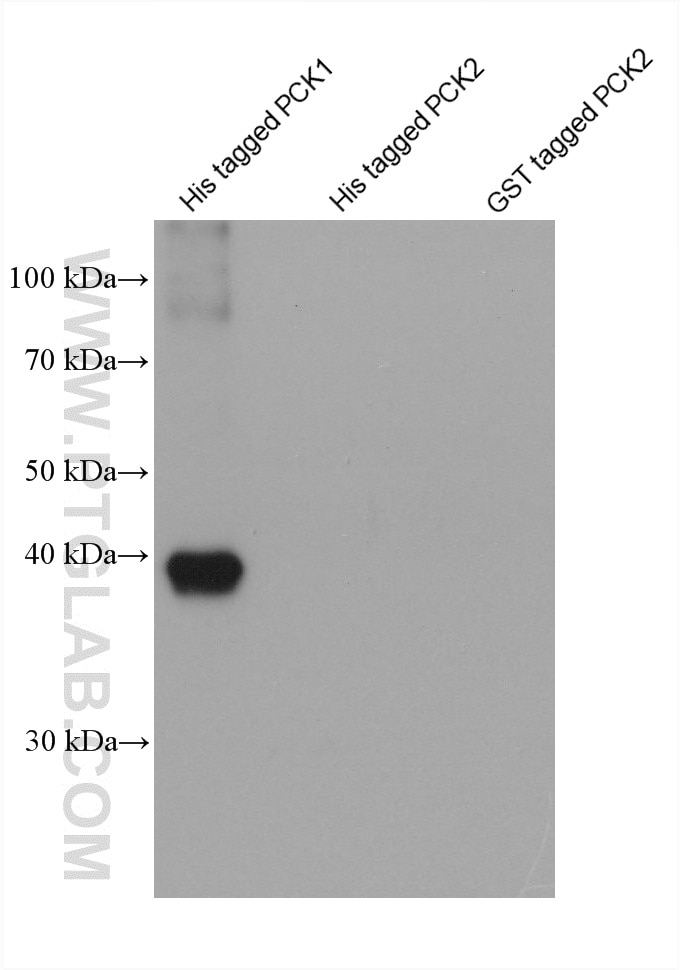
PCK1(Phosphoenolpyruvate carboxykinase, cytosolic) is also named as PEPCK1 and belongs to the phosphoenolpyruvate carboxykinase [GTP] family. It catalyzes the formation of phosphoenolpyruvate from oxaloacetate, with the release of carbon dioxide and GDP. It is also a main control point for the regulation of gluconeogenesis. In eukaryotes there are two isozymes: a cytoplasmic one and a mitochondrial one. Defects in PCK1 are the cause of cytosolic phosphoenolpyruvate carboxykinase deficiency (C-PEPCKD). This antibody specifically recognizes PCK1 but does not recognize PCK2.
Protocols
| Product Specific Protocols | |
|---|---|
| IF protocol for PCK1 antibody 66862-1-Ig | Download protocol |
| IHC protocol for PCK1 antibody 66862-1-Ig | Download protocol |
| WB protocol for PCK1 antibody 66862-1-Ig | Download protocol |
| Standard Protocols | |
|---|---|
| Click here to view our Standard Protocols |
Publications
What published studies show
I'll look up the citations for catalog 66862-1-Ig.The PCK1 Monoclonal antibody (catalog 66862-1-Ig) has 9 total citations. These appear in Nature, Advanced Science, Journal of Experimental Medicine, International Journal of Biological Macromolecules, Aging Cell, Communications Biology, bioRxiv, Chemico-Biological Interactions, and Journal of Ethnopharmacology. The cited research spans tumor immune evasion (cGAS-STING involvement), renal calcium oxalate stone formation, porcine reproductive and respiratory syndrome virus lipid metabolism, Pck1-driven mitochondrial dysfunction and adipocyte senescence, PEDV infection proteomics, hepatic adiponectin/hepatic metabolism, chromium-induced metabolic toxicity, and metabolic dysfunction-associated steatotic liver disease (MASLD).
| Species | Application | Title |
|---|---|---|
Adv Sci (Weinh) G6PC Downregulation Promotes Renal Calcium Oxalate Stone Formation via Lactate-Induced SNAIL1 K206 Lactylation and Epithelial-Mesenchymal Transition. | ||
J Exp Med PCK1 inhibits cGAS-STING activation by consumption of GTP to promote tumor immune evasion | ||
Int J Biol Macromol Porcine reproductive and respiratory syndrome virus activates lipid synthesis through a ROS-dependent AKT/PCK1/INSIG/SREBPs axis | ||
Aging Cell Pck1 Deficiency Drives Mitochondrial Dysfunction and Cellular Senescence in Adipocytes.
| ||
Commun Biol Spatially and temporally comparative proteomics provide insights into dynamic response patterns to PEDV infection. |




