
Tested Applications
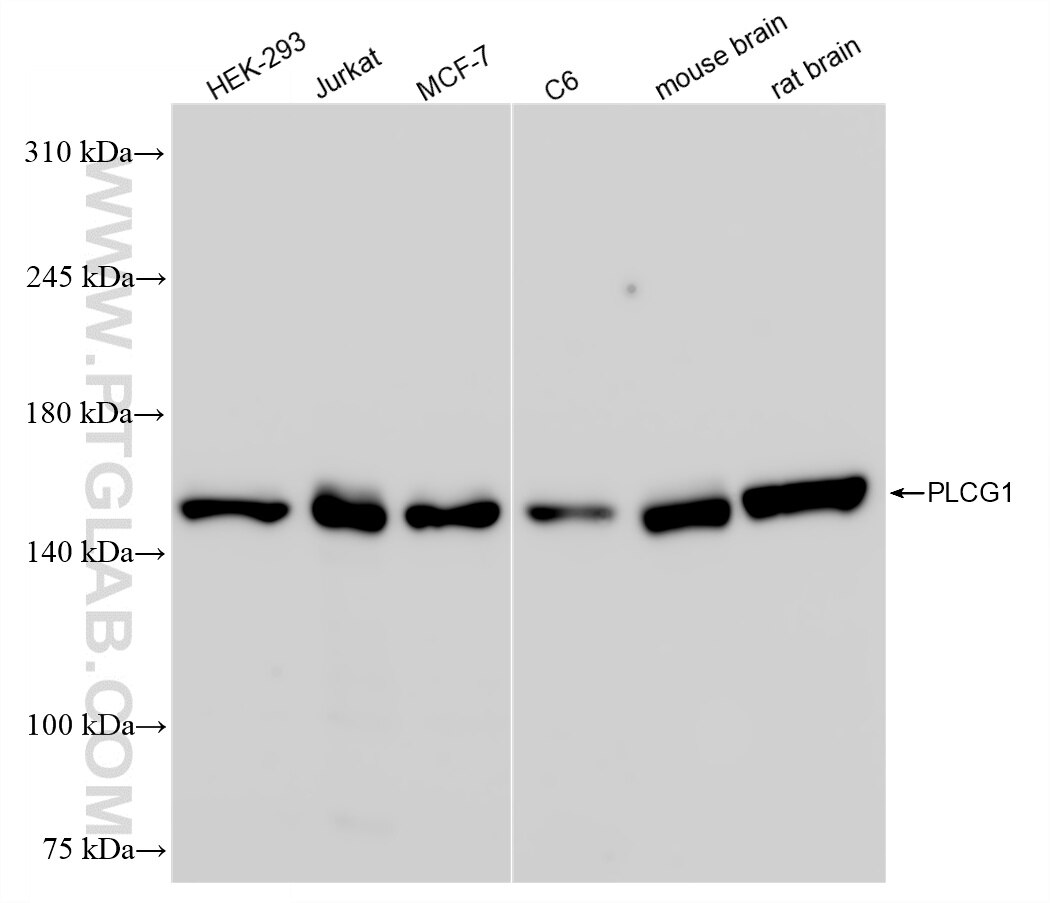
| Positive WB detected in | HEK-293 cells, Jurkat cells, MCF-7 cells, C6 cells, mouse brain tissue, rat brain tissue |
Recommended dilution
| Application | Dilution |
|---|---|
| Western Blot (WB) | WB : 1:5000-1:50000 |
| It is recommended that this reagent should be titrated in each testing system to obtain optimal results. | |
| Sample-dependent, Check data in validation data gallery. | |
Product Information
84941-4-RR targets PLCG1 in WB, ELISA applications and shows reactivity with human, mouse, rat samples.
| Tested Reactivity | human, mouse, rat |
| Cited Reactivity | human, mouse, rat |
| Host / Isotype | Rabbit / IgG |
| Class | Recombinant |
| Type | Antibody |
| Immunogen |
CatNo: Ag27218 Product name: Recombinant human PLCG1 protein Source: e coli.-derived, PGEX-4T Tag: GST Sequence: AEGSAYEEVPTSMMYSENDISNSIKNGILYLEDPVNHEWYPHYFVLTSSKIYYSEETSSDQGNEDEEEPKEVSSSTELHSNEKWFHGKLGAGRDGRH Predict reactive species |
| Full Name | phospholipase C, gamma 1 |
| Calculated Molecular Weight | 149 kDa |
| Observed Molecular Weight | 149 kDa |
| Gene Symbol | PLCG1 |
| Gene ID (NCBI) | 5335 |
| RRID | AB_3743867 |
| Conjugate | Unconjugated |
| Form | Liquid |
| Purification Method | Protein A purfication |
| UNIPROT ID | P19174 |
| Storage Buffer | PBS with 0.02% sodium azide and 50% glycerol, pH 7.3. |
| Storage Conditions | Store at -20°C. Stable for one year after shipment. Aliquoting is unnecessary for -20oC storage. 20ul sizes contain 0.1% BSA. |
Background Information
Phosphoinositide phospholipase C-gamma-1 (PLCG1) which belongs to the phosphoinositide-specific phospholipase C (PLC) family, is activated by many extracellular stimuli including hormones, neurotransmitters, and growth factors and modulates several cellular and physiological functions necessary for tumorigeneses such as cell survival, migration, invasion, and angiogenesis by generating inositol 1,4,5-triphosphate (IP3) and diacylglycerol (DAG) via hydrolysis of phosphatidylinositol 4,5-biphosphate (PIP2) (PMID: 9242915). Phosphorylation is one of the key mechanisms that regulate the activity of PLC. PLCγ is activated by both receptor and non-receptor tyrosine kinases (PMID: 2472218). PLCγ forms a complex with EGF and PDGF receptors, which leads to the phosphorylation of PLCγ at Tyr771, 783, and 1248 (PMID: 1708307). It has also been shown that PKA-mediated phosphorylation at Ser1248 is inhibitory to PLCγ1 tyrosine phosphorylation and phospholipase activity in CD3-treated Jurkat cells (PMID: 1370476), suggesting that Ser1248 may be an allosteric regulator of PLCγ1 activity.
Protocols
| Product Specific Protocols | |
|---|---|
| WB protocol for PLCG1 antibody 84941-4-RR | Download protocol |
| Standard Protocols | |
|---|---|
| Click here to view our Standard Protocols |
Publications
What published studies show
| Species | Application | Title |
|---|---|---|
Biochem Biophys Res Commun PLCγ1 knockdown in BMSCs enhances bone repair via IL-4-JAK2-STAT3-mediated reparative macrophage polarization.
| ||
Int J Mol Sci Characterization of DNA Methylation Episignatures for Radon-Induced Lung Cancer | ||
Phytomedicine Genistein alleviates skin inflammation in atopic dermatitis by inhibiting mast cell degranulation through toll-like receptor. |



