
Conjugation CleanAb Kits
Efficient Removal of Oligonucleotides, Dyes, and other Conjugation Reagents from Conjugated Antibodies
Written by: Dr. Daniela Kolhep, Dr. Marina Able, Dr. Philipp Becker
What defines CleanAb?
-
Affinity-based antibody clean-up at native pH
of mouse IgG and rabbit IgG after conjugation, with efficient removal of free nucleic acids (e.g., oligos), fluorescent dyes, and other non-binding components, followed by high-recovery elution at mild elution conditions (pH 7.5).
-
Flexible & efficient Fab-based clean-up
with high recovery, available in agarose and magnetic agarose formats, compatible with any Fab-containing antibody construct.
-
Alternative to Protein A/G or buffer exchange
for post-conjugation clean-up, Fab-isolation, and high-throughput antibody screening and processing.
1. CleanAb for fast and gentle antibody isolation
Antibody conjugation is widely used for many different applications, such as fluorescence imaging, flow cytometry, spatial biology, single-cell analysis, proximity assays, or development of antibody–drug conjugates (ADCs). After conjugation, however, excess oligos, fluorescent dyes, and other small molecules must, in most cases, be removed to ensure optimal results in downstream applications.
Proteintech’s CleanAb Kits rely on specialized affinity resins that selectively capture mouse or rabbit IgG while unbound conjugation reagents are removed during washing. The purified antibody is subsequently eluted under mild, native pH conditions at pH 7.5.
Compared with conventional desalting columns, filtration via molecular weight cutoff, size-exclusion, or Protein A/G-based purification workflows, CleanAb combines high capacity and affinity capture of the target antibody with a simple protocol and an exceptional antibody recovery rate of approximately 60-90%.
Key benefits of CleanAb
-
Reliable removal of free oligos and other small molecules (e.g., dyes)
-
Native antibody elution at pH 7.5
-
Exceptional recovery of 60-90%
-
Suitable for post-conjugation clean-up and selected on-bead workflows
-
Scalable for manual and high-throughput antibody clean-up
-
Agarose and magnetic agarose formats available
-
Suitable for purification/clean-up of Fab and F(ab')₂ fragments
2. How does CleanAb work?
CleanAb beads are coated with recombinantly produced Fab-binding proteins and can be used for both on-bead conjugation & post-conjugation antibody clean-up. Both workflows are described in the manual provided on the respective product pages (CleanAb Agarose Protocol, CleanAb Magnetic Agarose Protocol).
In short (Figure 1): Post-conjugation clean-up is done with already conjugated antibodies that still contain excess reagent that needs to be removed. On-bead conjugation and clean-up describes binding of the unconjugated antibody to the beads (no removal of BSA or glycerol required), which is then washed and conjugated while bound to the beads.
In both cases, excess conjugation reagents or other non-binding molecules remain unbound and are removed during washing. The purified antibody conjugate is then eluted using CleanAb Elution Buffer. This buffer has a neutral pH to preserve the integrity of the conjugated IgG and prevent exposure to harsh acidic elution conditions that are typically used when eluting IgG from Protein A/G (~pH 2.5).
The CleanAb workflow at a glance (post-conjugation):
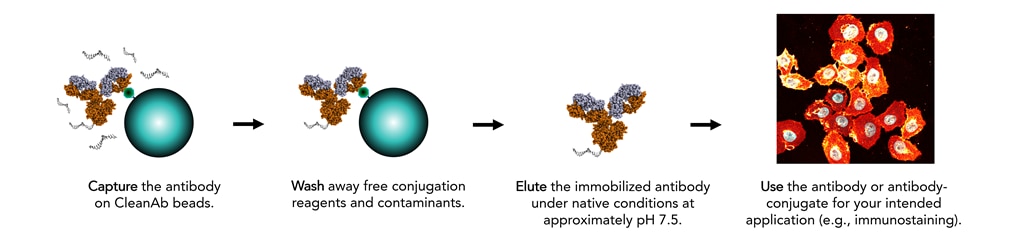
Figure 1: CleanAb workflow illustrated using the post-conjugation clean-up of an oligo-conjugated antibody. Note: For on-bead conjugation workflows, conjugation is performed between steps 1 and 2, after capturing the antibody and before washing the beads.
|
|
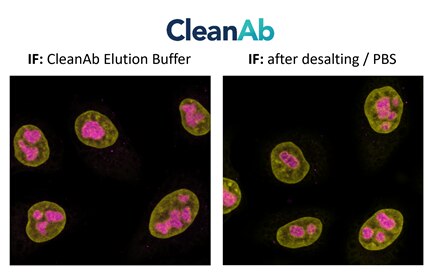
Optional: After CleanAb preparation of the conjugated antibodies, CleanAb elution buffer can be replaced with a target buffer by a standard buffer exchange, if required for downstream application. Most applications are unaffected by the CleanAb elution buffer, especially if the antibody is diluted in the application (Figure 2). Figure 2: IF comparison of oligo-antibody staining from CleanAb Elution Buffer vs. desalted. 60096-1-Ig: B23/NPM1 Mouse McAb was labeled with a 15nt oligo. Detection was done via anti-sense oligo carrying ATTO643 fluorescent dye. Both samples perform equally well, regardless of the buffer of the antibody. |
3. Which antibodies are compatible with CleanAb?
CleanAb is currently available for rabbit (CK001, CK002) and mouse (CK003, CK004) IgGs. The CleanAb ligand targeting mouse IgGs recognizes the κ light chain within the Fab region. Since more than 95% of mouse IgGs contain κ light chains (Woloschak and Krco, 1986), the technology is compatible with the majority of commonly used mouse antibodies.
The Fab specificity of CleanAb further facilitates use of this kit for isolation of:
-
Full length mouse or rabbit IgG
-
Fab fragments *
-
F(ab')₂ fragments *
-
Other Fab-containing constructs *
* from mouse or rabbit IgGs
Important Considerations for Compatibility
The main compatibility limitation for mouse IgGs is CleanAb’s dependence on the κ light chain. Mouse antibodies containing λ light chains are not captured.
Additionally, the ligands immobilized on CleanAb beads are highly species-specific, and IgGs from species other than mouse or rabbit are not compatible with the currently available CleanAb resins.
Further, binding of rabbit and mouse antibodies carrying modifications in the Fab region might be reduced, depending on the location of the modifications. Similarly, heavy excessive labelling, for example via NHS conjugation (or any other conjugation technique that is not site-specific), might lead to reduced binding to the CleanAb beads due to steric hindrance caused by blocking of the epitope of the binder by the labeling reagent. Conjugation reactions should therefore be performed with an appropriate molar ratio of labeling reagent to antibody. It may be necessary to test different labeling ratios to determine the optimal conditions. The same effect also applies not only to binding of CleanAb to the antibody, but also to binding of the antibody to the target protein, so avoiding over-labeling is generally advised when performing antibody conjugation. Good starting ratios are typically 1:5 or 1:10, depending on the intended downstream use of the conjugated antibody.
4. CleanAb formats and scaling
CleanAb is available for both rabbit and mouse antibodies in two bead formats:
-
Agarose: spin-column-based antibody isolation
-
Magnetic agarose: for magnetic separation in single-tube, automated, or high-throughput workflows
The recommended starting point for a standard clean-up is 100 µL (mouse) and 150 µl (rabbit) bead slurry. The bead volume can be scaled according to the amount of antibody being processed.
This makes CleanAb suitable for both small-scale conjugation experiments and parallel antibody-processing workflows.
For further information regarding custom options like high-throughput, bulk purchases, pre-packed tips for liquid handling systems, etc., see chapter 5.6.
5. CleanAb Use-cases
5.1 Oligonucleotide Removal
Oligonucleotide (Oligo) -conjugated antibodies are used in a wide range of advanced applications such as:
-
High-plex imaging techniques
-
Proximity ligation and extension assays (PLA/PEA)
-
NULISA
-
Spatial omics
-
Single-Cell omics
Following antibody conjugation with oligos, removal of excess oligo is a crucial step for most of these applications to reduce background and improve result quality.
Conventional purification methods, including molecular weight cut-off (MWCO) filtration, chromatography-based separation, and Protein A/G bead-based isolation, each have their own potential limitations, especially when working with charged molecules like oligos. Typical pain points are significant loss of antibody-conjugate, sample dilution, limited accessibility (chromatography), and exposure to acidic elution conditions that can compromise antibody integrity or conjugate stability.
With its mild elution at native pH 7.5 and the excellent recovery rates, CleanAb directly addresses these pain points.
CleanAb has been validated for oligos conjugated with oligos ranging from ~15 to 90 nucleotides, including Poly(A)-tailed and phosphorothioate-containing sequences, which are needed in certain applications like NULISA or CITE-seq.
Oligo-removal via CleanAb can be done post-conjugation or after on-bead conjugation (see Figure 3).
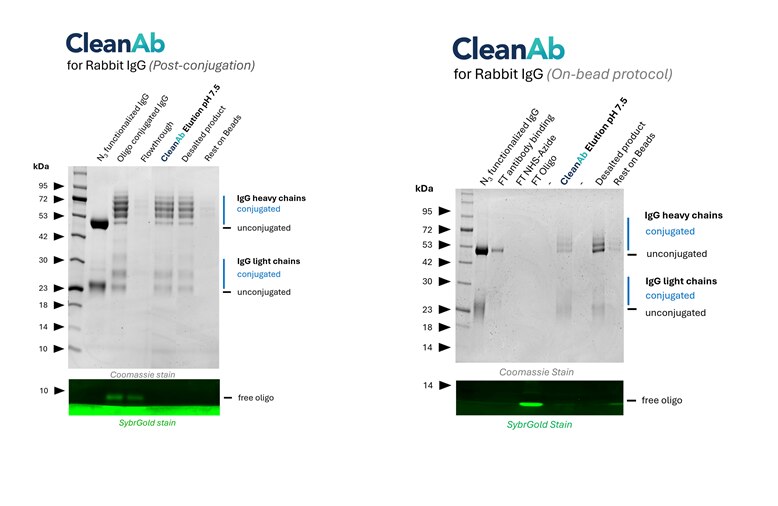
Figure 3: CleanAb post-conjugation and on-bead oligo conjugation workflows for rabbit IgG. (A) Post-conjugation workflow: Rabbit IgG (anti beta-tubulin; 80713-1-RR) was conjugated with NHS-Azide (lane 1) and then with DBCO-Oligo (lane 2). Post-conjugation clean-up was done using CleanAb Kit for rabbit IgG (lanes 3-5). Excess oligo was successfully removed as shown in SYBR Gold DNA staining, and IgG eluted with high recovery (~70%) at neutral pH (lane 4). Desalting was done with Zeba spin desalting columns (lane 5). Only very little IgG remained on beads (lane 6). (B) On-bead conjugation workflow: Rabbit IgG (Isotype control, lane 1) was bound to CleanAb rabbit beads (flowthrough, lane 2), then functionalized on beads with NHS-Azide (flowthrough, lane 3) and then with DBCO-Oligo (flowthrough, lane 4). Excess oligo was successfully removed as shown in SYBR Gold DNA staining, and the oligo-conjugated IgG was eluted with high recovery at neutral pH (lane 6). Desalting was done with Zeba spin desalting columns (lane 8). Only very little IgG remained on beads (lane 9). Note: The CleanAb Elution Buffer can interfere with SDS gels, which can make the CleanAb elution appear washed out.
CleanAb is also applicable after using certain conjugation kits that do not have a purification step included, like Proteintech’s ZymeBright™ DBCO-Ready Kits. Here, a subsequent removal of excessive DBCO-oligo via CleanAb is generally recommended.
An example of an IgG conjugated with an oligo using ZymeBright™ DBCO-Ready followed by CleanAb purification is shown in Figure 4. The purified antibody was subsequently used for FACS analysis.
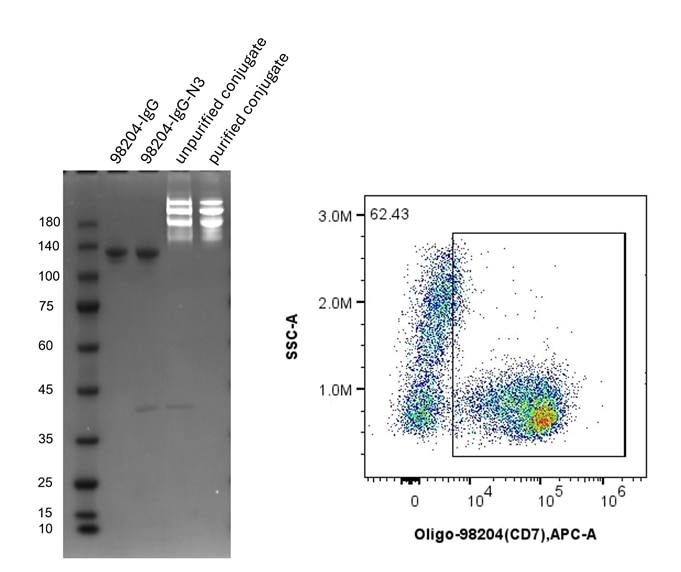
Figure 4: (left) A rabbit anti-CD7 antibody (98204-1-RR) was conjugated to an oligo using Zymebright™ DBCO-Ready (PK30100) and subsequently isolated using CleanAb agarose for rabbit IgGs (CK001). (right) The conjugated antibody was used for FACS analysis.
5.2 (Small Molecule) Fluorescent Dye Removal
Excess fluorescent dye can increase background fluorescence and negatively affect the signal-to-noise ratio of labeled antibodies in immunoassays like Immunofluorescence or Flow Cytometry.
CleanAb Beads can be used post-conjugation to remove free dyes. Dye removal was validated for a variety of relevant fluorescent dyes, such as:
-
FITC
-
Cy3, Cy5
-
Alexa Fluor™ 647, Alexa Fluor™ 750
-
Atto 647N
-
CoraLite® Plus 488
-
CoraLite® Plus 550
-
CoraLite® Plus 650
Removal of more than 95% of excess dye was achieved in representative experiments (see Figure 5) while maintaining high antibody recovery.
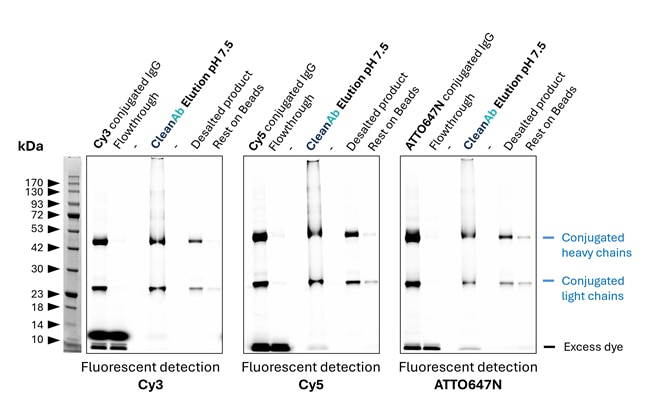
Figure 5: Mouse IgG1 (anti-Lamin B1; 66095-1-Ig) was conjugated with NHS-dyes (lane 1, respectively). Post-conjugation clean-up was done using CleanAb Kit (Agarose) for for Mouse IgG (CK003, lanes 2-4). At least 95% of excess dye was successfully removed, as evident from the faint excess dye band (lane 4). The conjugated IgG was eluted with high recovery (>70%) at neutral pH (lane 4). Desalting was done with Zeba spin desalting columns to exchange buffer after elution (lane 6), successfully removing all residual dye (buffer exchange is only recommended for long-term storage or if required for downstream assays). Minimal IgG remains on beads after elution with CleanAb elution buffer (lane 7). Note: The CleanAb Elution Buffer can interfere with SDS gels, which can make the CleanAb elution appear smeared.
5.3 Biotin Removal after Antibody Biotinylation
Similar to dye removal, CleanAb can also be used after antibody biotinylation. The biotinylated antibody binds to the CleanAb beads, and free biotin is removed during the washing step before elution of the biotinylated antibody with the CleanAb elution buffer.
5.4 Fab and F(ab')₂ Fragment Clean-up
Because CleanAb binds within the Fab region, it can be used for the efficient isolation of Fab and F(ab')₂ antibody fragments derived from mouse or rabbit (Figure 6-7).
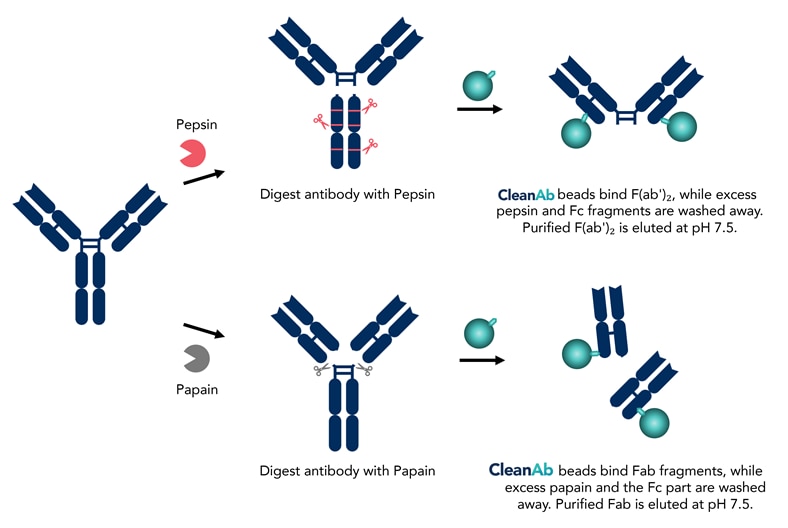
Figure 6: Workflow for Fab/F(ab’)2 fragment purification with CleanAb Beads after antibody digestion using papain or pepsin.
Following papain or pepsin digestion, Fab-containing fragments can be captured using CleanAb. Digested fragments of the Fc region that do not bind are removed during the washing steps before the Fab-containing fraction is eluted.
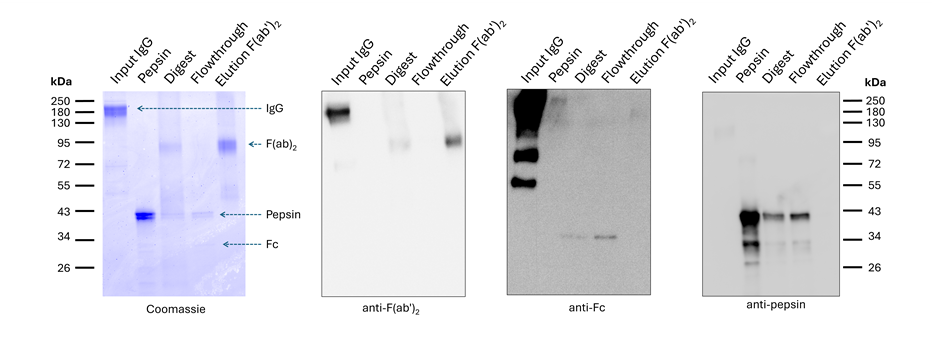
Figure 7: Pepsin digestion of a polyclonal rabbit IgG (PTG, 10205-2-AP) followed by CleanAb F(ab')2 isolation. The successful digestion and separation of F(ab')2 is shown in the Coomassie Blue-stained SDS-gel. Non-reduced samples were loaded. Upon pepsin-digestion, the IgG is cleaved into F(ab')2 and Fc region. Successful isolation was verified using Western Blot analysis with an anti-F(ab')2 antibody, an anti-Fc antibody and an anti-pepsin antibody. The elution fraction contains intact F(ab')2 without Fc- and pepsin-contamination. Additional bands in the anti-Fc western blot point towards partial reduction of the IgG, resulting in Fc containing fragments of MWs around 50 kDa (HC monomers) and 75 kDa (HC-LC dimers).
A second option is to immobilize the intact antibody on CleanAb beads before enzymatic digestion. This reduces the number of handling and isolation steps.
Note: Digestion efficiency and fragment release depend on antibody structure and enzyme accessibility. On-bead digestion workflows should be optimized for the specific antibody and protease before scale-up.
5.5 Antibody–Drug Conjugate (ADC) Clean-up
Antibody–drug conjugate (ADC) workflows usually also require removal of excess payload or other small-molecule components after conjugation. CleanAb provides a potential affinity-based isolation solution for these conjugates.
While the technology is compatible with commonly used antibody conjugation chemistries, including NHS ester, Maleimide, or click chemistry, compatibility should be validated for the specific payloads, drug-to-antibody ratio, and antibody formats, if CleanAb is to be applied for this application.
5.6 High-throughput clean-up of conjugated antibodies
The magnetic agarose CleanAb format enables rapid separation of beads from the liquid phase, which makes it particularly suited for automated high-throughput antibody purification and is therefore a valuable tool for antibody screening and validation of conjugation strategies using magnetic systems.
The agarose format can also be used to scale up antibody clean-up efforts, e.g., when used in pre-packed tips (e.g., 96-well format).
CleanAb can enhance efficiency, reduce antibody loss, and cut costs in the following areas:
-
Antibody screening workflows
-
Conjugation optimization experiments
-
Development of multiplex antibody panels
-
Assay development
-
Automated liquid-handling systems
-
Medium- and high-throughput antibody clean-up
For customized CleanAb-based solutions like pre-filled tips or bulk purchases, reach out to our customer support team.
Note: Custom products like pre-packed tips might lead to longer lead times because there’s no one-fits-all solution.
6. CleanAb compared to alternative workflows
6.1 CleanAb vs. Protein A/G isolation
Protein A and G are widely used for antibody isolation, but they generally require acidic conditions (~pH 2.5) to release the antibody from the affinity matrix, unlike CleanAb, which allows native elution at pH 7.5.
This is a key advantage for antibodies or antibody conjugates that can be sensitive to very acidic conditions.
Further, Protein A shows inconsistent binding affinity/capacity towards different IgG species and subtypes, e.g., mouse IgG1, affecting binding to and elution from Protein A (see Figure 8).
CleanAb, in contrast, shows efficient binding of the antibody to CleanAb beads, and recovery rates of ~60–90% (depending on the antibody, its initial concentration, and the workflow that was used).
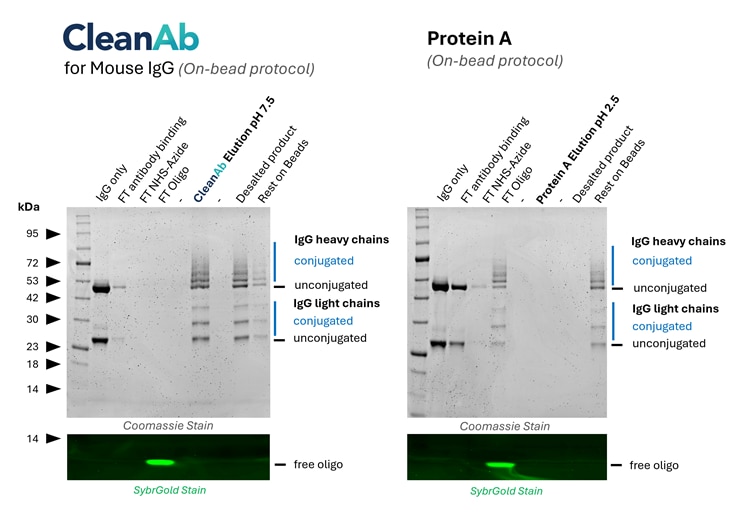
Figure 8: (left) Mouse IgG1 (anti-Lamin B1 IgG1; 66095-1-Ig, lane 1) was bound to CleanAb rabbit beads (flowthrough in lane 2), then functionalized on beads with NHS-Azide (flowthrough in lane 3) and then with DBCO-Oligo (flowthrough in lane 4). Excess oligo was successfully removed as shown in SYBR Gold DNA staining, and the oligo-conjugated IgG was eluted with high recovery at neutral pH (lane 6). Desalting was done with Zeba spin desalting columns (lane 8). Only very little IgG remained on the beads (lane 9). Note: The CleanAb Elution Buffer can interfere with SDS gels, which can make the CleanAb elution appear washed out. (right) Mouse IgG (anti-Lamin B1 IgG1; 66095-1-Ig, lane 1) was bound to Protein A beads (flowthrough in lane 2). Excess oligo was successfully removed as shown in SYBR Gold DNA staining, but the oligo-conjugated IgG failed to elute at low pH (lane 6). Most IgG remains on the beads (lane 9).
For conjugation workflows, CleanAb consequently offers several advantages:
|
Protein A/G |
|
|
Fab/κ-light-chain-based capture |
Fc-based capture |
|
Native elution at pH 7.5 |
Typically, acidic elution at pH 2.5 |
|
Designed for conjugate clean-up |
Primarily designed for IgG purification |
|
Suitable for Fab/F(ab')₂ fragments |
Fab fragments generally not retained |
|
Agarose and magnetic formats |
Multiple resin formats available |
|
Binds all mouse kappa subtypes with high affinity |
Weak binding of IgG1 by Protein A results in inefficient binding & recovery |
6.2 CleanAb vs. buffer exchange & desalting-columns
Buffer-exchange columns or MW-cutoff filters are often used to remove small molecules after antibody conjugation. These solutions are easily accessible and cheap; however, they come with significant disadvantages.
Potential disadvantages of buffer exchange/desalting approaches:
-
Incomplete separation from certain conjugates
-
Loss of antibody
-
Sample dilution
-
Longer optimization required
The mechanism of CleanAb makes it independent of the molecular size of the conjugate and instead uses a simple protocol based on antibody-specific affinity capture.
Note: In some cases, desalting after the use of CleanAb can still be beneficial, e.g., if a certain assay or storage buffer is required for the conjugate.
For example:
-
for long-term storage at -20°C (> 6 months)
-
if very clean and sharp bands on SDS-PAGE are required (e.g., for publications)
-
chemical or enzymatic conjugations (downstream of CleanAb use)
-
for very sensitive functional assays that require minimal buffer systems
However, for most applications, a buffer exchange is not required, and the antibody can be used in the CleanAb elution buffer, especially when diluted for the assay (see Figure 1).
6.3 CleanAb vs. BSA Depletion Beads (Proteintech)
CleanAb can be used to isolate antibodies (currently: rabbit or mouse) from solutions containing substances that may interfere with downstream conjugation reactions, such as BSA or other molecules (e.g., glycerol). Specifically, reagents such as BSA may compete with the antibody during conjugation. This effect is more pronounced when their concentrations far exceed the concentration of the antibody itself, which is the case even for concentrations of 0.1% BSA.
During the on-bead conjugation workflow of CleanAb, the antibody gets immobilized, interfering components get washed away, and antibodies will be conjugated while being bound to the beads. Thus, CleanAb can combine antibody isolation, buffer exchange, and the desired conjugation in a single affinity step.
In certain cases, Proteintech's BSA Depletion Beads (Agarose: MG-3232AK, Magnetic Agarose: MG-3232MA) can be more suitable to prepare the antibody for purification:
|
|
||
|
Target |
Binds the antibody/conjugate |
Bind BSA |
|
Compatibility |
Binds only rabbit IgG or mouse kappa IgG |
Compatible with all antibodies and antibody-like proteins independent of species/isotype |
|
Recovery |
High IgG Recovery ~60-90% |
Near 100% recovery for all IgGs |
|
Elution |
Antibody or antibody-conjugate is gently eluted from the beads at pH 7.5 |
Antibody remains in the flowthrough |
|
What can be removed? |
Removes any unbound molecules (BSA, contaminants, free oligo, dye, and other unbound conjugation reagents) |
Only removes (depletes) BSA by directly binding it; everything else flows through. |
7. Conclusion
CleanAb is an affinity-based antibody clean-up platform designed for efficient isolation of mouse and rabbit IgG after conjugation.
By selectively capturing the antibody and removing free oligos, fluorescent dyes, and other reaction components, CleanAb simplifies post-conjugation and on-bead conjugation isolation and enables highly efficient antibody recovery under mild conditions at pH 7.5.
CleanAb is particularly useful when:
-
mouse or rabbit IgG must be isolated after conjugation
-
free oligos need to be removed
-
excess fluorescent dye needs to be removed
-
gentle antibody recovery at neutral pH is important
-
antibody fragments such as Fab or F(ab')₂ require isolation
-
multiple antibody samples must be processed in parallel
-
buffer components interfere with antibody conjugation
-
conventional buffer exchange workflows lead to excessive sample loss
With recovery rates of 60 to 90%, the availability of agarose and magnetic agarose formats, and compatibility with any Fab-containing antibody construct, CleanAb Kits offer a simple and scalable alternative to conventional buffer exchange and Protein A/G-based isolation, helping streamline antibody conjugation workflows, fully avoiding harsh elution conditions and unnecessary sample loss.
8. Sources & related documents
-
Woloschak, G.E., and Krco, C.J. (1987). Regulation of κ/λ immunoglobulin light chain expression in normal murine lymphocytes. Molecular Immunology 24, 751-757.
-
Protocols for removal of excess conjugate from conjugated primary antibodies. Proteintech Group Inc.

Related Content
Conjugation CleanAb Kits | Proteintech
Conjugation CleanAb Kit Protocol
Antibody Conjugation and Labeling
The Complete Guide to Multiplex Immunofluorescence
Support
Newsletter Signup
Stay up-to-date with our latest news and events. New to Proteintech? Get 10% off your first order when you sign up.
Able®