
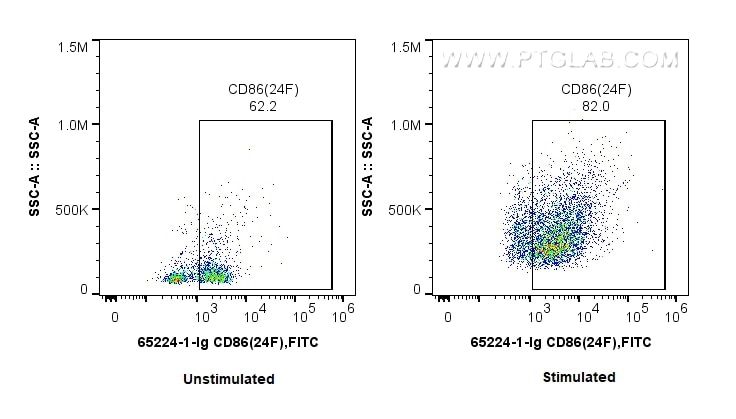

Tested Applications
| Positive FC detected in | LPS-stimulated Wistar rat splenocytes |
Recommended dilution
| Application | Dilution |
|---|---|
| Flow Cytometry (FC) | FC : 0.5 ug per 10^6 cells in 100 μl suspension |
| This reagent has been tested for flow cytometric analysis. It is recommended that this reagent should be titrated in each testing system to obtain optimal results. | |
| Sample-dependent, Check data in validation data gallery. | |
Product Information
65224-1-Ig targets CD86 in IF, FC applications and shows reactivity with rat samples.
| Tested Reactivity | rat |
| Cited Reactivity | rat |
| Host / Isotype | Mouse / IgG1, kappa |
| Class | Monoclonal |
| Type | Antibody |
| Immunogen |
HTLV-1-transformed Lewis-S1 rat T cell line Predict reactive species |
| Full Name | CD86 molecule |
| Calculated Molecular Weight | 36 kDa |
| GenBank Accession Number | NM_020081 |
| Gene Symbol | Cd86 |
| Gene ID (NCBI) | 56822 |
| RRID | AB_3670278 |
| Conjugate | Unconjugated |
| Form | Liquid |
| Purification Method | Affinity purification |
| UNIPROT ID | O35531 |
| Storage Buffer | PBS with 0.09% sodium azide, pH 7.3. |
| Storage Conditions | Store at 2-8°C. Stable for one year after shipment. |
Background Information
CD86 (also known as B7.2) is a costimulatory molecule belonging to the immunoglobulin superfamily. Primarily expressed on antigen-presenting cells (APCs), including B cells, dendritic cells, and macrophages, CD86 is the ligand for two proteins at the cell surface of T cells, CD28 antigen and cytotoxic T-lymphocyte-associated protein 4. Binding of CD86 with CD28 antigen is a costimulatory signal for activation of the T-cell. Binding of CD86 with cytotoxic T-lymphocyte-associated protein 4 negatively regulates T-cell activation and diminishes the immune response.
Protocols
| Product Specific Protocols | |
|---|---|
| FC protocol for CD86 antibody 65224-1-Ig | Download protocol |
| Standard Protocols | |
|---|---|
| Click here to view our Standard Protocols |
Publications
What published studies show
Anti-Rat CD86 (24F), catalog number 65224-1-Ig, has 9 total citations. These appear in journals including ACS Nano, Biomaterials, Mater Today Bio, ACS Applied Materials & Interfaces, Current Issues in Molecular Biology, and Prostaglandins and Other Lipid Mediators. The research fields span biomaterials and tissue engineering, bone regeneration, peripheral nerve repair, diabetic wound healing, macrophage polarization, immune microenvironment regulation, periodontitis, intervertebral disc degeneration, osteoarthritis, and endometritis. All cited studies used rat models with IF or FC applications.
| Species | Application | Title |
|---|---|---|
ACS Nano Engineering Smart Bimetallic Ionic-Site MOF Nanozyme Nanocomposites for Microenvironment-Responsive Dynamic Therapy of Periapical Periodontitis. | ||
Biomaterials Bioactive prosthetic interface constructed with cascading multi-nanozyme hydrogel to induce M2 macrophage polarization and heal diabetic bone defects. | ||
Mater Today Bio Acetylated chitosan scaffolds modulate the micro-environment and promote peripheral nerve regeneration through macrophage TLR2/4 pathway activation. | ||
Mater Today Bio Apoptotic extracellular vesicles derived from MSCs exposed to hypoxic and inflammatory environments slow intervertebral disc degeneration by enhancing cell activity and regulating immunity microenvironment. | ||
Mater Today Bio 3D-printed nHA/PA66 porous scaffold: Regulating immune balance and vascularization synergistically promotes bone regeneration. | ||
ACS Appl Mater Interfaces MXene-Based Conductive Microneedle Patch Promotes Diabetic Wound Healing by Regulating Oxidative Stress and Immune Microenvironment. |


