
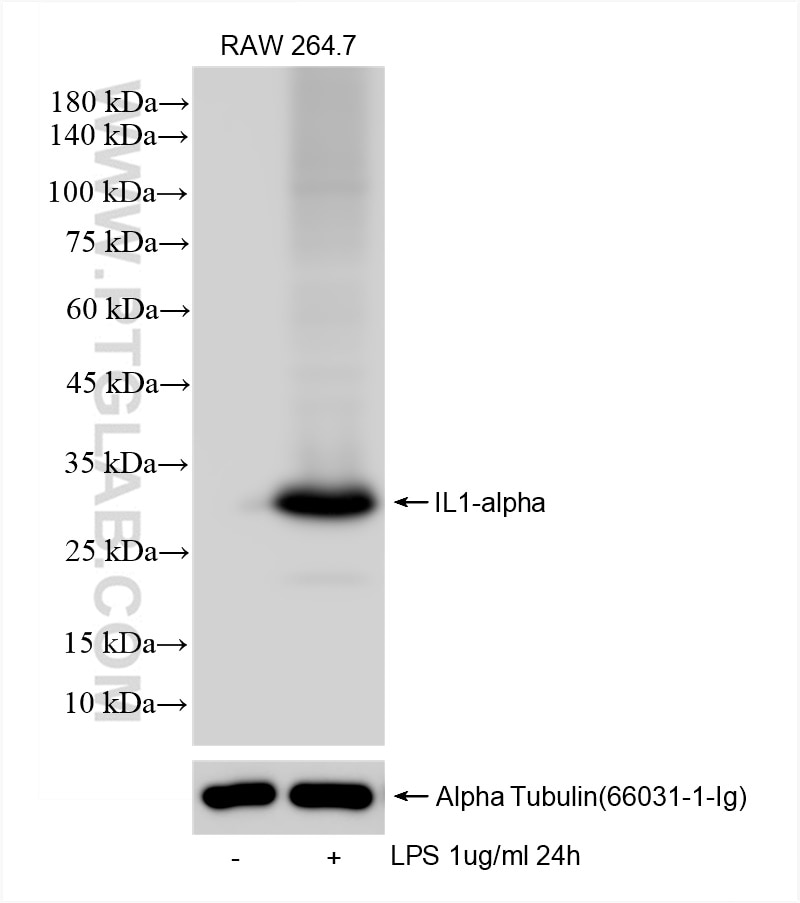
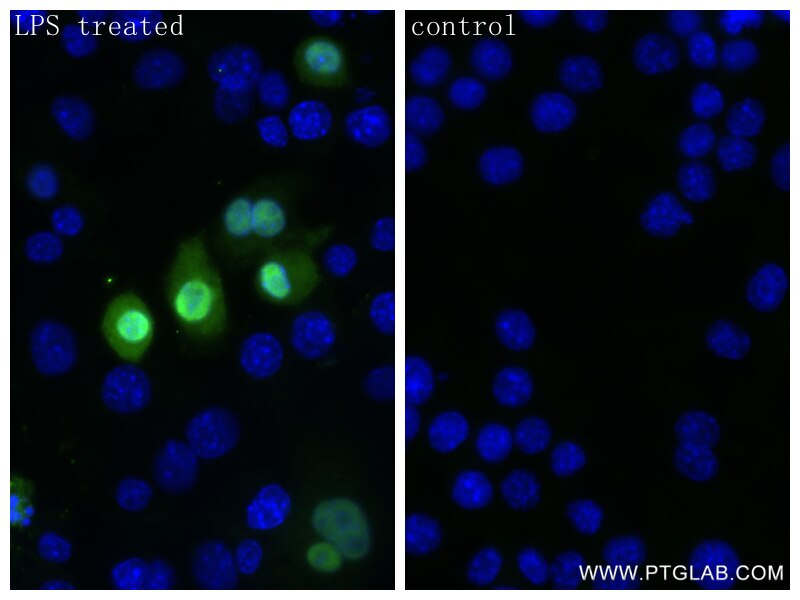
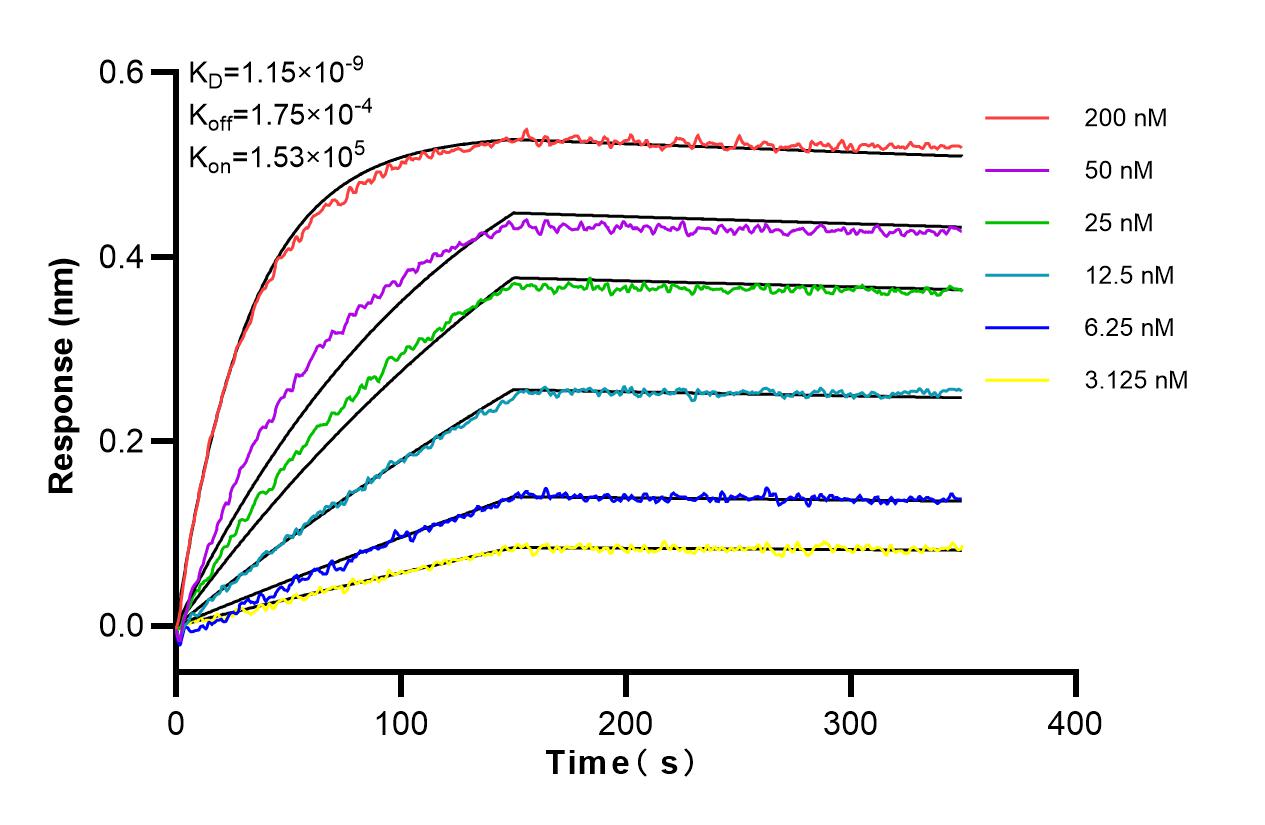

Tested Applications
| Positive WB detected in | RAW 264.7 cells |
| Positive IF/ICC detected in | LPS treated RAW 264.7 cells |
Recommended dilution
| Application | Dilution |
|---|---|
| Western Blot (WB) | WB : 1:1000-1:4000 |
| Immunofluorescence (IF)/ICC | IF/ICC : 1:125-1:500 |
| It is recommended that this reagent should be titrated in each testing system to obtain optimal results. | |
| Sample-dependent, Check data in validation data gallery. | |
Product Information
83644-1-RR targets IL-1 alpha in WB, IF/ICC, ELISA applications and shows reactivity with mouse samples.
| Tested Reactivity | mouse |
| Cited Reactivity | mouse |
| Host / Isotype | Rabbit / IgG |
| Class | Recombinant |
| Type | Antibody |
| Immunogen |
CatNo: Eg0263 Product name: Recombinant mouse IL1-alpha protein Source: mammalian cells-derived, pHZ-KIsec-C-6*HIS Tag: C-6*HIS Domain: 115-270 aa of NM_010554 Sequence: MSAPYTYQSDLRYKLMKLVRQKFVMNDSLNQTIYQDVDKHYLSTTWLNDLQQEVKFDMYAYSSGGDDSKYPVTLKISDSQLFVSAQGEDQPVLLKELPETPKLITGSETDLIFFWKSINSKNYFTSAAYPELFIATKEQSRVHLARGLPSMTDFQIS Predict reactive species |
| Full Name | interleukin 1 alpha |
| Calculated Molecular Weight | 31kd |
| Observed Molecular Weight | 31 kDa |
| GenBank Accession Number | NM_010554 |
| Gene Symbol | Il1a |
| Gene ID (NCBI) | 16175 |
| RRID | AB_3671254 |
| Conjugate | Unconjugated |
| Form | Liquid |
| Purification Method | Protein A purification |
| UNIPROT ID | P01582 |
| Storage Buffer | PBS with 0.02% sodium azide and 50% glycerol, pH 7.3. |
| Storage Conditions | Store at -20°C. Stable for one year after shipment. Aliquoting is unnecessary for -20oC storage. 20ul sizes contain 0.1% BSA. |
Background Information
Interleukin-1α (IL-1 Alpha) is a protein that plays a crucial role in the regulation of a number of key cellular processes. IL-1 Alpha is a cytokine and a potent mediator of body's response to inflammation, microbial invasion, tissue injury and immunological response. In addition, recent studies suggest that IL-1 Alpha also has a role in wound healing, rheumatoid arthritis, Alzheimer's disease and tumor growth. IL-1 Alpha functions as an alarmin during the process of sterile inflammation. It serves as a signal from dying cells to potentiate the inflammatory response, increasing the expression of other secreted factors like IL-6 and IL-8. IL-1 Alpha was found to affect the cell cycle of osteosarcoma cell to reduce cell growth. IL-1 Alpha is initially translated as approximately 30-kD polypeptides that are processed to approximately 17.5-kD polypeptides prior to, or during, release from macrophages.
Protocols
| Product Specific Protocols | |
|---|---|
| IF protocol for IL-1 alpha antibody 83644-1-RR | Download protocol |
| WB protocol for IL-1 alpha antibody 83644-1-RR | Download protocol |
| Standard Protocols | |
|---|---|
| Click here to view our Standard Protocols |
Publications
What published studies show
The IL-1 alpha Recombinant monoclonal antibody (240431B5), catalog number 83644-1-RR, has 8 citations. These appear in journals including Nature Communications, Environmental Pollution, ACS Infectious Diseases, Journal of Pharmaceutical and Biomedical Analysis, Reproductive Toxicology, Biomedical Reports, Chinese Journal of Lung Cancer, and Experimental Neurology. Associated research fields span systemic aging, PFAS-induced retinal neurotoxicity, mycobacterial infection, atherosclerosis, ovarian aging, chronic rhinosinusitis, lung adenocarcinoma, and Parkinson's disease via the gut-liver axis.
| Species | Application | Title |
|---|---|---|
Environ Pollut PFAS exposure is associated with retinal neurotoxicity in Chinese adolescents: Mechanistic insights from integrated toxicogenomic and in vitro analyses. | ||
ACS Infect Dis Rv2741 Promotes Mycobacterium Survival by Modulating Macrophage Function via the IL-1α-MAPK Axis | ||
Reprod Toxicol Guarding the ovarian reserve: Maternal methyl donor supplementation protects against propylparaben-induced ovarian aging in offspring. | ||
J Pharm Biomed Anal Exploring potential mechanism of Chuanzhi Qingyu recipe for vulnerable atherosclerosis plaques based on UPLC-Q-TOF-MS(E), systems biology strategy, and experimental validation. | ||
Biomed Rep Potential effect and mechanism of ultrashort wave therapy in mice with chronic rhinosinusitis. |




