
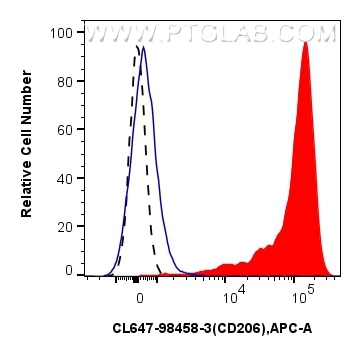

Tested Applications
| Positive FC detected in | GM-CSF, IL-4, and IL-10 treated human PBMCs |
Recommended dilution
| Application | Dilution |
|---|---|
| Flow Cytometry (FC) | FC : 5 ul per 10^6 cells in a 100 µl suspension |
| This reagent has been pre-titrated and tested for flow cytometric analysis. The suggested use of this reagent is 5 ul per 10^6 cells in a 100 µl suspension or 5 ul per 100 µl of whole blood. | |
| Sample-dependent, Check data in validation data gallery. | |
Product Information
CL647-98458-3 targets CD206 in FC applications and shows reactivity with human samples.
| Tested Reactivity | human |
| Cited Reactivity | human |
| Host / Isotype | Rabbit / IgG |
| Class | Recombinant |
| Type | Antibody |
| Immunogen |
CatNo: Eg2428 Product name: Recombinant Human CD206 protein (rFc Tag) Source: mammalian cells-derived, pHZ-KIsec-C-rFc Tag: C-rFc Domain: 19-1389 aa of NM_002438.4 Sequence: LLDTRQFLIYNEDHKRCVDAVSPSAVQTAACNQDAESQKFRWVSESQIMSVAFKLCLGVPSKTDWVAITLYACDSKSEFQKWECKNDTLLGIKGEDLFFNYGNRQEKNIMLYKGSGLWSRWKIYGTTDNLCSRGYEAMYTLLGNANGATCAFPFKFENKWYADCTSAGRSDGWLWCGTTTDYDTDKLFGYCPLKFEGSESLWNKDPLTSVSYQINSKSALTWHQARKSCQQQNAELLSITEIHEQTYLTGLTSSLTSGLWIGLNSLSFNSGWQWSDRSPFRYLNWLPGSPSAEPGKSCVSLNPGKNAKWENLECVQKLGYICKKGNTTLNSFVIPSESDVPTHCPSQWWPYAGHCYKIHRDEKKIQRDALTTCRKEGGDLTSIHTIEELDFIISQLGYEPNDELWIGLNDIKIQMYFEWSDGTPVTFTKWLRGEPSHENNRQEDCVVMKGKDGYWADRGCEWPLGYICKMKSRSQGPEIVEVEKGCRKGWKKHHFYCYMIGHTLSTFAEANQTCNNENAYLTTIEDRYEQAFLTSFVGLRPEKYFWTGLSDIQTKGTFQWTIEEEVRFTHWNSDMPGRKPGCVAMRTGIAGGLWDVLKCDEKAKFVCKHWAEGVTHPPKPTTTPEPKCPEDWGASSRTSLCFKLYAKGKHEKKTWFESRDFCRALGGDLASINNKEEQQTIWRLITASGSYHKLFWLGLTYGSPSEGFTWSDGSPVSYENWAYGEPNNYQNVEYCGELKGDPTMSWNDINCEHLNNWICQIQKGQTPKPEPTPAPQDNPPVTEDGWVIYKDYQYYFSKEKETMDNARAFCKRNFGDLVSIQSESEKKFLWKYVNRNDAQSAYFIGLLISLDKKFAWMDGSKVDYVSWATGEPNFANEDENCVTMYSNSGFWNDINCGYPNAFICQRHNSSINATTVMPTMPSVPSGCKEGWNFYSNKCFKIFGFMEEERKNWQEARKACIGFGGNLVSIQNEKEQAFLTYHMKDSTFSAWTGLNDVNSEHTFLWTDGRGVHYTNWGKGYPGGRRSSLSYEDADCVVIIGGASNEAGKWMDDTCDSKRGYICQTRSDPSLTNPPATIQTDGFVKYGKSSYSLMRQKFQWHEAETYCKLHNSLIASILDPYSNAFAWLQMETSNERVWIALNSNLTDNQYTWTDKWRVRYTNWAADEPKLKSACVYLDLDGYWKTAHCNESFYFLCKRSDEIPATEPPQLPGRCPESDHTAWIPFHGHCYYIESSYTRNWGQASLECLRMGSSLVSIESAAESSFLSYRVEPLKSKTNFWIGLFRNVEGTWLWINNSPVSFVNWNTGDPSGERNDCVALHASSGFWSNIHCSSYKGYICKRPKIIDAKPTHELLTTKADTRKMDPSKPSSNVA Predict reactive species |
| Full Name | mannose receptor, C type 1 |
| Calculated Molecular Weight | 166 kDa |
| GenBank Accession Number | NM_002438.4 |
| Gene Symbol | CD206 |
| Gene ID (NCBI) | 4360 |
| RRID | AB_3748876 |
| Conjugate | CoraLite® Plus 647 Fluorescent Dye |
| Excitation/Emission Maxima Wavelengths | 654 nm / 674 nm |
| Excitation Laser | Red Laser (633 nm) |
| Form | Liquid |
| Purification Method | Protein A purification |
| UNIPROT ID | P22897-1 |
| Storage Buffer | PBS with 0.09% sodium azide and 0.5% BSA, pH 7.3. |
| Storage Conditions | Store at 2-8°C. Avoid exposure to light. Stable for one year after shipment. |
Background Information
CD206, also named as MMR, CLEC13D and MRC1, is a type I membrane receptor that mediates the endocytosis of glycoproteins by macrophages. CD206 has been shown to bind high-mannose structures on the surface of potentially pathogenic viruses, bacteria, and fungi so that they can be neutralized by phagocytic engulfment. CD206 is a 170 kDa transmembrane protein which contains 5 domains: an amino-terminal cysteine-rich region, a fibronectin type II repeat, a series of eight tandem lectin-like carbohydrate recognition domains (responsible for the recognition of mannose and fucose), a transmembrane domain, and an intracellular carboxy-terminal tail. It is expressed on most tissue macrophages, in vitro derived dendritic cells, lymphatic and sinusoidal endothelia.
Protocols
| Product Specific Protocols | |
|---|---|
| FC protocol for CL Plus 647 CD206 antibody CL647-98458-3 | Download protocol |
| Standard Protocols | |
|---|---|
| Click here to view our Standard Protocols |
Publications
What published studies show
The Anti-Human CD206 Rabbit Recombinant Antibody (250381C1), catalog number CL647-98458-3, has 1 citation. It appears in Journal of Translational Medicine (IF 9.7), published in 2026. The cited study investigates how m6A methylation-modified ETV1 drives multiple myeloma progression and M2 polarization of tumor-associated macrophages through transcriptional activation of RBMS1. The antibody was applied in flow cytometry on human samples, placing its use in the fields of oncology (multiple myeloma) and tumor immunology (macrophage biology).
| Species | Application | Title |
|---|---|---|
J Transl Med m6A methylation-modified ETV1 drives multiple myeloma progression and M2 polarization of tumor-associated macrophage through transcriptional activation of RBMS1. |


