




Tested Applications
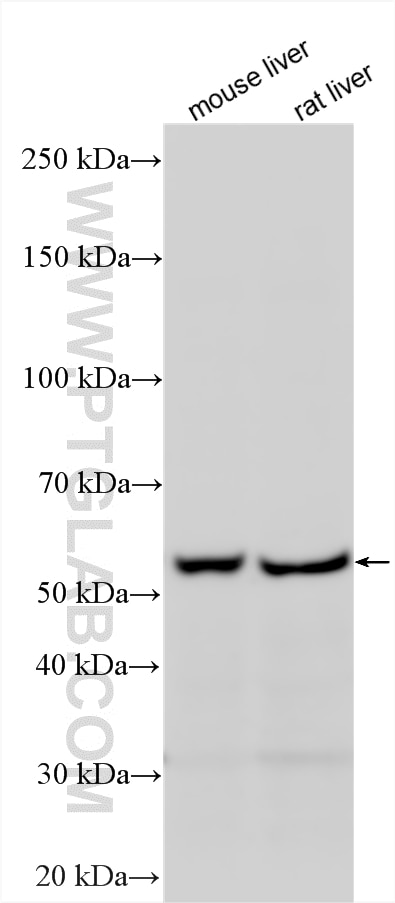
| Positive WB detected in | HeLa cells, mouse liver tissue, Y79 cells, rat liver tissue |
| Positive IHC detected in | mouse brain tissue, human breast cancer tissue Note: suggested antigen retrieval with TE buffer pH 9.0; (*) Alternatively, antigen retrieval may be performed with citrate buffer pH 6.0 |
| Positive IF/ICC detected in | HeLa cells, MCF-7 cells |
| Positive FC (Intra) detected in | HeLa cells |
Recommended dilution
| Application | Dilution |
|---|---|
| Western Blot (WB) | WB : 1:1000-1:5000 |
| Immunohistochemistry (IHC) | IHC : 1:50-1:500 |
| Immunofluorescence (IF)/ICC | IF/ICC : 1:200-1:800 |
| Flow Cytometry (FC) (INTRA) | FC (INTRA) : 0.40 ug per 10^6 cells in a 100 µl suspension |
| It is recommended that this reagent should be titrated in each testing system to obtain optimal results. | |
| Sample-dependent, Check data in validation data gallery. | |
Product Information
13474-1-AP targets Cryptochrome 1 in WB, IHC, IF/ICC, FC (Intra), CoIP, ChIP, ELISA applications and shows reactivity with human, mouse, rat samples.
| Tested Reactivity | human, mouse, rat |
| Cited Reactivity | human, mouse, rat, hamster |
| Host / Isotype | Rabbit / IgG |
| Class | Polyclonal |
| Type | Antibody |
| Immunogen |
CatNo: Ag4270 Product name: Recombinant human CRY1 protein Source: e coli.-derived, PGEX-4T Tag: GST Domain: 236-586 aa of BC030519 Sequence: RPRMNANSLLASPTGLSPYLRFGCLSCRLFYFKLTDLYKKVKKNSSPPLSLYGQLLWREFFYTAATNNPRFDKMEGNPICVQIPWDKNPEALAKWAEGRTGFPWIDAIMTQLRQEGWIHHLARHAVACFLTRGDLWISWEEGMKVFEELLLDADWSINAGSWMWLSCSSFFQQFFHCYCPVGFGRRTDPNGDYIRRYLPVLRGFPAKYIYDPWNAPEGIQKVAKCLIGVNYPKPMVNHAEASRLNIERMKQIYQQLSRYRGLGLLASVPSNPNGNGGFMGYSAENIPGCSSSGSCSQGSGILHYAHGDSQQTHLLKQGRSSMGTGLSGGKRPSQEEDTQSIGPKVQRQSTN Predict reactive species |
| Full Name | cryptochrome 1 (photolyase-like) |
| Calculated Molecular Weight | 586 aa, 66 kDa |
| Observed Molecular Weight | 60-66 kDa |
| GenBank Accession Number | BC030519 |
| Gene Symbol | CRY1 |
| Gene ID (NCBI) | 1407 |
| RRID | AB_10697652 |
| Conjugate | Unconjugated |
| Form | Liquid |
| Purification Method | Antigen affinity purification |
| UNIPROT ID | Q16526 |
| Storage Buffer | PBS with 0.02% sodium azide and 50% glycerol, pH 7.3. |
| Storage Conditions | Store at -20°C. Stable for one year after shipment. Aliquoting is unnecessary for -20oC storage. 20ul sizes contain 0.1% BSA. |
Background Information
Cryptochrome circadian clock 1 (CRY1) is a flavin adenine dinucleotide-binding protein with MW of 66 kDa. CRY1 is a key component of the circadian core oscillator complex, which regulates the circadian clock. CRY1 predominantly displays evening-time expression and serves as a strong repressor of morning-time elements (E box/E-prime box) when bound to the BMAL1 (ARNTL; 602550)/CLOCK (601851) complex (PubMed: 21236481). This antibody can recognize CRY1 and CRY2 due to the high homology.
Protocols
| Product Specific Protocols | |
|---|---|
| FC protocol for Cryptochrome 1 antibody 13474-1-AP | Download protocol |
| IF protocol for Cryptochrome 1 antibody 13474-1-AP | Download protocol |
| IHC protocol for Cryptochrome 1 antibody 13474-1-AP | Download protocol |
| WB protocol for Cryptochrome 1 antibody 13474-1-AP | Download protocol |
| Standard Protocols | |
|---|---|
| Click here to view our Standard Protocols |
Publications
What published studies show
The CRY1 antibody (Cat# 13474-1-AP) has 49 citations spanning journals including Cell, Free Radic Biol Med, FASEB J, EMBO Rep, Theranostics, Adv Sci, Metabolism, Phytomedicine, Sci Total Environ, Transl Psychiatry, Biochem Pharmacol, Commun Biol, Stem Cell Reports, Arthritis Res Ther, Sci Rep, Mol Brain, and others. Research fields cover circadian biology, metabolism, neuroscience, reproductive health, oncology, immunology, toxicology, and aging.
| Species | Application | Title |
|---|---|---|
Metabolism Dysregulation of CRY1 impairs brain thyroid hormone pathway and promotes anxiety-like behavior in male mice
| ||
Theranostics Development of human cartilage circadian rhythm in a stem cell-chondrogenesis model. | ||
Adv Sci (Weinh) Chronotoxici-Plate Containing Droplet-Engineered Rhythmic Liver Organoids for Drug Toxicity Evaluation | ||
Cell Death Dis hPER3 promotes adipogenesis via hHSP90AA1-mediated inhibition of Notch1 pathway. |
Reviews
What customers say
Both reviews are for Western Blot applications at a 1:1000 dilution. One user reported successful use on human cardiomyocytes and mouse skin and liver tissues, giving a 5-star rating. The other user tested it on fallopian tube epithelial cells and noted it "works fine" at the same dilution, awarding 3 stars. Overall, the antibody performs reliably at 1:1000 across multiple cell types and tissues, with generally positive feedback.
The reviews below have been submitted by verified Proteintech customers who received an incentive for providing their feedback.
Priya (Verified Customer) (01-11-2023) | I have used this for Human cardiomyocytes cell line and mice skin, and liver tissues
|
Iru (Verified Customer) (06-26-2020) | It works fine in 1:1000.
|




