
Filter:

Able AI
What's the best dilution for Collagen Type II in ?
Tested Applications
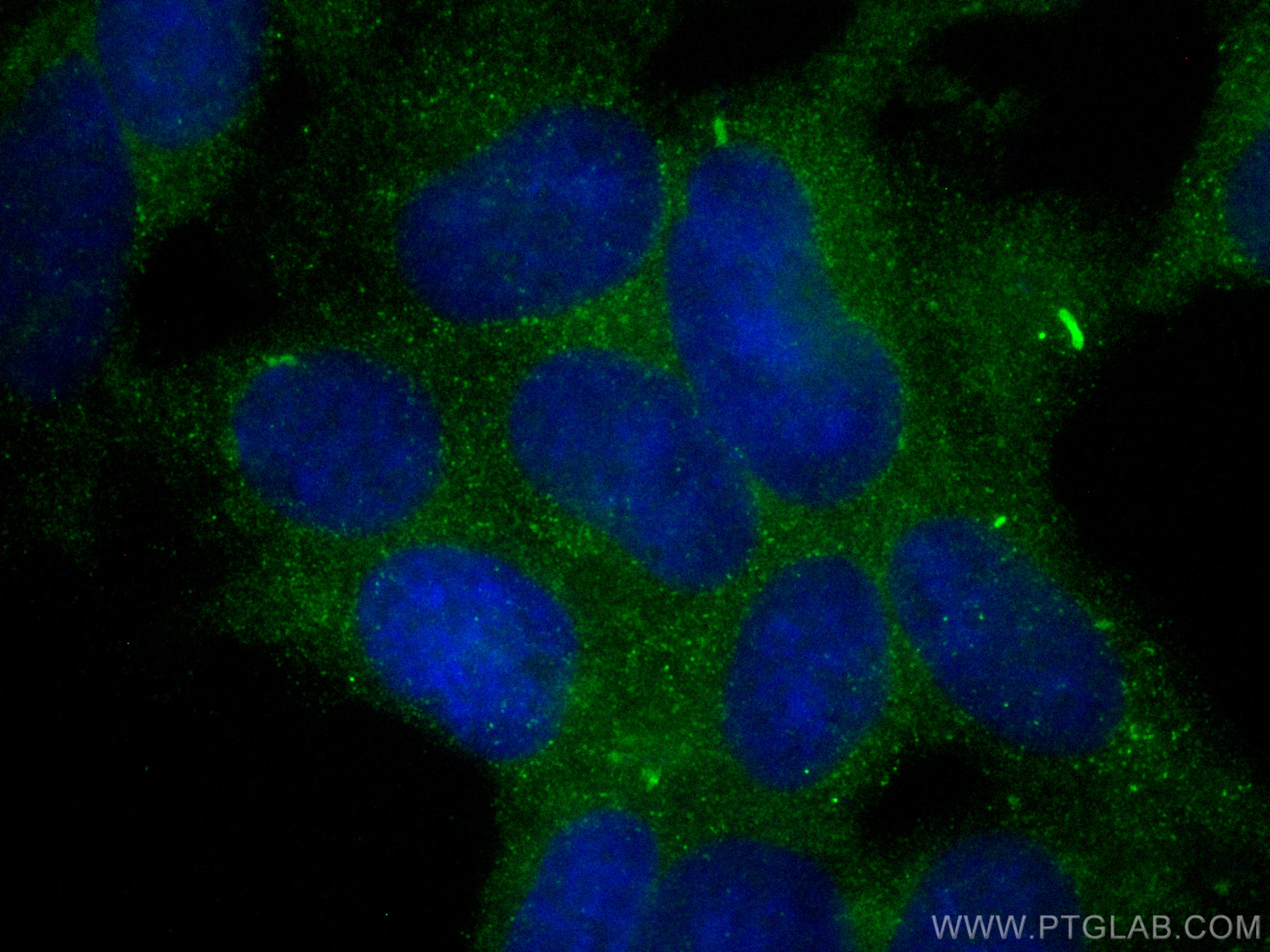
| Positive IF/ICC detected in | HEK-293 cells |
Recommended dilution
| Application | Dilution |
|---|---|
| Immunofluorescence (IF)/ICC | IF/ICC : 1:50-1:500 |
| It is recommended that this reagent should be titrated in each testing system to obtain optimal results. | |
| Sample-dependent, Check data in validation data gallery. | |
Product Information
CL488-28459 targets Collagen Type II in IF/ICC applications and shows reactivity with human samples.
| Tested Reactivity | human |
| Host / Isotype | Rabbit / IgG |
| Class | Polyclonal |
| Type | Antibody |
| Immunogen |
CatNo: Ag29265 Product name: Recombinant human COL2A1 protein Source: e coli.-derived, PGEX-4T Tag: GST Domain: 1-63 aa of BC007252 Sequence: MSAFAGLGPREKGPDPLQYMRADQAAGGLRQHDAEVDATLKSLNNQIESIRSPEGSRKNPART Predict reactive species |
| Full Name | collagen, type II, alpha 1 |
| Calculated Molecular Weight | 134 kDa |
| GenBank Accession Number | BC007252 |
| Gene Symbol | COL2A1 |
| Gene ID (NCBI) | 1280 |
| RRID | AB_3672827 |
| Conjugate | CoraLite® Plus 488 Fluorescent Dye |
| Excitation/Emission Maxima Wavelengths | 493 nm / 522 nm |
| Excitation Laser | Blue laser (488 nm) |
| Form | Liquid |
| Purification Method | Antigen affinity purification |
| UNIPROT ID | P02458 |
| Storage Buffer | PBS with 50% glycerol, 0.05% Proclin300, 0.5% BSA, pH 7.3. |
| Storage Conditions | Store at -20°C. Avoid exposure to light. Stable for one year after shipment. Aliquoting is unnecessary for -20oC storage. |
Background Information
The COL2A1 gene encodes the alpha-1 chain of type II collagen, a fibrillar collagen found primarily in cartilage and the vitreous humor of the eye. Type II collagen is essential for the formation of the extracellular matrix in cartilage and other connective tissues, providing structure and strength to these tissues .
Protocols
| Product Specific Protocols | |
|---|---|
| IF protocol for CL Plus 488 Collagen Type II antibody CL488-28459 | Download protocol |
| Standard Protocols | |
|---|---|
| Click here to view our Standard Protocols |


