
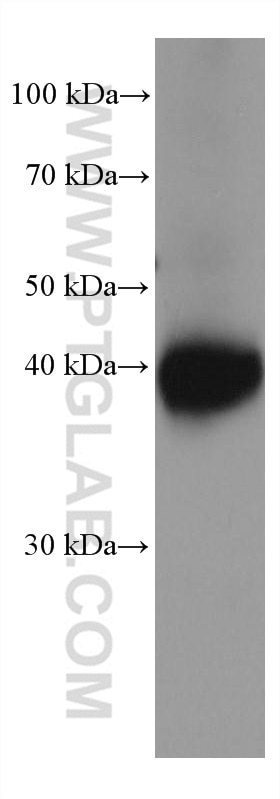
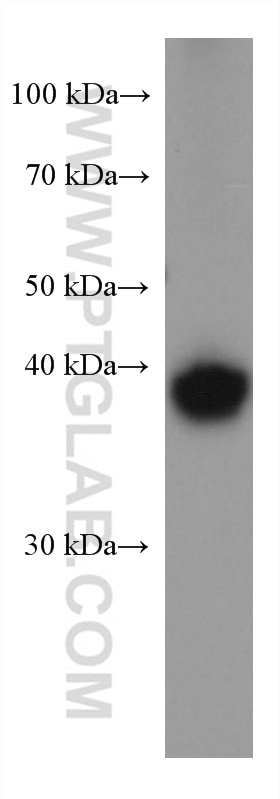
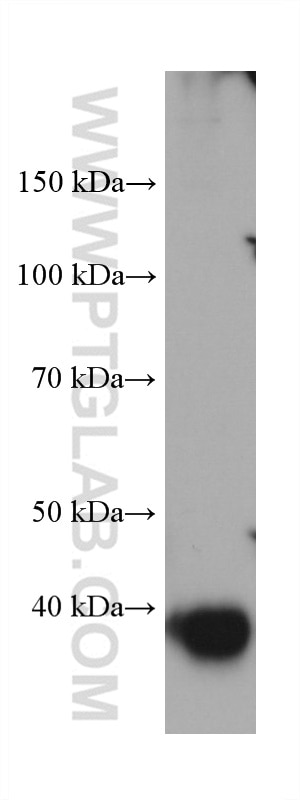

Tested Applications
| Positive WB detected in | mouse cerebellum tissue, mouse brain tissue, SH-SY5Y cells |
Recommended dilution
| Application | Dilution |
|---|---|
| Western Blot (WB) | WB : 1:5000-1:50000 |
| It is recommended that this reagent should be titrated in each testing system to obtain optimal results. | |
| Sample-dependent, Check data in validation data gallery. | |
Product Information
66931-1-Ig targets Kir4.1 in WB, IHC, ELISA applications and shows reactivity with human, mouse samples.
| Tested Reactivity | human, mouse |
| Cited Reactivity | mouse |
| Host / Isotype | Mouse / IgG1 |
| Class | Monoclonal |
| Type | Antibody |
| Immunogen |
CatNo: Ag16785 Product name: Recombinant human KCNJ10 protein Source: e coli.-derived, PET28a Tag: 6*His Domain: 224-426 aa of BC034036 Sequence: ETIRFSQHAVVASHNGKPCLMIRVANMRKSLLIGCQVTGKLLQTHQTKEGENIRLNQVNVTFQVDTASDSPFLILPLTFYHVVDETSPLKDLPLRSGEGDFELVLILSGTVESTSATCQVRTSYLPEEILWGYEFTPAISLSASGKYIADFSLFDQVVKVASPSGLRDSTVRYGDPEKLKLEESLREQAEKEGSALSVRISNV Predict reactive species |
| Full Name | potassium inwardly-rectifying channel, subfamily J, member 10 |
| Calculated Molecular Weight | 379 aa, 41 kDa |
| Observed Molecular Weight | 40 kDa |
| GenBank Accession Number | BC034036 |
| Gene Symbol | Kir4.1 |
| Gene ID (NCBI) | 3766 |
| RRID | AB_2882257 |
| Conjugate | Unconjugated |
| Form | Liquid |
| Purification Method | Protein G purification |
| UNIPROT ID | P78508 |
| Storage Buffer | PBS with 0.02% sodium azide and 50% glycerol, pH 7.3. |
| Storage Conditions | Store at -20°C. Stable for one year after shipment. Aliquoting is unnecessary for -20oC storage. 20ul sizes contain 0.1% BSA. |
Background Information
ATP-sensitive inward rectifier potassium channel 10 (KCNJ10, also known as Kir4.1) is an inwardly rectifying K⁺ channel predominantly expressed in glial cells within the central nervous system. In glial cells, Kir4.1 participates in multiple physiological processes, including the maintenance of extracellular K⁺ homeostasis, preservation of astrocyte resting membrane potential, regulation of cell volume, and promotion of glutamate uptake (PMID: 26961251). Kir4.1 can assemble into Kir4.1/Kir5.1 heteromeric channels, which mediate basolateral K⁺ recycling in renal distal tubules. This activity is essential for tubular Na⁺ reabsorption. Pathogenic mutations in Kir4.1 are associated with EAST/SeSAME syndrome, a genetic disorder marked by renal salt wasting (PMID: 24561201; 8995301).
Protocols
| Product Specific Protocols | |
|---|---|
| WB protocol for Kir4.1 antibody 66931-1-Ig | Download protocol |
| Standard Protocols | |
|---|---|
| Click here to view our Standard Protocols |
Publications
What published studies show
The Kir4.1 Monoclonal antibody (2D6A6), catalog number 66931-1-Ig, has a total of 2 citations. These appear in Journal of Ovarian Research and Biochimica et Biophysica Acta – Molecular Basis of Disease. The associated research fields include reproductive medicine (ovarian tissue transplantation, osteoporosis, dyslipidaemia) and neuroscience (Kir4.1 involvement in pain insensitivity in autism spectrum disorder models). Both studies used mouse samples with IHC and WB applications.
| Species | Application | Title |
|---|---|---|
J Ovarian Res Ovarian tissue transplantation ameliorates osteoporosis and dyslipidaemia in ovariectomised mice | ||
Biochim Biophys Acta Mol Basis Dis Involvement of Kir4.1 in pain insensitivity of the BTBR mouse model of autism spectrum disorder |




