
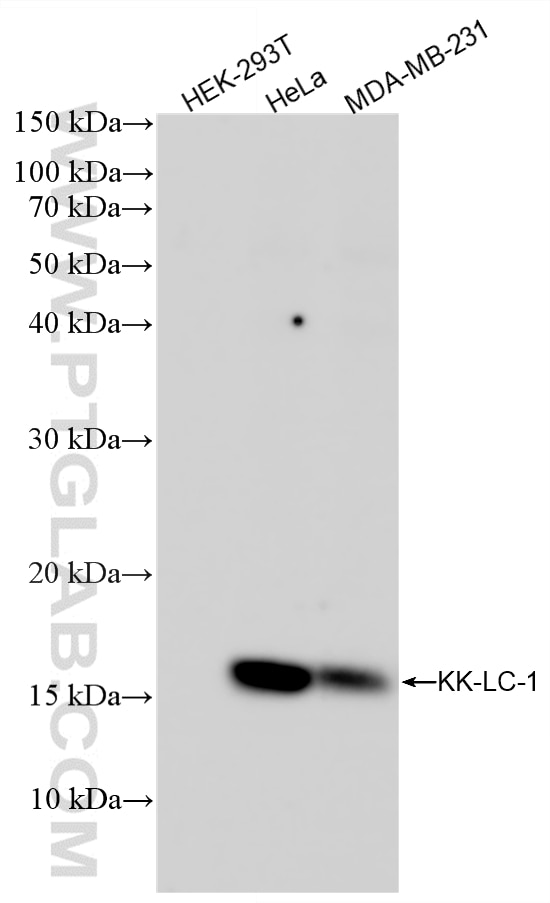
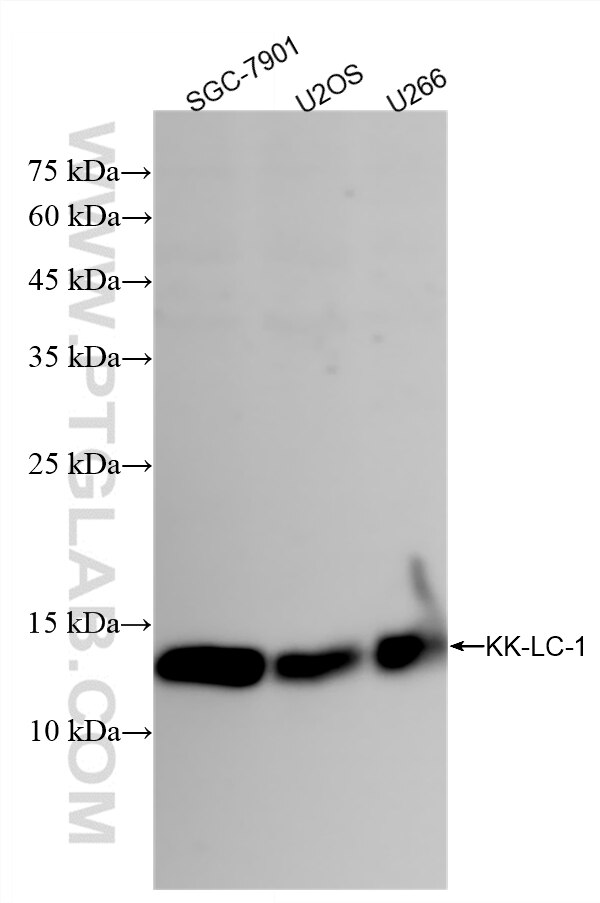
Tested Applications
| Positive WB detected in | HeLa cells, SGC-7901 cells, MDA-MB-231 cells, U2OS cells, U266 cells |
Recommended dilution
| Application | Dilution |
|---|---|
| Western Blot (WB) | WB : 1:2000-1:10000 |
| It is recommended that this reagent should be titrated in each testing system to obtain optimal results. | |
| Sample-dependent, Check data in validation data gallery. | |
Product Information
87944-1-RR targets KK-LC-1 in WB, ELISA applications and shows reactivity with human samples.
| Tested Reactivity | human |
| Host / Isotype | Rabbit / IgG |
| Class | Recombinant |
| Type | Antibody |
| Immunogen |
CatNo: Eg5757 Product name: Recombinant Human KK-LC-1 protein (rFc Tag) Source: mammalian cells-derived, V37 Tag: C-rFc Domain: 22-113 aa of NM_001017978.3 Sequence: RRFQRNTGEMSSNSTALALVRPSSSGLINSNTDNNLAVYDLSRDILNNFPHSIARQKRILVNLSMVENKLVELEHTLLSKGFRGASPHRKST Predict reactive species |
| Full Name | chromosome X open reading frame 61 |
| Calculated Molecular Weight | 13 kDa |
| Observed Molecular Weight | 13-16 kDa |
| GenBank Accession Number | NM_001017978.3 |
| Gene Symbol | KK-LC-1 |
| Gene ID (NCBI) | 203413 |
| Conjugate | Unconjugated |
| Form | Liquid |
| Purification Method | Protein A purification |
| UNIPROT ID | Q5H943 |
| Storage Buffer | PBS with 0.02% sodium azide and 50% glycerol, pH 7.3. |
| Storage Conditions | Store at -20°C. Stable for one year after shipment. Aliquoting is unnecessary for -20oC storage. 20ul sizes contain 0.1% BSA. |
Background Information
KK-LC-1 has been described as kita-kyushu lung cancer antigen 1, cancer/testis antigen 83. Therefore, KK-LC-1 is also known as CXorf61 and CT83. KK-LC-1 has been tested for association to diseases, such as adenocarcinoma and lung neoplasms. Studies have shown that KK-LC-1 is an ideal target for immunotherapy of triple-negative breast cancer (TNBC) (PMID: 26327325).
Protocols
| Product Specific Protocols | |
|---|---|
| WB protocol for KK-LC-1 antibody 87944-1-RR | Download protocol |
| Standard Protocols | |
|---|---|
| Click here to view our Standard Protocols |



