





Tested Applications
| Positive WB detected in | A2780 cells, HeLa cells, mouse brain tissue, rat brain tissue, HT-1080 cells, NIH/3T3 cells, C6 cells, PC-12 cells |
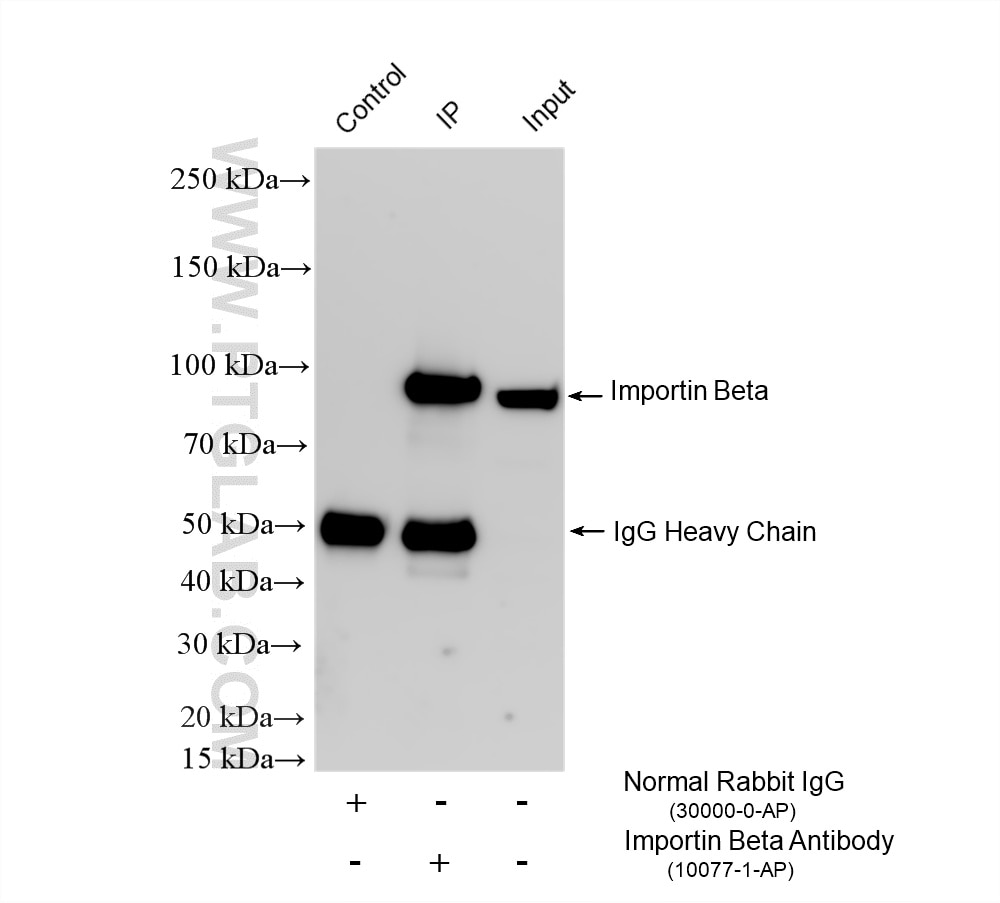
| Positive IP detected in | A2780 cells |
| Positive IHC detected in | human colon cancer tissue, mouse brain tissue Note: suggested antigen retrieval with TE buffer pH 9.0; (*) Alternatively, antigen retrieval may be performed with citrate buffer pH 6.0 |
| Positive IF/ICC detected in | HeLa cells |
| Positive FC (Intra) detected in | Jurkat cells |
Recommended dilution
| Application | Dilution |
|---|---|
| Western Blot (WB) | WB : 1:2000-1:12000 |
| Immunoprecipitation (IP) | IP : 0.5-4.0 ug for 1.0-3.0 mg of total protein lysate |
| Immunohistochemistry (IHC) | IHC : 1:50-1:500 |
| Immunofluorescence (IF)/ICC | IF/ICC : 1:50-1:500 |
| Flow Cytometry (FC) (INTRA) | FC (INTRA) : 0.40 ug per 10^6 cells in a 100 µl suspension |
| It is recommended that this reagent should be titrated in each testing system to obtain optimal results. | |
| Sample-dependent, Check data in validation data gallery. | |
Product Information
10077-1-AP targets Importin Beta in WB, IHC, IF/ICC, FC (Intra), IP, CoIP, ELISA applications and shows reactivity with human, mouse, rat samples.
| Tested Reactivity | human, mouse, rat |
| Cited Reactivity | human, mouse, rat, zebrafish |
| Host / Isotype | Rabbit / IgG |
| Class | Polyclonal |
| Type | Antibody |
| Immunogen |
CatNo: Ag0122 Product name: Recombinant human KPNB1 protein Source: e coli.-derived, PGEX-4T Tag: GST Domain: 409-612 aa of BC003572 Sequence: AMPTLIELMKDPSVVVRDTAAWTVGRICELLPEAAINDVYLAPLLQCLIEGLSAEPRVASNVCWAFSSLAEAAYEAADVADDQEEPATYCLSSSFELIVQKLLETTDRPDGHQNNLRSSAYESLMEIVKNSAKDCYPAVQKTTLVIMERLQQVLQMESHIQSTSDRIQFNDLQSLLCATLQNVLRKVQHQDALQISDVVMASLL Predict reactive species |
| Full Name | karyopherin (importin) beta 1 |
| Calculated Molecular Weight | 97 kDa |
| Observed Molecular Weight | 90-97 kDa |
| GenBank Accession Number | BC003572 |
| Gene Symbol | KPNB1 |
| Gene ID (NCBI) | 3837 |
| RRID | AB_2133977 |
| Conjugate | Unconjugated |
| Form | Liquid |
| Purification Method | Antigen affinity purification |
| UNIPROT ID | Q14974 |
| Storage Buffer | PBS with 0.02% sodium azide and 50% glycerol, pH 7.3. |
| Storage Conditions | Store at -20°C. Stable for one year after shipment. Aliquoting is unnecessary for -20oC storage. 20ul sizes contain 0.1% BSA. |
Background Information
Importin beta1, also known karyopherin beta or KPNB1, is a nuclear transport receptor that plays a key role in the nuclear import process. Importin beta1 and importin alpha work in concert to transport cargo into the nucleus, functioning as an essential component of the classical nuclear localization signal (NLS) pathway. Elevated expression of importin beta1 has been found in cervical tumors. (PMID: 22125623)
Protocols
| Product Specific Protocols | |
|---|---|
| FC protocol for Importin Beta antibody 10077-1-AP | Download protocol |
| IF protocol for Importin Beta antibody 10077-1-AP | Download protocol |
| IHC protocol for Importin Beta antibody 10077-1-AP | Download protocol |
| IP protocol for Importin Beta antibody 10077-1-AP | Download protocol |
| WB protocol for Importin Beta antibody 10077-1-AP | Download protocol |
| Standard Protocols | |
|---|---|
| Click here to view our Standard Protocols |
Publications
What published studies show
The Importin Beta Polyclonal antibody (catalog 10077-1-AP) has 28 citations. These appear across journals including Molecular Cancer, Cell Research, Nature Cancer, Autophagy, Molecular Cell, Nature Chemical Biology, Science Advances, Cell Reports, Oncogene, PLoS Pathogens, Journal of Biological Chemistry, and Viruses. Research fields span cancer biology (thyroid, breast, glioblastoma, lung, liver, pancreatic), autophagy, ferroptosis, viral infection (HPV, influenza, HBV, African swine fever), nuclear import, cardiotoxicity, and neurobiology. Applications are predominantly Western blot, with IP, IHC, CoIP, and IF.
| Species | Application | Title |
|---|---|---|
Mol Cancer CREB3L1 promotes tumor growth and metastasis of anaplastic thyroid carcinoma by remodeling the tumor microenvironment | ||
Cell Res Neddylation of PTEN regulates its nuclear import and promotes tumor development. | ||
Nat Cancer Phase separation of phospho-HDAC6 drives aberrant chromatin architecture in triple-negative breast cancer | ||
Autophagy TMX2 potentiates cell viability of hepatocellular carcinoma by promoting autophagy and mitophagy. | ||
Autophagy Ablation of endothelial Atg7 inhibits ischemia-induced angiogenesis by upregulating Stat1 that suppresses Hif1a expression | ||
Mol Cell EGFR promotes ALKBH5 nuclear retention to attenuate N6-methyladenosine and protect against ferroptosis in glioblastoma |
Reviews
What customers say
The single review for this product reports a 4-star rating. The user found it effective for both Western Blot (1:1000 dilution) and Immunofluorescence in permeabilized cells (1:100 dilution), using RPE-1 and MSC cell lines. The antibody was validated with siRNA knockdown, confirming its specificity. Overall, the reviewer was satisfied with its performance across both applications.
The reviews below have been submitted by verified Proteintech customers who received an incentive for providing their feedback.
María (Verified Customer) (02-08-2022) | Works for WB (1:1000) and IF in permeabilized cells (1:100 ON). Validated with siRNA
|





