
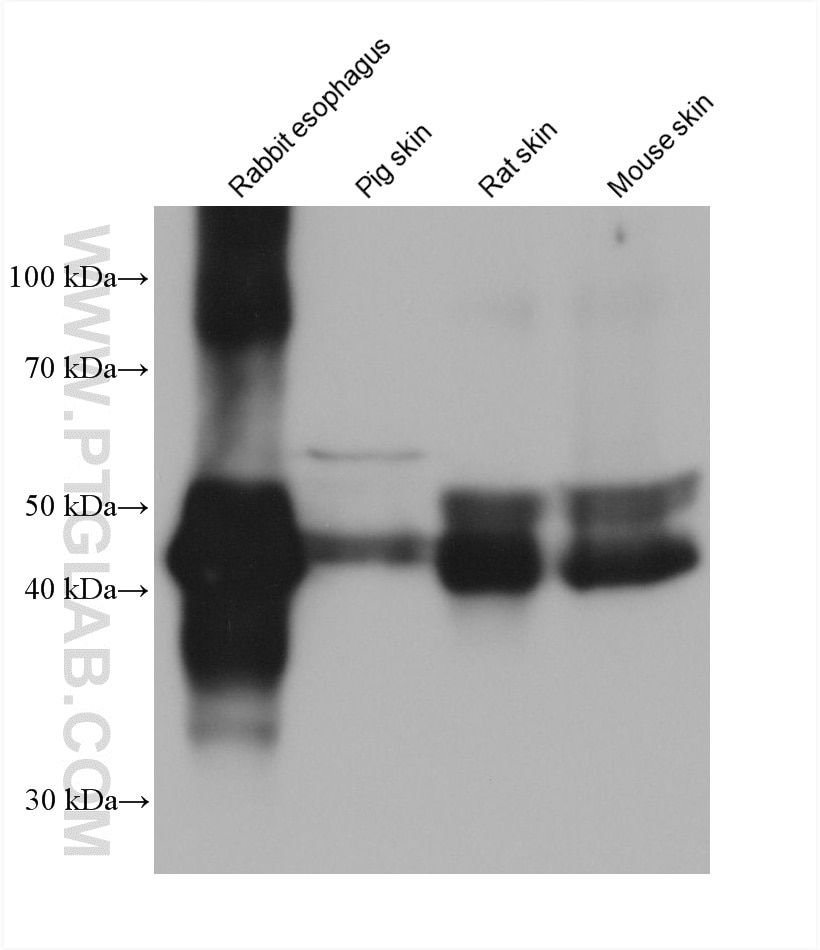


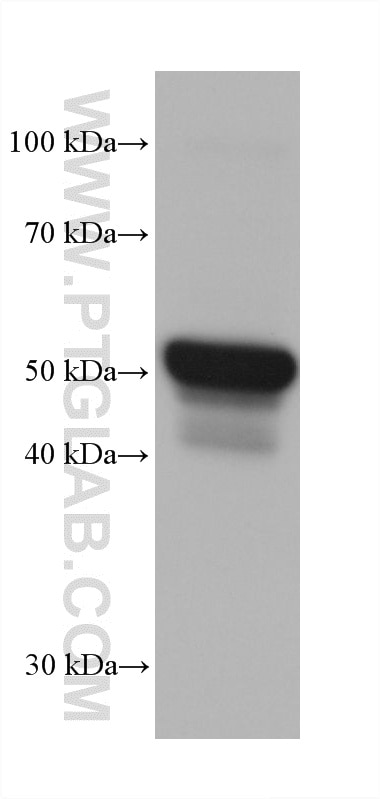



Tested Applications
| Positive WB detected in | Rabbit esophagus tissue, A431 cells, rat skin tissue, HaCaT cells, pig skin tissue, mouse skin tissue |
| Positive IHC detected in | human cervical cancer tissue, human oesophagus cancer tissue Note: suggested antigen retrieval with TE buffer pH 9.0; (*) Alternatively, antigen retrieval may be performed with citrate buffer pH 6.0 |
| Positive IF-P detected in | human cervical cancer tissue |
Recommended dilution
| Application | Dilution |
|---|---|
| Western Blot (WB) | WB : 1:20000-1:100000 |
| Immunohistochemistry (IHC) | IHC : 1:1000-1:4000 |
| Immunofluorescence (IF)-P | IF-P : 1:200-1:800 |
| It is recommended that this reagent should be titrated in each testing system to obtain optimal results. | |
| Sample-dependent, Check data in validation data gallery. | |
Product Information
66684-1-Ig targets Cytokeratin 13 in WB, IHC, IF-P, ELISA applications and shows reactivity with human, mouse, rat, pig samples.
| Tested Reactivity | human, mouse, rat, pig |
| Cited Reactivity | human, rat |
| Host / Isotype | Mouse / IgG1 |
| Class | Monoclonal |
| Type | Antibody |
| Immunogen |
CatNo: Ag0217 Product name: Recombinant human KRT13 protein Source: e coli.-derived, PGEX-4T Tag: GST Domain: 184-457 aa of BC002661 Sequence: RLAVDDFRLKYENELALRQSVEADINGLRRVLDELTLSKTDLEMQIESLNEELAYMKKNHEEEMKEFSNQVVGQVNVEMDATPGIDLTRVLAEMREQYEAMAERNRRDAEEWFHAKSAELNKEVSTNTAMIQTSKTEITELRRTLQGLEIELQSQLSMKAGLENTVAETECRYALQLQQIQGLISSIEAQLSELRSEMECQNQEYKMLLDIKTRLEQEIATYRSLLEGQDAKMIGFPSSAGSVSPRSTSVTTTSSASVTTTSNASGRRTSDVRR Predict reactive species |
| Full Name | keratin 13 |
| Calculated Molecular Weight | 50 kDa |
| Observed Molecular Weight | 50 kDa |
| GenBank Accession Number | BC002661 |
| Gene Symbol | Cytokeratin 13 |
| Gene ID (NCBI) | 3860 |
| RRID | AB_2882038 |
| Conjugate | Unconjugated |
| Form | Liquid |
| Purification Method | Protein G purification |
| UNIPROT ID | P13646 |
| Storage Buffer | PBS with 0.02% sodium azide and 50% glycerol, pH 7.3. |
| Storage Conditions | Store at -20°C. Stable for one year after shipment. Aliquoting is unnecessary for -20oC storage. 20ul sizes contain 0.1% BSA. |
Background Information
Keratins are a large family of proteins that form the intermediate filament cytoskeleton of epithelial cells, which are classified into two major sequence types. Type I keratins are a group of acidic intermediate filament proteins, including K9-K23, and the hair keratins Ha1-Ha8. Type II keratins are the basic or neutral courterparts to the acidic type I keratins, including K1-K8, and the hair keratins, Hb1-Hb6. This type I cytokeratin is paired with keratin 4 and expressed in the suprabasal layers of non-cornified stratified epithelia. The Keratin 13 (KRT13) gene encodes a type I acidic keratin which is expressed in the differentiated cells of non-cornified stratified squamous epithelia. This antibody can react with Cytokeratin 15.
Protocols
| Product Specific Protocols | |
|---|---|
| IF protocol for Cytokeratin 13 antibody 66684-1-Ig | Download protocol |
| IHC protocol for Cytokeratin 13 antibody 66684-1-Ig | Download protocol |
| WB protocol for Cytokeratin 13 antibody 66684-1-Ig | Download protocol |
| Standard Protocols | |
|---|---|
| Click here to view our Standard Protocols |
Publications
What published studies show
The Cytokeratin 13 Monoclonal antibody (Cat# 66684-1-Ig) has 4 total citations. These appear in the Journal of Allergy and Clinical Immunology, International Journal of Biological Macromolecules, Cell Molecular Gastroenterology and Hepatology, and Scientific Reports. Research fields span eosinophilic chronic rhinosinusitis with squamous metaplasia, alginate-catechol hydrogels for oral ulcer healing, plectin's oncogenic role in esophageal squamous cell carcinoma, and GSDME-driven pyroptosis in head and neck cancer.
| Species | Application | Title |
|---|---|---|
J Allergy Clin Immunol Eosinophilic chronic rhinosinusitis with nasal polyps: Squamous metaplasia as an associated remodeling feature. | ||
Int J Biol Macromol Substitution degree-regulated alginate-catechol hydrogels for oral ulcer healing. | ||
Cell Mol Gastroenterol Hepatol Unraveling the Oncogenic Characteristics of the Cytolinker, Plectin, in Esophageal Squamous Cell Carcinoma | ||






