




Tested Applications
| Positive WB detected in | mouse brain tissue |
| Positive IHC detected in | human liver tissue, mouse brain tissue Note: suggested antigen retrieval with TE buffer pH 9.0; (*) Alternatively, antigen retrieval may be performed with citrate buffer pH 6.0 |
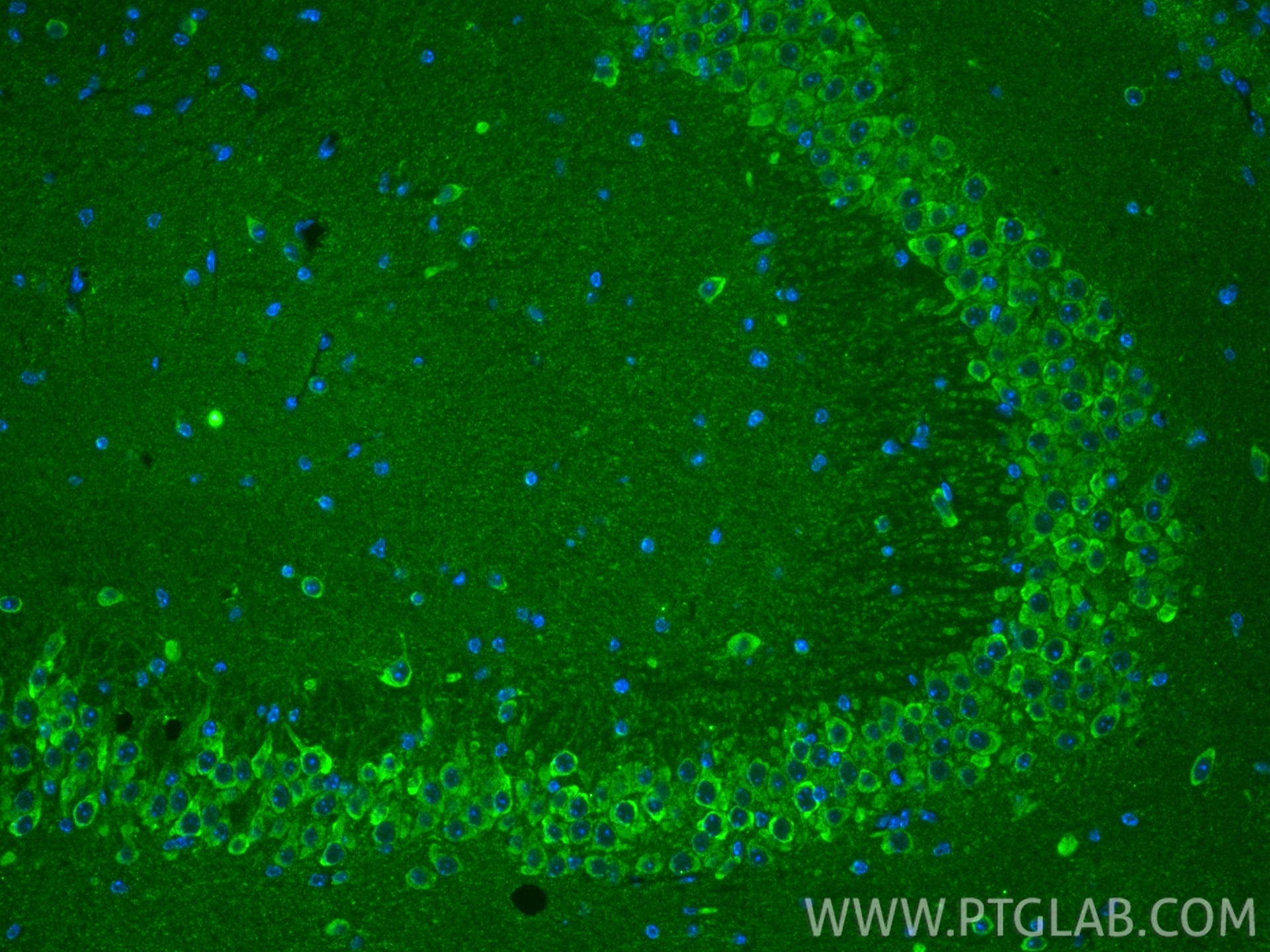
| Positive IF-P detected in | mouse brain tissue |
| Positive FC (Intra) detected in | HEK-293 cells |
Recommended dilution
| Application | Dilution |
|---|---|
| Western Blot (WB) | WB : 1:500-1:2000 |
| Immunohistochemistry (IHC) | IHC : 1:50-1:500 |
| Immunofluorescence (IF)-P | IF-P : 1:200-1:800 |
| Flow Cytometry (FC) (INTRA) | FC (INTRA) : 0.50 ug per 10^6 cells in a 100 ul suspension |
| It is recommended that this reagent should be titrated in each testing system to obtain optimal results. | |
| Sample-dependent, Check data in validation data gallery. | |
Product Information
15913-1-AP targets MRPL38 in WB, IHC, IF-P, FC (Intra), ELISA applications and shows reactivity with human, mouse, rat samples.
| Tested Reactivity | human, mouse, rat |
| Cited Reactivity | human, mouse, rat |
| Host / Isotype | Rabbit / IgG |
| Class | Polyclonal |
| Type | Antibody |
| Immunogen |
CatNo: Ag8706 Product name: Recombinant human MRPL38 protein Source: e coli.-derived, PGEX-4T Tag: GST Domain: 1-346 aa of BC013311 Sequence: MPNSDIDLSNLERLEKYRSFDRYRRRAEQEAQAPHWWRTYREYFGEKTDPKEKIDIGLPPPKVSRTQQLLERKQAIQELRANVEEERAARLRTASVPLDAVRAEWERTCGPYHKQRLAEYYGLYRDLFHGATFVPRVPLHVAYAVGEDDLMPVYCGNEVTPTEAAQAPEVTYEAEEGSLWTLLLTSLDGHLLEPDAEYLHWLLTNIPGNRVAEGQVTCPYLPPFPARGSGIHRLAFLLFKQDQPIDFSEDARPSPCYQLAQRTFRTFDFYKKHQETMTPAGLSFFQCRWDDSVTYIFHQLLDMREPVFEFVRPPPYHPKQKRFPHRQPLRYLDRYRDSHEPTYGIY Predict reactive species |
| Full Name | mitochondrial ribosomal protein L38 |
| Calculated Molecular Weight | 346 aa, 41 kDa |
| Observed Molecular Weight | 37-45 kDa |
| GenBank Accession Number | BC013311 |
| Gene Symbol | MRPL38 |
| Gene ID (NCBI) | 64978 |
| RRID | AB_2146047 |
| Conjugate | Unconjugated |
| Form | Liquid |
| Purification Method | Antigen affinity purification |
| UNIPROT ID | Q96DV4 |
| Storage Buffer | PBS with 0.02% sodium azide and 50% glycerol, pH 7.3. |
| Storage Conditions | Store at -20°C. Stable for one year after shipment. Aliquoting is unnecessary for -20oC storage. 20ul sizes contain 0.1% BSA. |
Protocols
| Product Specific Protocols | |
|---|---|
| FC protocol for MRPL38 antibody 15913-1-AP | Download protocol |
| IF protocol for MRPL38 antibody 15913-1-AP | Download protocol |
| IHC protocol for MRPL38 antibody 15913-1-AP | Download protocol |
| WB protocol for MRPL38 antibody 15913-1-AP | Download protocol |
| Standard Protocols | |
|---|---|
| Click here to view our Standard Protocols |
Publications
What published studies show
The MRPL38 Polyclonal antibody (catalog #15913-1-AP) has 5 total citations. These appear in journals including Nature Structural & Molecular Biology, Proceedings of the National Academy of Sciences (PNAS), Cell Reports, International Journal of Molecular Sciences, and Journal of Toxicological Sciences. The associated research fields span mitochondrial ribosome assembly, age-related mitoribosome decline and T cell dysfunction, tRNA-derived small RNA regulation of β cell maturation, translation fidelity and respiratory deficits, and epigenetic gene regulation in neurogenesis. Applications cited include Western blotting and immunohistochemistry.
| Species | Application | Title |
|---|---|---|
Proc Natl Acad Sci U S A Cryoelectron tomography reveals an age-related decline in mitoribosomes that contributes to T cell dysfunction in older individuals | ||
Cell Rep Small RNAs derived from tRNA fragmentation regulate the functional maturation of neonatal β cells. | ||
Int J Mol Sci Translation Fidelity and Respiration Deficits in CLPP-Deficient Tissues: Mechanistic Insights from Mitochondrial Complexome Profiling | ||
J Toxicol Sci Aberrant epigenetic gene regulation in hippocampal neurogenesis of mouse offspring following maternal exposure to 3,3'-iminodipropionitrile. |





