
Recombinant Mouse CD300LG protein (rFc Tag)
Species
Mouse
Purity
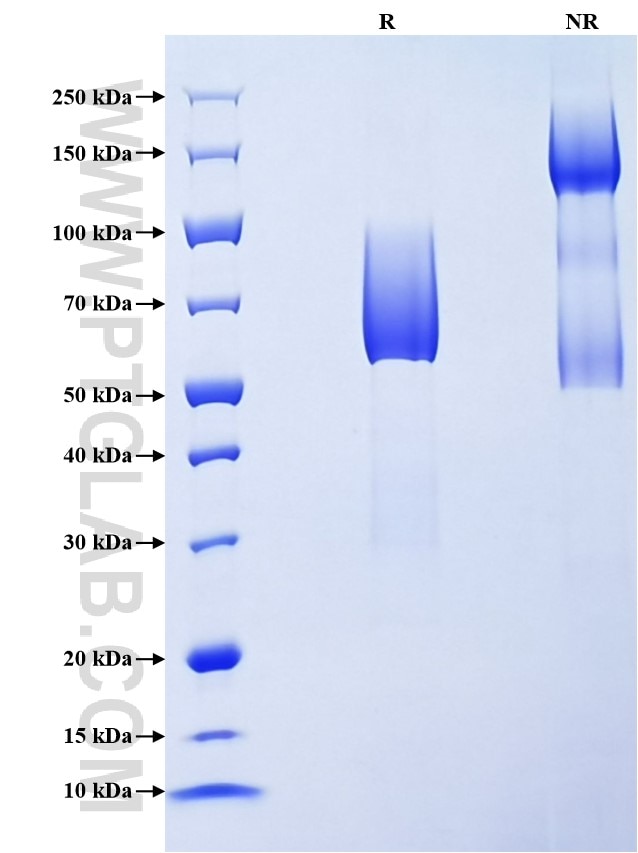
>90 %, SDS-PAGE
Tag
rFc Tag
Activity
not tested
Cat no : Eg2731
Validation Data Gallery
Product Information
| Purity | >90 %, SDS-PAGE |
| Endotoxin | <0.1 EU/μg protein, LAL method |
| Activity |
Not tested |
| Expression | HEK293-derived Mouse CD300LG protein Leu19-Ile284 (Accession# Q1ERP8-3) with a rabbit IgG Fc tag at the C-terminus. |
| GeneID | 52685 |
| Accession | Q1ERP8-3 |
| PredictedSize | 54.5 kDa |
| SDS-PAGE | 58-100 kDa, reducing (R) conditions |
| Formulation | Lyophilized from 0.22 μm filtered solution in PBS, pH 7.4. Normally 5% trehalose and 5% mannitol are added as protectants before lyophilization. |
| Reconstitution | Briefly centrifuge the tube before opening. Reconstitute at 0.1-0.5 mg/mL in sterile water. |
| Storage Conditions |
It is recommended that the protein be aliquoted for optimal storage. Avoid repeated freeze-thaw cycles.
|
| Shipping | The product is shipped at ambient temperature. Upon receipt, store it immediately at the recommended temperature. |
Background
CD300LG, also known as CD300 molecule-like family member G, is a part of the CD300 antigen-like family. it is known to have at least four isoforms in both species. The immunoglobulin (Ig) V-like domain of CD300LG exhibits approximately 35% identity to those of the polymeric Ig receptor (pIgR) and Fcα/μR. mouse CD300LG proteins are uniquely expressed on capillary endothelium. CD300LG may play a significant role in molecular transport across the capillary endothelium. In addition, CD300LG is capable of bidirectional transcytosis in assays using polarized MDCK epithelial cells.
References:
1. Hiroyuki Takatsu. et al. (2006). Biochem Biophys Res Commun. 15;348(1):183-191.
2. Randall S Davis. et al. (2005). Eur J Immunol. 35(3):674-680.
3. B.J. Green. et al. (1998). Int. Immunol. 10(7):891-899.