
Recombinant Mouse IL-7 protein (rFc Tag)
Species
Mouse
Purity
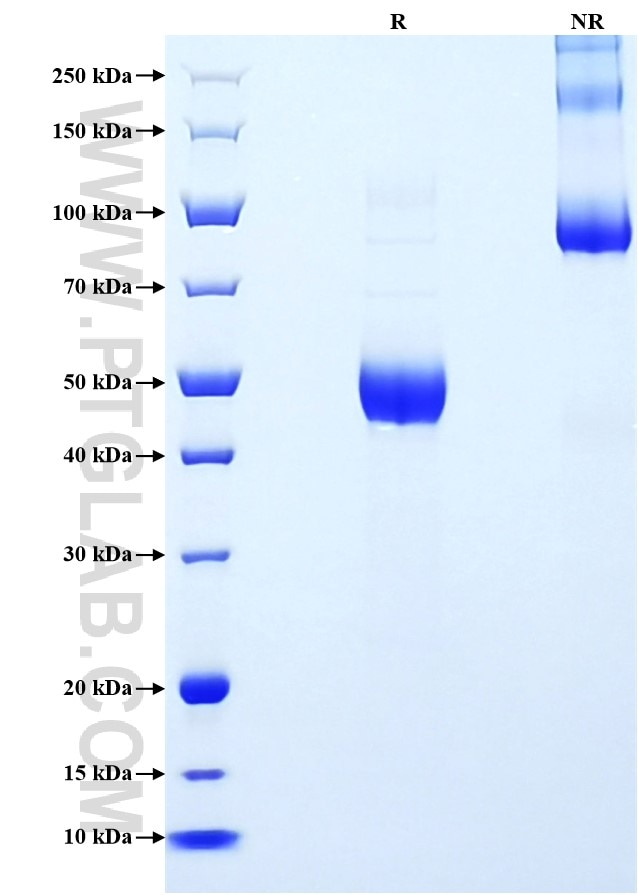
>90 %, SDS-PAGE
Tag
rFc Tag
Activity
not tested
Cat no : Eg3825
Validation Data Gallery
Product Information
| Purity | >90 %, SDS-PAGE |
| Endotoxin | <0.1 EU/μg protein, LAL method |
| Activity |
Not tested |
| Expression | HEK293-derived Mouse IL-7 protein Met+Glu26-Ile154 (Accession# Q544C8) with a rabbit IgG Fc tag at the C-terminus. |
| GeneID | 16196 |
| Accession | Q544C8 |
| PredictedSize | 41.3 kDa |
| SDS-PAGE | 45-52 kDa, reducing (R) conditions |
| Formulation | Lyophilized from 0.22 μm filtered solution in PBS, pH 7.4. Normally 5% trehalose and 5% mannitol are added as protectants before lyophilization. |
| Reconstitution | Briefly centrifuge the tube before opening. Reconstitute at 0.1-0.5 mg/mL in sterile water. |
| Storage Conditions |
It is recommended that the protein be aliquoted for optimal storage. Avoid repeated freeze-thaw cycles.
|
| Shipping | The product is shipped at ambient temperature. Upon receipt, store it immediately at the recommended temperature. |
Background
IL-7 is one of the members of IL-2 superfamily. IL-7 is a hematopoietic growth factor secreted by stromal cells in the bone marrow and thymus. It is also produced by keratinocytes, dendritic cells, hepatocytes, neurons, and epithelial cells, but is not produced by normal lymphocytes. IL-7 plays an active role in the development, survival, maintaining and restoring homeostasis of mature T lymphocytes. It is also a key regulator of the commitment, survival, proliferation and maturation of B cells during development. Severe acute respiratory syndrome coronavirus 2 (SARS-CoV-2) infection can be a potent inducer of proinflammatory cytokines and chemokines which may defend against the infection, but may also mediate destructive lung injury. Elevated serum IL-7 levels, together with several other circulating cytokines and chemokines, has been found to be associated with the severity of Coronavirus Disease 19 (COVID-19).
References:
1. Steven A Corfe. et al. (2012) Semin Immunol. 24(3):198-208.
2. Sarah R Jacobs. et al. (2010) J Immunol. 184(7):3461-9.
3. C Heufler. et al. (1993) J Exp Med. 178(3):1109-14.
4. R Kröncke. et al. (1996) Eur J Immunol. 26(10):2541-4.
5. Yukihisa Sawa. et al. (2009) Immunity.30(3):447-57.
6. Pierre Francois Laterre. et al. (2020) JAMA Netw Open. 3(7):e2016485.