




Tested Applications
| Positive WB detected in | pig kidney tissue, pig liver tissue, rat liver tissue, recombinant protein |
| Positive IHC detected in | mouse kidney tissue, human kidney tissue, human colon tissue Note: suggested antigen retrieval with TE buffer pH 9.0; (*) Alternatively, antigen retrieval may be performed with citrate buffer pH 6.0 |
| Positive IF/ICC detected in | HeLa cells |
Recommended dilution
| Application | Dilution |
|---|---|
| Western Blot (WB) | WB : 1:1000-1:4000 |
| Immunohistochemistry (IHC) | IHC : 1:200-1:800 |
| Immunofluorescence (IF)/ICC | IF/ICC : 1:400-1:1600 |
| It is recommended that this reagent should be titrated in each testing system to obtain optimal results. | |
| Sample-dependent, Check data in validation data gallery. | |
Product Information
66862-1-Ig targets PCK1 in WB, IHC, IF/ICC, ELISA applications and shows reactivity with human, mouse, rat, pig samples.
| Tested Reactivity | human, mouse, rat, pig |
| Cited Reactivity | human, mouse, monkey |
| Host / Isotype | Mouse / IgG1 |
| Class | Monoclonal |
| Type | Antibody |
| Immunogen |
CatNo: Ag9720 Product name: Recombinant human PCK1 protein Source: e coli.-derived, PET28a Tag: 6*His Domain: 274-622 aa of BC023978 Sequence: EGEKKYLAAAFPSACGKTNLAMMNPSLPGWKVECVGDDIAWMKFDAQGHLRAINPENGFFGVAPGTSVKTNPNAIKTIQKNTIFTNVAETSDGGVYWEGIDEPLASGVTITSWKNKEWSSEDGEPCAHPNSRFCTPASQCPIIDAAWESPEGVPIEGIIFGGRRPAGVPLVYEALSWQHGVFVGAAMRSEATAAAEHKGKIIMHDPFAMRPFFGYNFGKYLAHWLSMAQHPAAKLPKIFHVNWFRKDKEGKFLWPGFGENSRVLEWMFNRIDGKASTKLTPIGYIPKEDALNLKGLGHINMMELFSISKEFWEKEVEDIEKYLEDQVNADLPCEIEREILALKQRISQM Predict reactive species |
| Full Name | phosphoenolpyruvate carboxykinase 1 (soluble) |
| Calculated Molecular Weight | 622 aa, 69 kDa |
| Observed Molecular Weight | 65-69 kDa |
| GenBank Accession Number | BC023978 |
| Gene Symbol | PCK1 |
| Gene ID (NCBI) | 5105 |
| RRID | AB_2882200 |
| Conjugate | Unconjugated |
| Form | Liquid |
| Purification Method | Protein G purification |
| UNIPROT ID | P35558 |
| Storage Buffer | PBS with 0.02% sodium azide and 50% glycerol, pH 7.3. |
| Storage Conditions | Store at -20°C. Stable for one year after shipment. Aliquoting is unnecessary for -20oC storage. 20ul sizes contain 0.1% BSA. |
Background Information
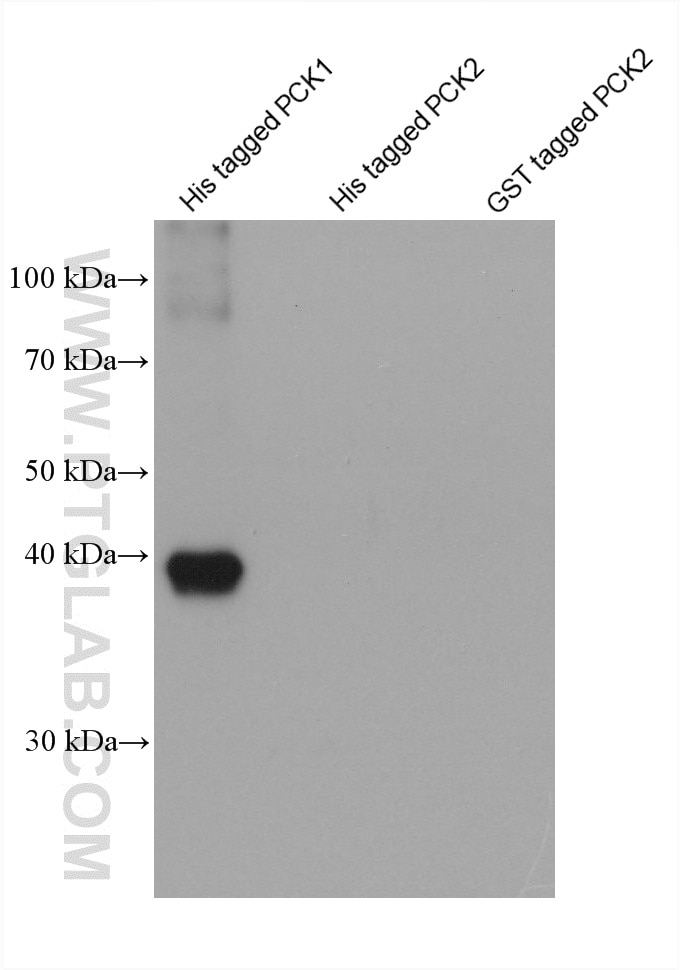
PCK1(Phosphoenolpyruvate carboxykinase, cytosolic) is also named as PEPCK1 and belongs to the phosphoenolpyruvate carboxykinase [GTP] family. It catalyzes the formation of phosphoenolpyruvate from oxaloacetate, with the release of carbon dioxide and GDP. It is also a main control point for the regulation of gluconeogenesis. In eukaryotes there are two isozymes: a cytoplasmic one and a mitochondrial one. Defects in PCK1 are the cause of cytosolic phosphoenolpyruvate carboxykinase deficiency (C-PEPCKD). This antibody specifically recognizes PCK1 but does not recognize PCK2.
Protocols
| Product Specific Protocols | |
|---|---|
| IF protocol for PCK1 antibody 66862-1-Ig | Download protocol |
| IHC protocol for PCK1 antibody 66862-1-Ig | Download protocol |
| WB protocol for PCK1 antibody 66862-1-Ig | Download protocol |
| Standard Protocols | |
|---|---|
| Click here to view our Standard Protocols |
Publications
What published studies show
The PCK1 Monoclonal antibody (2F11B5), catalog number 66862-1-Ig, has 9 citations. These appear in journals including Nature, Advanced Science, Journal of Experimental Medicine, International Journal of Biological Macromolecules, Aging Cell, Communications Biology, bioRxiv, Chemical and Biological Interactions, and Journal of Ethnopharmacology. Research fields span pathology and disease mapping, renal stone formation, tumor immune evasion, viral infection, mitochondrial dysfunction, hepatic signaling, metabolic toxicity, and MASLD.
| Species | Application | Title |
|---|---|---|
Adv Sci (Weinh) G6PC Downregulation Promotes Renal Calcium Oxalate Stone Formation via Lactate-Induced SNAIL1 K206 Lactylation and Epithelial-Mesenchymal Transition. | ||
J Exp Med PCK1 inhibits cGAS-STING activation by consumption of GTP to promote tumor immune evasion | ||
Int J Biol Macromol Porcine reproductive and respiratory syndrome virus activates lipid synthesis through a ROS-dependent AKT/PCK1/INSIG/SREBPs axis | ||
Aging Cell Pck1 Deficiency Drives Mitochondrial Dysfunction and Cellular Senescence in Adipocytes.
| ||
Commun Biol Spatially and temporally comparative proteomics provide insights into dynamic response patterns to PEDV infection. |




