
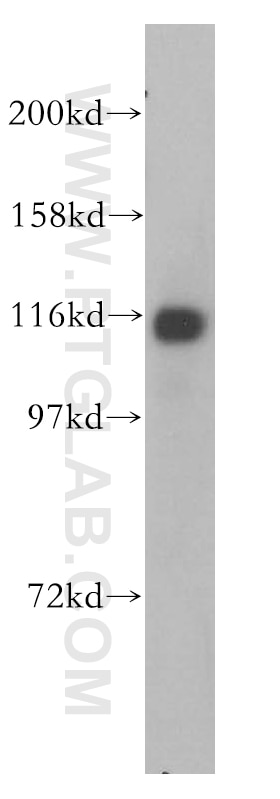



Tested Applications
| Positive WB detected in | HepG2 cells, DU 145 cells |
| Positive IP detected in | HepG2 cells, Neuro-2a cells |
| Positive IF/ICC detected in | U2OS cells |
| Positive FC (Intra) detected in | HepG2 cells |
Recommended dilution
| Application | Dilution |
|---|---|
| Western Blot (WB) | WB : 1:500-1:1000 |
| Immunoprecipitation (IP) | IP : 0.5-4.0 ug for 1.0-3.0 mg of total protein lysate |
| Immunofluorescence (IF)/ICC | IF/ICC : 1:200-1:800 |
| Flow Cytometry (FC) (INTRA) | FC (INTRA) : 0.25 ug per 10^6 cells in a 100 ul suspension |
| It is recommended that this reagent should be titrated in each testing system to obtain optimal results. | |
| Sample-dependent, Check data in validation data gallery. | |
Product Information
13961-1-AP targets PPFIBP1 in WB, IF/ICC, FC (Intra), IP, ELISA applications and shows reactivity with human, mouse samples.
| Tested Reactivity | human, mouse |
| Cited Reactivity | human |
| Host / Isotype | Rabbit / IgG |
| Class | Polyclonal |
| Type | Antibody |
| Immunogen |
CatNo: Ag4884 Product name: Recombinant human PPFIBP1 protein Source: e coli.-derived, PET28a Tag: 6*His Domain: 662-1011 aa of BC050281 Sequence: GSYLNSGKHWIASGQTLLQASQQDLEKELGIKHSLHRKKLQLALQALGSEEETNHGKLDFNWVTRWLDDIGLPQYKTQFDEGRVDGRMLHYMTVDDLLSLKVVSVLHHLSIKRAIQVLRINNFEPNCLRRRPSDENTIAPSEVQKWTNHRVMEWLRSVDLAEYAPNLRGSGVHGGLMVLEPRFNVETMAQLLNIPPNKTLLRRHLATHFNLLIGAEAQHQKRDAMELPDYVLLTATAKVKPKKLAFSNFGNLRKKKQEDGEEYVCPMELGQASGSASKKGFKPGLDMRLYEEDDLDRLEQMEDSEGTVRQIGAFSEGINNLTHMLKEDDMFKDFAARSPSASITDEDSNV Predict reactive species |
| Full Name | PTPRF interacting protein, binding protein 1 (liprin beta 1) |
| Calculated Molecular Weight | 1011 aa, 114 kDa |
| Observed Molecular Weight | 114 kDa |
| GenBank Accession Number | BC050281 |
| Gene Symbol | PPFIBP1 |
| Gene ID (NCBI) | 8496 |
| RRID | AB_2171631 |
| Conjugate | Unconjugated |
| Form | Liquid |
| Purification Method | Antigen affinity purification |
| UNIPROT ID | Q86W92 |
| Storage Buffer | PBS with 0.02% sodium azide and 50% glycerol, pH 7.3. |
| Storage Conditions | Store at -20°C. Stable for one year after shipment. Aliquoting is unnecessary for -20oC storage. 20ul sizes contain 0.1% BSA. |
Protocols
| Product Specific Protocols | |
|---|---|
| FC protocol for PPFIBP1 antibody 13961-1-AP | Download protocol |
| IF protocol for PPFIBP1 antibody 13961-1-AP | Download protocol |
| IP protocol for PPFIBP1 antibody 13961-1-AP | Download protocol |
| WB protocol for PPFIBP1 antibody 13961-1-AP | Download protocol |
| Standard Protocols | |
|---|---|
| Click here to view our Standard Protocols |
Publications
What published studies show
The PPFIBP1 Polyclonal antibody (catalog number 13961-1-AP) has 3 total citations. These appear in the Journal of Inflammation Research, Open Biology, and Discovery Oncology. The associated research fields include osteoarthritis transcriptomic signature diagnostics, the talin–KANK1 interaction coordinating actin and microtubule cytoskeletons at focal adhesions, and cancer-associated fibroblast signatures for neuroblastoma prognosis and therapeutic response prediction.
| Species | Application | Title |
|---|---|---|
J Inflamm Res Development and Validation of Diagnostic Models for Transcriptomic Signature Genes for Multiple Tissues in Osteoarthritis | ||
Open Biol The structural basis of the talin-KANK1 interaction that coordinates the actin and microtubule cytoskeletons at focal adhesions | ||
Discov Oncol Integrated single-cell and bulk RNA sequencing analysis establishes a cancer associated fibroblast-related signature for predicting prognosis and therapeutic responses in neuroblastoma. |



