

Product Information
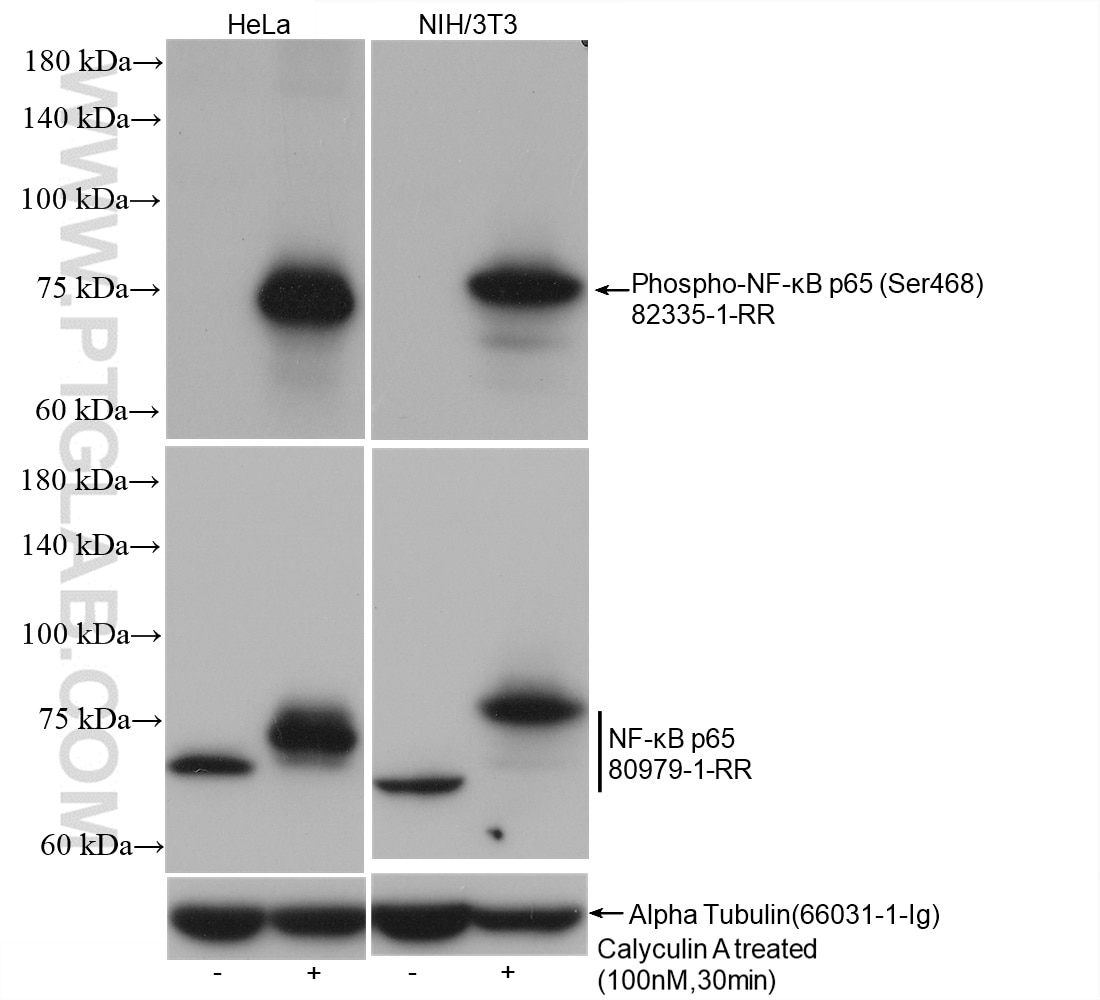
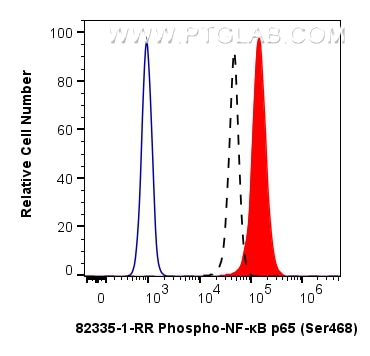
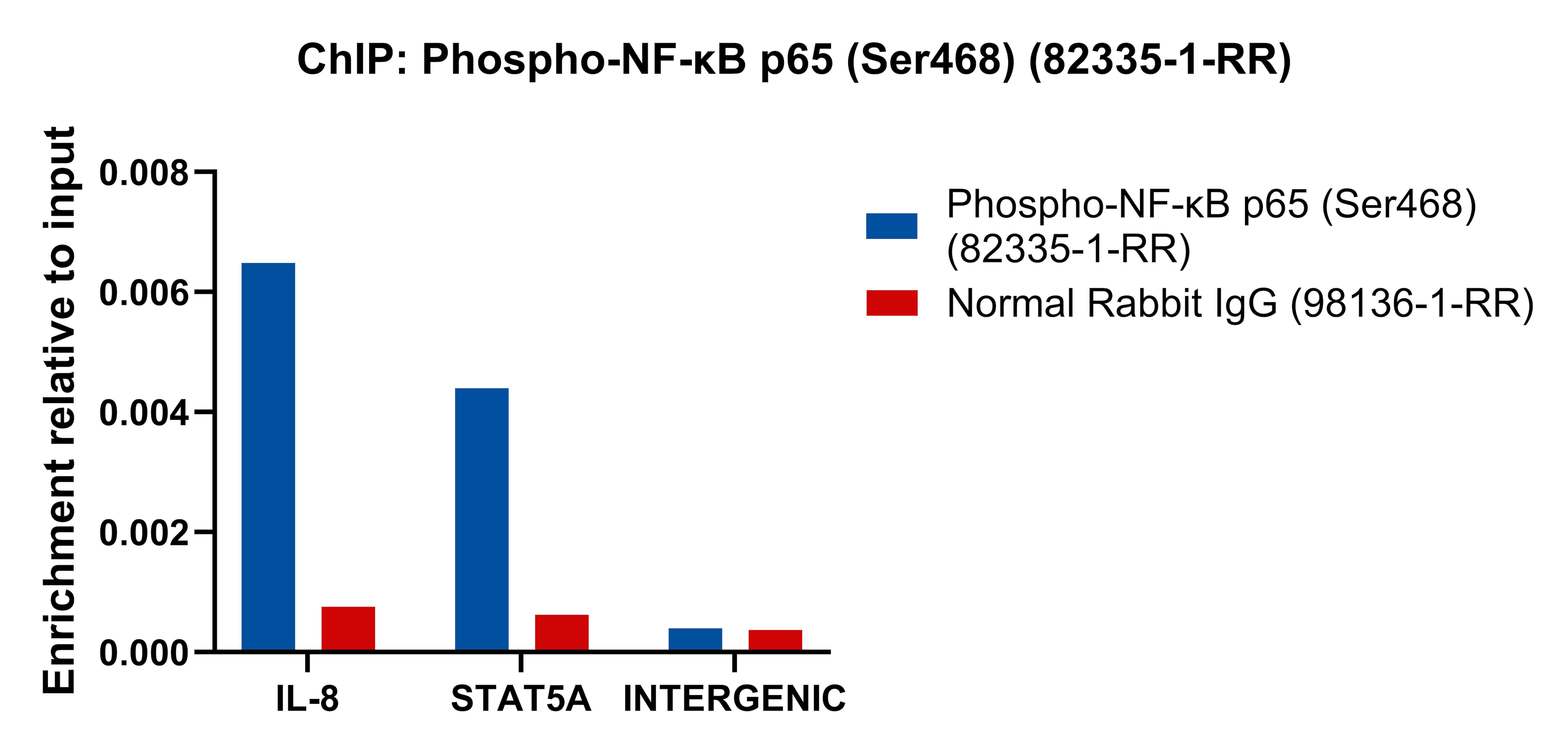
82335-1-PBS targets Phospho-NF-κB p65 (Ser468) in WB, FC (Intra), Indirect ELISA, ChIP-qPCR applications and shows reactivity with human, mouse samples.
| Tested Reactivity | human, mouse |
| Cited Reactivity | human, mouse |
| Host / Isotype | Rabbit / IgG |
| Class | Recombinant |
| Type | Antibody |
| Immunogen |
Peptide Predict reactive species |
| Full Name | v-rel reticuloendotheliosis viral oncogene homolog A (avian) |
| Calculated Molecular Weight | 65 kDa |
| Observed Molecular Weight | 75 kDa |
| GenBank Accession Number | BC011603 |
| Gene Symbol | NF-κB p65 |
| Gene ID (NCBI) | 5970 |
| RRID | AB_3083091 |
| Conjugate | Unconjugated |
| Form | Liquid |
| Purification Method | Protein A purification |
| UNIPROT ID | Q04206 |
| Storage Buffer | PBS only, pH 7.3. |
| Storage Conditions | Store at -80°C. |
Background Information
Nuclear factor kB (NF-kB) is a collective term for a small family of dimeric transcription factors [comprising p65 (RelA) and RelB, c-Rel, p50/p105 (NF-κB1), and p52/p100 (NF-κB2)]. All NF-κB proteins share a Rel homology domain (RHD), which is responsible for DNA binding and dimerization. Only p65, RelB, and c-Rel contain potent transactivation domains within sequences from the C-terminal to the RHD. Exterior signals lead to the phosphorylation and degradation of the inhibitory complex IκB, which is modulated by the IκB kinase (IKK), and its degradation allows for the release of the typical NF-κB heterodimer, p65/p50, to translocate into the nucleus. NF-κB binds to its cognate DNA elements and can transcriptionally activate different target genes among which 200-500 genes have been implicated in cell survival/apoptosis, cell growth, immune response, and inflammation.
Publications
What published studies show
The Phospho-NF-κB p65 (Ser468) Recombinant monoclonal antibody (6N1), catalog number 82335-1-PBS, has a total of 633 citations. A retrieved citation appears in Neoplasia (2025), addressing bone cancer pain through neuronal oxidative stress and microglial inhibition, reflecting research fields spanning oncology, neuroscience, and inflammation. The antibody has been cited across applications including WB, IHC, IF, and ELISA in species such as human, mouse, rat, pig, chicken, bovine, sheep, and goat.
| Species | Application | Title |
|---|---|---|
Neoplasia ZC3H15 suppression ameliorates bone cancer pain through inhibiting neuronal oxidative stress and microglial inflammation |




