


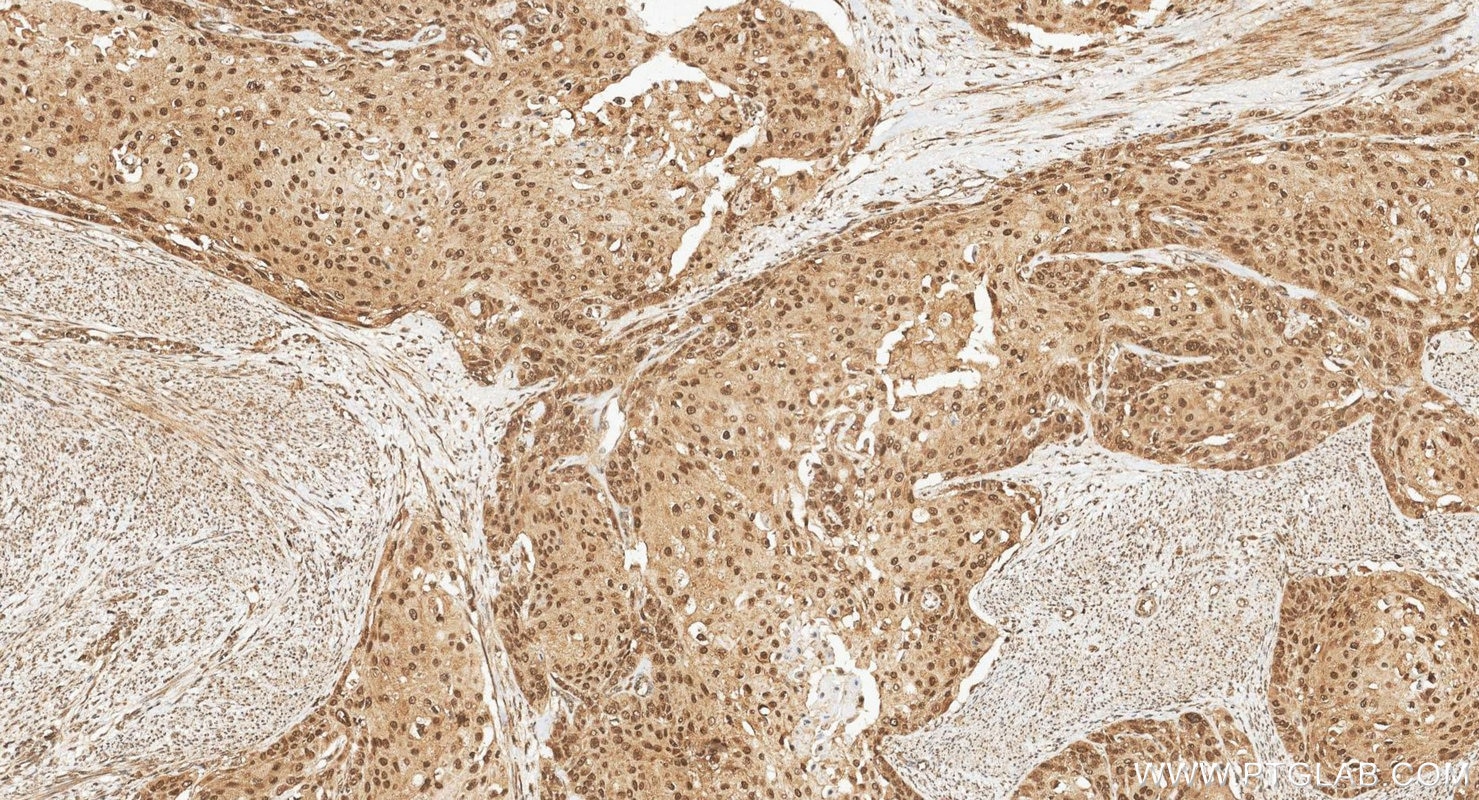


Product Information
24542-1-PBS targets RPRD1B in WB, IHC, IF/ICC, Indirect ELISA applications and shows reactivity with human samples.
| Tested Reactivity | human |
| Host / Isotype | Rabbit / IgG |
| Class | Polyclonal |
| Type | Antibody |
| Immunogen |
CatNo: Ag21578 Product name: Recombinant human RPRD1B protein Source: e coli.-derived, PET30a Tag: 6*His Domain: 79-181 aa of BC033629 Sequence: REFESVLVDAFSHVAREADEGCKKPLERLLNIWQERSVYGGEFIQQLKLSMEDSKSPPPKATEEKKSLKRTFQQIQEEEDDDYPGSYSPQDPSAGPLLTEELI Predict reactive species |
| Full Name | regulation of nuclear pre-mRNA domain containing 1B |
| Calculated Molecular Weight | 326 aa, 37 kDa |
| Observed Molecular Weight | 37 kDa |
| GenBank Accession Number | BC033629 |
| Gene Symbol | RPRD1B |
| Gene ID (NCBI) | 58490 |
| RRID | AB_2879597 |
| Conjugate | Unconjugated |
| Form | Liquid |
| Purification Method | Antigen affinity purification |
| UNIPROT ID | Q9NQG5 |
| Storage Buffer | PBS only, pH 7.3. |
| Storage Conditions | Store at -80°C. |
Background Information
RPRD1B, also known as CREPT, is a protein-coding gene located on chromosome 20q11.23 that encodes a 326-amino-acid nuclear protein. RPRD1B functions primarily as a scaffold for the C-terminal domain (CTD) of RNA polymerase II (RNAPII), interacting with phosphorylated CTD repeats via its CTD-interaction domain (CID) and coordinating the dephosphorylation of phospho-Ser5 by the RPAP2 phosphatase. It forms homodimers and heterodimers with its paralog RPRD1A through coiled-coil domains and participates in transcription-coupled RNA processing and RNAPII promoter clearance. Functionally, RPRD1B enhances the expression of cell cycle-related genes, notably cyclin D1 (CCND1), by promoting RNAPII binding to the CCND1 promoter and facilitating loop formation that may enable RNAPII recycling during transcription. Beyond its physiological roles in transcription regulation and cell proliferation, RPRD1B is frequently overexpressed across multiple cancer types and has been shown to promote tumorigenesis by accelerating cell cycle progression, enhancing proliferative signaling, and supporting cancer cell migration and invasion, positioning it as a promising diagnostic and prognostic biomarker.





