
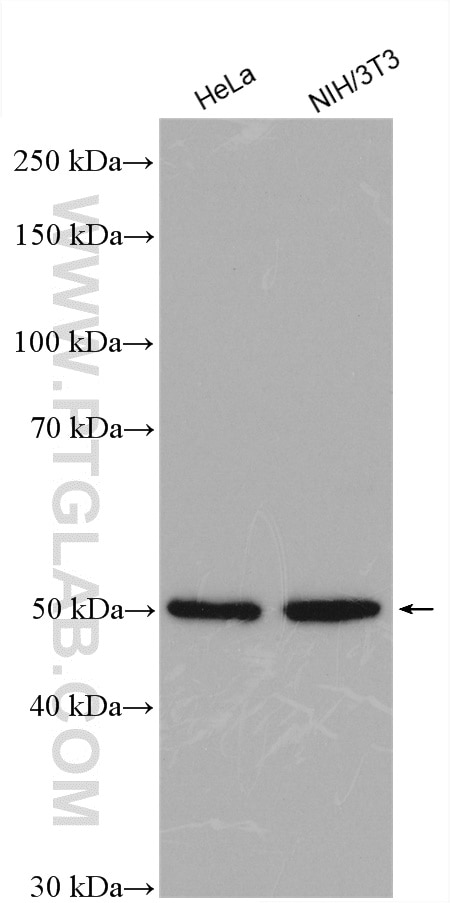
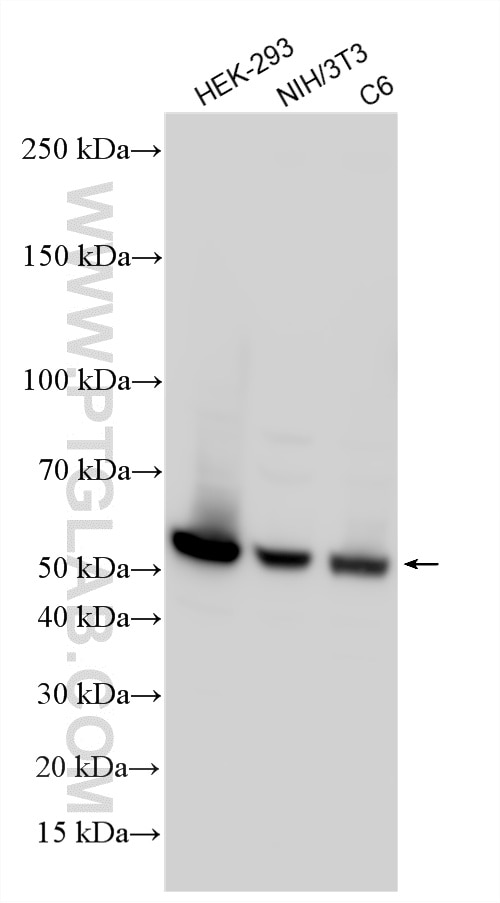
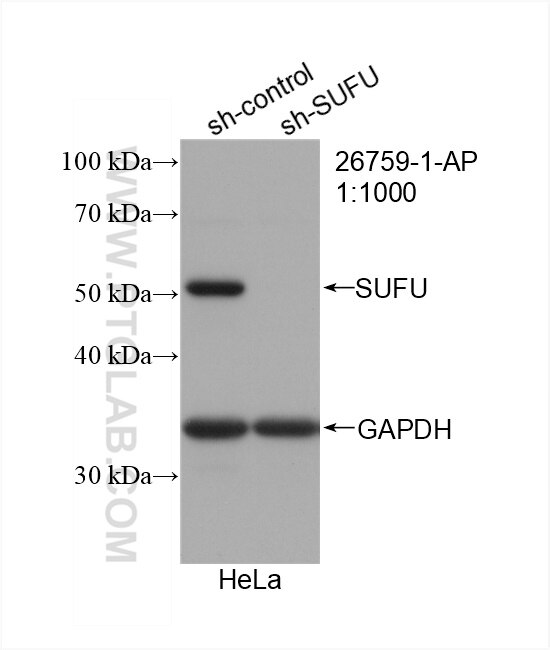
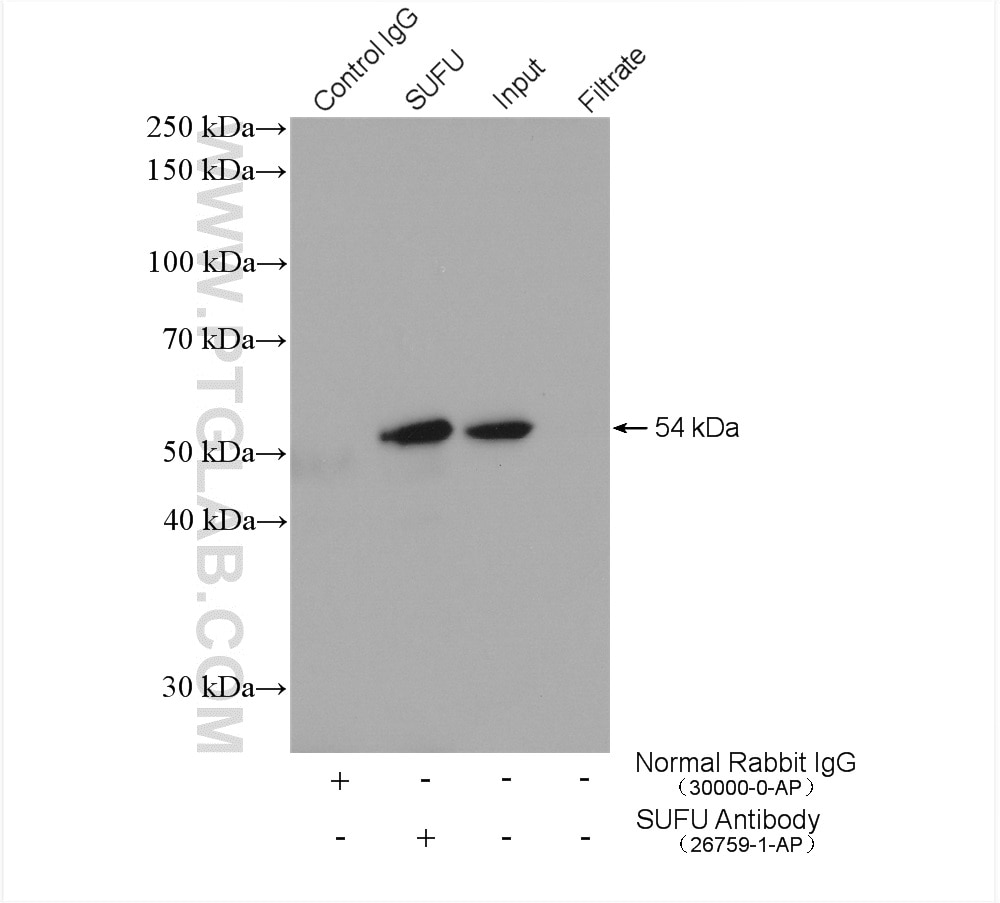

Tested Applications
| Positive WB detected in | HeLa cells, HEK-293 cells, NIH/3T3 cells, C6 cells |
| Positive IP detected in | NIH/3T3 cells |
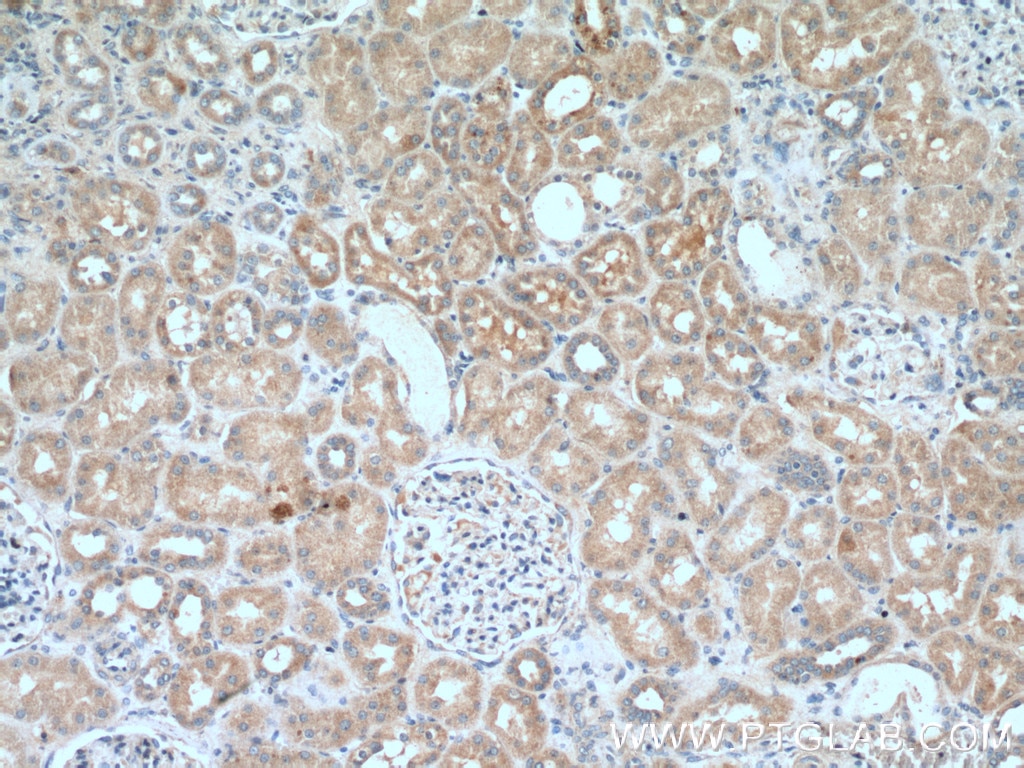
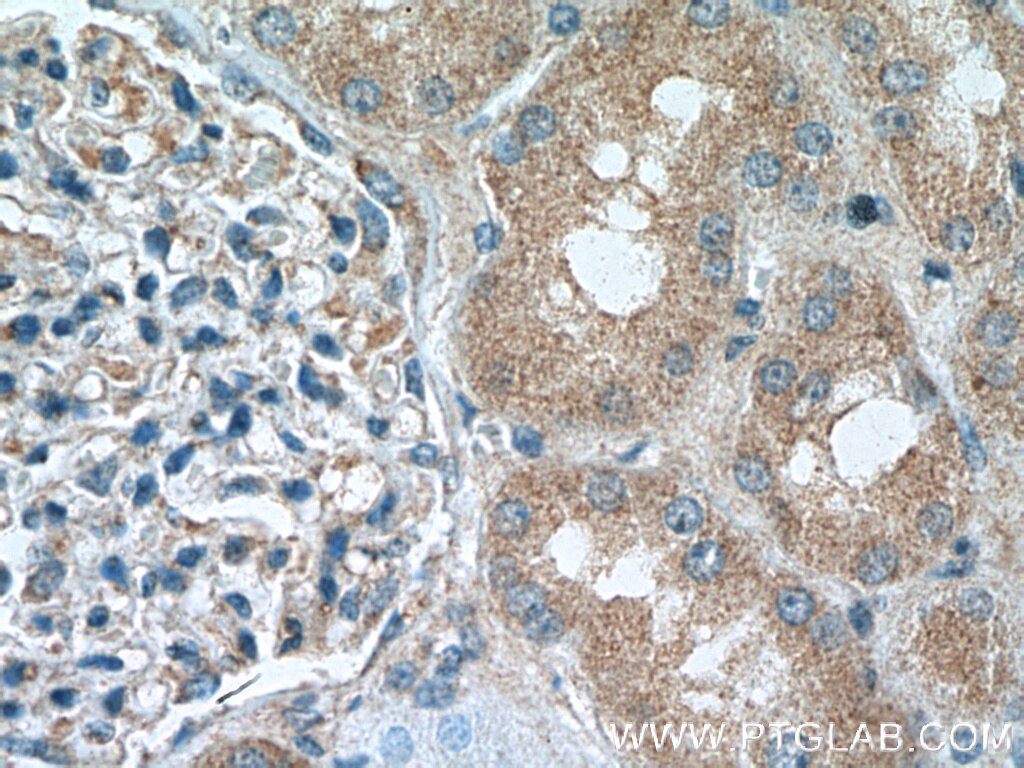
| Positive IHC detected in | human kidney tissue Note: suggested antigen retrieval with TE buffer pH 9.0; (*) Alternatively, antigen retrieval may be performed with citrate buffer pH 6.0 |
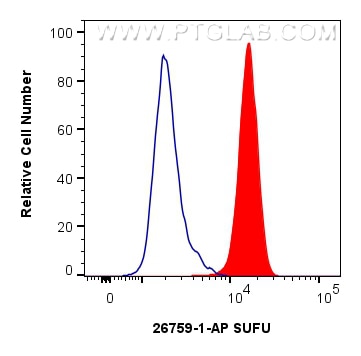
| Positive FC (Intra) detected in | HEK-293 cells |
Recommended dilution
| Application | Dilution |
|---|---|
| Western Blot (WB) | WB : 1:1000-1:4000 |
| Immunoprecipitation (IP) | IP : 0.5-4.0 ug for 1.0-3.0 mg of total protein lysate |
| Immunohistochemistry (IHC) | IHC : 1:50-1:500 |
| Flow Cytometry (FC) (INTRA) | FC (INTRA) : 0.25 ug per 10^6 cells in a 100 µl suspension |
| It is recommended that this reagent should be titrated in each testing system to obtain optimal results. | |
| Sample-dependent, Check data in validation data gallery. | |
Product Information
26759-1-AP targets SUFU in WB, IHC, IF/ICC, FC (Intra), IP, ELISA applications and shows reactivity with human, mouse, rat samples.
| Tested Reactivity | human, mouse, rat |
| Cited Reactivity | human, mouse, rat |
| Host / Isotype | Rabbit / IgG |
| Class | Polyclonal |
| Type | Antibody |
| Immunogen |
CatNo: Ag25200 Product name: Recombinant human SUFU protein Source: e coli.-derived, PET28a Tag: 6*His Domain: 185-454 aa of BC013291 Sequence: MQPVQTPFGVVTFLQIVGVCTEELHSAQQWNGQGILELLRTVPIAGGPWLITDMRRGETIFEIDPHLQERVDKGIETDGSNLSGVSAKCAWDDLSRPPEDDEDSRSICIGTQPRRLSGKDTEQIRETLRRGLEINSKPVLPPINPQRQNGLAHDRAPSRKDSLESDSSTAIIPHELIRTRQLESVHLKFNQESGALIPLCLRGRLLHGRHFTYKSITGDMAITFVSTGVEGAFATEEHPYAAHGPWLQILLTEEFVEKMLEDLEDLTSPE Predict reactive species |
| Full Name | suppressor of fused homolog (Drosophila) |
| Calculated Molecular Weight | 54 kDa |
| Observed Molecular Weight | 50-54 kDa |
| GenBank Accession Number | BC013291 |
| Gene Symbol | SUFU |
| Gene ID (NCBI) | 51684 |
| RRID | AB_2880625 |
| Conjugate | Unconjugated |
| Form | Liquid |
| Purification Method | Antigen affinity purification |
| UNIPROT ID | Q9UMX1 |
| Storage Buffer | PBS with 0.02% sodium azide and 50% glycerol, pH 7.3. |
| Storage Conditions | Store at -20°C. Stable for one year after shipment. Aliquoting is unnecessary for -20oC storage. 20ul sizes contain 0.1% BSA. |
Background Information
Sufu (Suppressor of fused) is a central regulator of Hh (Hedgehog) signaling and acts as a tumor suppressor by maintaining the Gli (Glioma-associated oncogene homolog) transcription factors inactive. Loss of Sufu function promotes tumorigenesis.
Protocols
| Product Specific Protocols | |
|---|---|
| FC protocol for SUFU antibody 26759-1-AP | Download protocol |
| IF protocol for SUFU antibody 26759-1-AP | Download protocol |
| IHC protocol for SUFU antibody 26759-1-AP | Download protocol |
| IP protocol for SUFU antibody 26759-1-AP | Download protocol |
| WB protocol for SUFU antibody 26759-1-AP | Download protocol |
| Standard Protocols | |
|---|---|
| Click here to view our Standard Protocols |
Publications
What published studies show
The SUFU Polyclonal antibody (Cat# 26759-1-AP) has 11 citations published in journals including Theranostics, Leukemia, Cell Reports, J Exp Clin Cancer Res, Phytotherapy Research, Am J Respir Cell Mol Biol, Mol Med Rep, Sci Rep, iScience, and Comput Intell Neurosci. Research fields span Hedgehog signaling, osteoclastogenesis, pituitary adenomas, B-cell lymphoma, pulmonary fibrosis, colorectal cancer, cortical organoid development, pulmonary ionocyte specification, intrauterine growth restriction, cementum apposition, intervertebral disc degeneration, and renal carcinoma.
| Species | Application | Title |
|---|---|---|
Theranostics Genetic and pharmacological activation of Hedgehog signaling inhibits osteoclastogenesis and attenuates titanium particle-induced osteolysis partly through suppressing the JNK/c-Fos-NFATc1 cascade. | ||
J Exp Clin Cancer Res SCP2-mediated cholesterol membrane trafficking promotes the growth of pituitary adenomas via Hedgehog signaling activation. | ||
Leukemia P4HA2 hydroxylates SUFU to regulate the paracrine Hedgehog signaling and promote B-cell lymphoma progression | ||
Phytother Res Ursolic acid inhibits the activation of smoothened-independent non-canonical hedgehog pathway in colorectal cancer by suppressing AKT signaling cascade. | ||
Phytother Res Total flavonoid extract from Dracocephalum moldavica L. improves pulmonary fibrosis by reducing inflammation and inhibiting the hedgehog signaling pathway | ||
Cell Rep The ciliary gene INPP5E confers dorsal telencephalic identity to human cortical organoids by negatively regulating Sonic hedgehog signaling. |
Reviews
What customers say
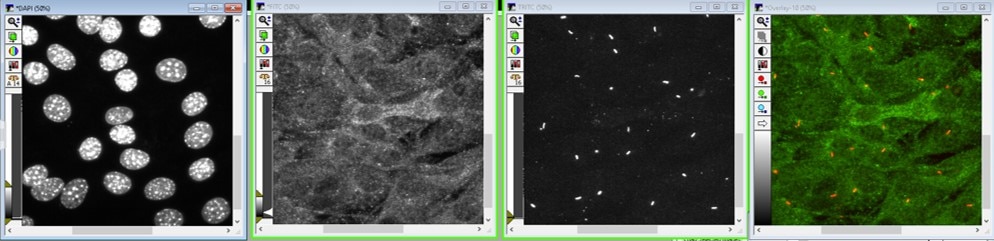
The single review reports a 1-star experience with this antibody for immunofluorescence. The user tested it at 1:250 dilution in NIH-3T3 and IMCD3 cells after PFA and cold methanol fixation, using 1% BSA blocking. While some signal was observed and appeared to overlap with ARL13B staining, the user remained unconvinced because signal persisted in SuFuKO cells (a knockout line), suggesting potential non-specific binding. Overall, the reviewer expressed doubt about the antibody's specificity for the intended target.
The reviews below have been submitted by verified Proteintech customers who received an incentive for providing their feedback.
Charlotte (Verified Customer) (07-15-2024) | I tried immunofluorescence in NIH-3T3 and in IMCD3 cells. I did PFA 4% followed by cold methanol 5min. Then blocking and ab solution in BSA 1%. Surprisingly I obtained some signal and it even overlap with the ARL13B signal! But when I used SuFuKO cells, I still have this signal so I'm not convinced by this antibody. The picture is done in starvation (no ShhN) nuclei-SuFu-ARL13b-Merged
 |








