

Tested Applications
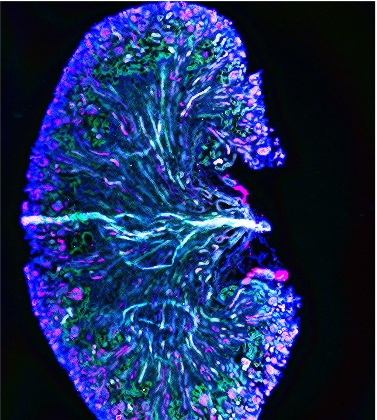
| Positive IF-Fro detected in | mouse kidney tissue |
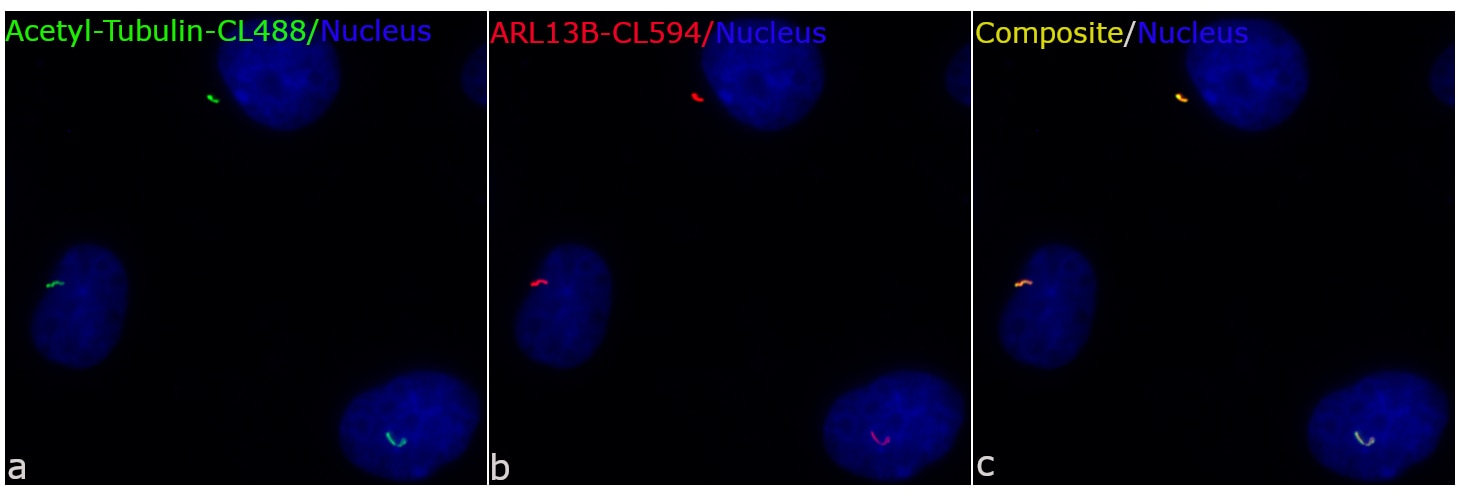
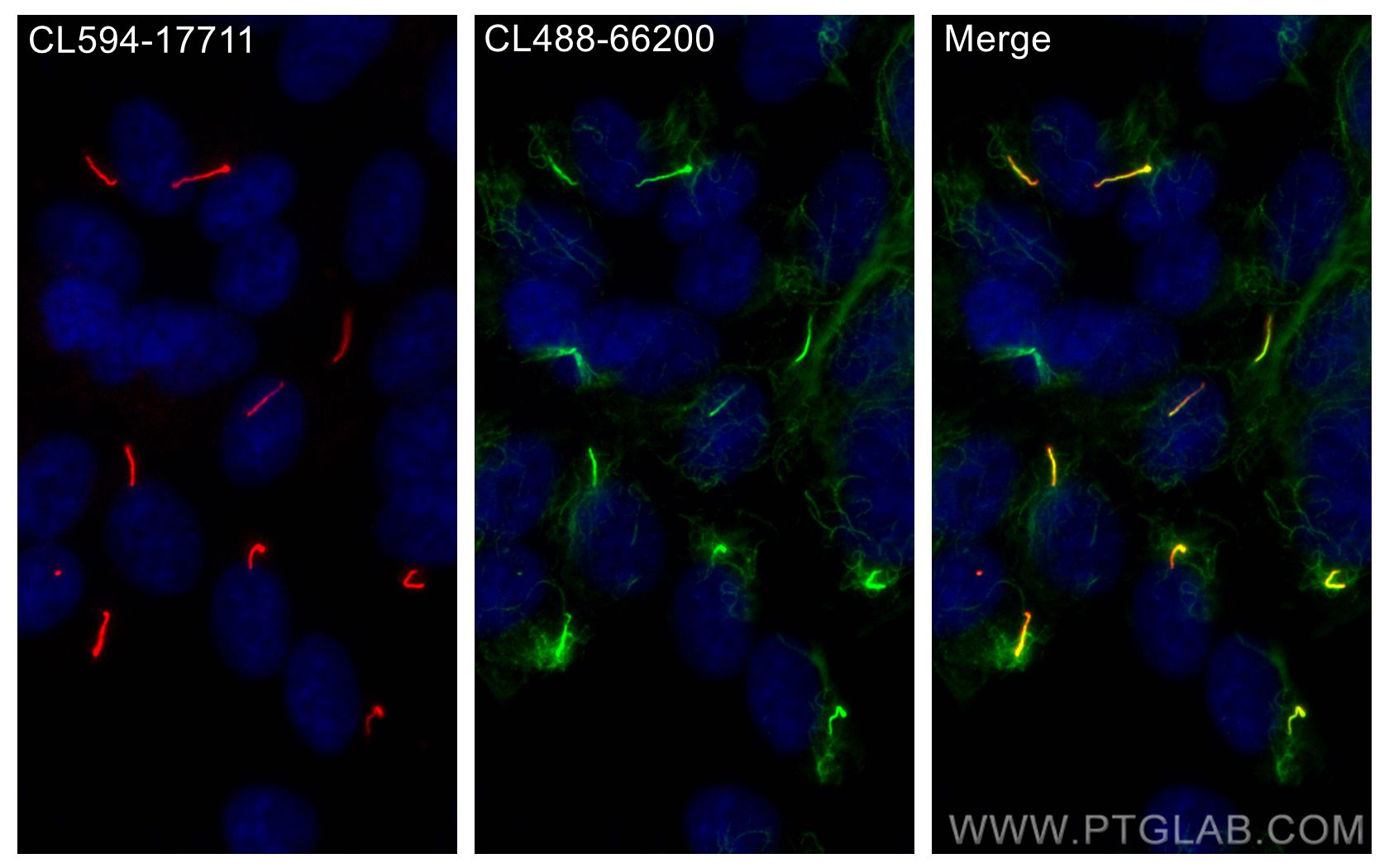
| Positive IF/ICC detected in | MDCK cells, hTERT-RPE1 cells |
Recommended dilution
| Application | Dilution |
|---|---|
| Immunofluorescence (IF)-FRO | IF-FRO : 1:50-1:500 |
| Immunofluorescence (IF)/ICC | IF/ICC : 1:50-1:500 |
| It is recommended that this reagent should be titrated in each testing system to obtain optimal results. | |
| Sample-dependent, Check data in validation data gallery. | |
Product Information
CL488-66200 targets Acetyl-Tubulin (Lys40) in IF/ICC, IF-Fro applications and shows reactivity with human, mouse, rat, pig, canine samples.
| Tested Reactivity | human, mouse, rat, pig, canine |
| Cited Reactivity | human, rat |
| Host / Isotype | Mouse / IgG1 |
| Class | Monoclonal |
| Type | Antibody |
| Immunogen |
Peptide Predict reactive species |
| Full Name | tubulin, alpha 1a |
| Calculated Molecular Weight | 52 kDa |
| GenBank Accession Number | NM_006009 |
| Gene Symbol | Alpha Tubulin |
| Gene ID (NCBI) | 7846 |
| RRID | AB_2883282 |
| Conjugate | CoraLite® Plus 488 Fluorescent Dye |
| Excitation/Emission Maxima Wavelengths | 493 nm / 522 nm |
| Excitation Laser | Blue laser (488 nm) |
| Form | Liquid |
| Purification Method | Protein G purification |
| UNIPROT ID | Q71U36 |
| Storage Buffer | PBS with 50% glycerol, 0.05% Proclin300, 0.5% BSA, pH 7.3. |
| Storage Conditions | Store at -20°C. Avoid exposure to light. Stable for one year after shipment. Aliquoting is unnecessary for -20oC storage. |
Background Information
What is the molecular weight of acetyl-α-tubulin?
The molecular weight of acetylated tubulin is 52 kD.
Where does the acetylation of Lys 40 occur?
This acetylation occurs inside the microtubule lumen by the α-tubulin acetyltransferase 1 (αTAT1) (PMID: 29207274).
How can acetylation be reversed?
Acetylation of Lys 40 can be reversed by deacetylase 6 (HDAC6), which is mostly cytoplasmic that also deacetylates Hsp90, and sirtuin 2 (SIRT2), which also mainly cytoplasmic and uses NAD as a coenzyme. Unlike HDAC6, SIRT uses both polymerized and soluble tubulin as substrates. Deacetylases are believed to be more active on soluble tubulin, while acetylases function preferentially on stable polymers (PMIDs: 29207274, 30079247, 19185337).
What is the function of acetylation?
Acetylation is a conserved post-translational modification of alpha tubulin at Lys 40 during tubulin assembly, and it correlates to increased microtubule stability and intracellular transport (PMIDs: 29207274, 30079247, 20940043).
Is acetylation of α-tubulin strictly associated with stable microtubules?
Not necessarily, as acetylation can have other effects on microtubule subpopulations (PMID 20940043).
Is ac-tubulin found only in cilia?
Acetylated-α-tubulin is located in cytoplasmic tubulin as well as in cilia; therefore, it is not strictly region-specific (PMID: 30079247).
What are the cellular effects of tubulin acetylation?
Microtubule acetylation seems to provide a critical role in neuronal development and function, and while its effect on cancer cells remains unclear, it has been shown that decreased acetylated α-tubulin impairs neuronal cell line migration. The post-translational modification may also help regulate organelle-independent signalling throughout the cell, supporting the notion of a microtubule network serving as a coordinator of cellular signaling (PMIDs: 29207274, 25503560, 20940043, 19185337).
Protocols
| Product Specific Protocols | |
|---|---|
| IF protocol for CL Plus 488 Acetyl-Tubulin (Lys40) antibody CL488-66200 | Download protocol |
| Standard Protocols | |
|---|---|
| Click here to view our Standard Protocols |
Publications
What published studies show
CL488-66200 is the CoraLite® Plus 488-conjugated Acetyl-Tubulin (Lys40) Monoclonal antibody (7E5H8). It has 6 citations published in Frontiers in Bioengineering and Biotechnology, Frontiers in Cell and Developmental Biology, BBA Advances, Journal of Cell Science, American Journal of Physiology—Lung Cellular and Molecular Physiology, and STAR Protocols. Research fields include lung organoid generation, ciliopathy and cilia biology, airway epithelial differentiation, ciliogenesis, and nasal epithelial cell protocols.
| Species | Application | Title |
|---|---|---|
Front Bioeng Biotechnol Upscaling: efficient generation of human lung organoids from induced pluripotent stem cells using a stirring bioreactor. | ||
Front Cell Dev Biol PIH1D3-knockout rats exhibit full ciliopathy features and dysfunctional pre-assembly and loading of dynein arms in motile cilia | ||
BBA Adv The dynamic nature of the coronavirus receptor, angiotensin-converting enzyme 2 (ACE2) in differentiating airway epithelia. | ||
J Cell Sci Importin α regulates ciliogenesis and cilia length with implications for Xenopus nephrogenesis. | ||
Am J Physiol Lung Cell Mol Physiol Protocol For Differentiating Primary Human Small Airway Epithelial Cells at the Air-liquid Interface | ||
STAR Protoc Isolation, expansion, differentiation, and histological processing of human nasal epithelial cells |




