
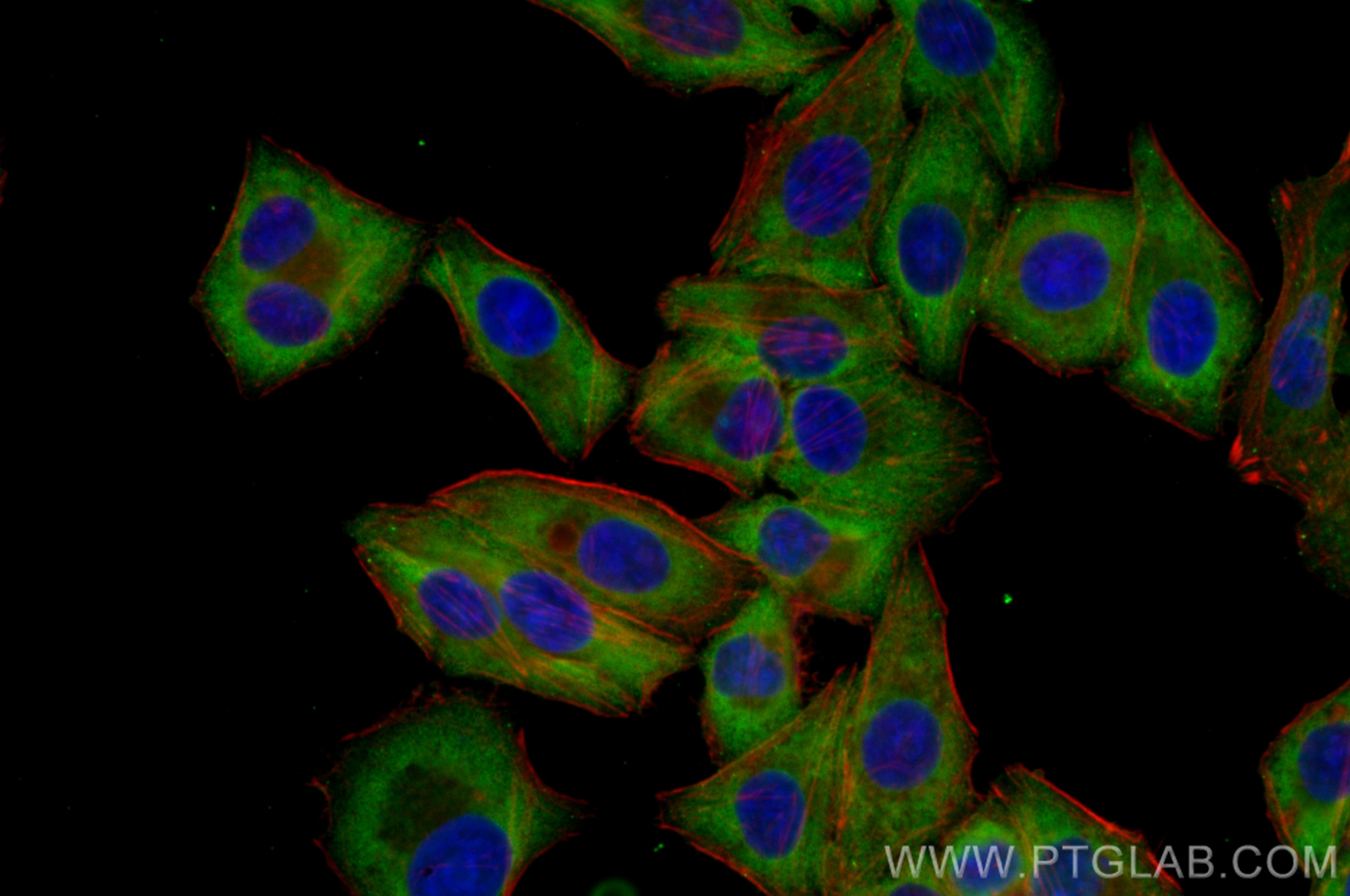

Tested Applications
| Positive IF/ICC detected in | HepG2 cells |
Recommended dilution
| Application | Dilution |
|---|---|
| Immunofluorescence (IF)/ICC | IF/ICC : 1:50-1:500 |
| It is recommended that this reagent should be titrated in each testing system to obtain optimal results. | |
| Sample-dependent, Check data in validation data gallery. | |
Product Information
CL488-66129 targets Arginase-1 in WB, IF/ICC applications and shows reactivity with human, mouse, rat, pig samples.
| Tested Reactivity | human, mouse, rat, pig |
| Cited Reactivity | mouse |
| Host / Isotype | Mouse / IgG1 |
| Class | Monoclonal |
| Type | Antibody |
| Immunogen |
CatNo: Ag8810 Product name: Recombinant human ARG1 protein Source: e coli.-derived, PET28a Tag: 6*His Domain: 1-236 aa of BC005321 Sequence: MSAKSRTIGIIGAPFSKGQPRGGVEEGPTVLRKAGLLEKLKEQECDVKDYGDLPFADIPNDSPFQIVKNPRSVGKASEQLAGKVAEVKKNGRISLVLGGDHSLAIGSISGHARVHPDLGVIWVDAHTDINTPLTTTSGNLHGQPVSFLLKELKGKIPDVPGFSWVTPCISAKDIVYIGLRDVDPGEHYILKTLGIKYFSMTEVTRTVNTAVAITLACFGLAREGNHKPIDYLNPPK Predict reactive species |
| Full Name | arginase, liver |
| Calculated Molecular Weight | 236aa,25 kDa; 322aa,35 kDa |
| GenBank Accession Number | BC005321 |
| Gene Symbol | Arginase-1 |
| Gene ID (NCBI) | 383 |
| RRID | AB_2883268 |
| Conjugate | CoraLite® Plus 488 Fluorescent Dye |
| Excitation/Emission Maxima Wavelengths | 493 nm / 522 nm |
| Excitation Laser | Blue laser (488 nm) |
| Form | Liquid |
| Purification Method | Protein G purification |
| UNIPROT ID | P05089 |
| Storage Buffer | PBS with 50% glycerol, 0.05% Proclin300, 0.5% BSA, pH 7.3. |
| Storage Conditions | Store at -20°C. Avoid exposure to light. Stable for one year after shipment. Aliquoting is unnecessary for -20oC storage. |
Background Information
Arginase-1 (Liver arginase) belongs to the arginase family. ARG1 is a novel immunohistochemical marker of hepatocellular differentiation in fine needle aspiration cytology and a marker of hepatocytes and hepatocellular neoplasms. ARG1 is closely associated with alternative macrophage activation(PMID:12098359) and ARG1 has been shown to protectmotor neurons from trophic factor deprivation and allow sensory neurons to overcome neurite outgrowth inhibition by myelin proteins(PMID: 20071539).It can exsit as a homotrimer(PMID:16141327) and it has 3 isoforms produced by alternative splicing.Defects in ARG1 are the cause of argininemia (ARGIN). Deletion or TNF-mediated restriction of ARG1 unleashes the production of NO by NOS2, which is critical for pathogen control.(PMID:27117406). ARG1 is a novel biomarker of post-stroke immune suppression(2016). The antibody is conjugated with CL488, Ex/Em 488 nm/515 nm.
Protocols
| Product Specific Protocols | |
|---|---|
| IF protocol for CL Plus 488 Arginase-1 antibody CL488-66129 | Download protocol |
| Standard Protocols | |
|---|---|
| Click here to view our Standard Protocols |
Publications
What published studies show
The Arginase-1 Monoclonal Antibody (5D6D12) CoraLite® Plus 488 (CL488-66129) has 7 citations. They appear in Biomaterials, Clinical Cancer Research, International Journal of Biological Macromolecules, Cell Signaling, Bioscience Reports, and Archives of Biochemistry and Biophysics. Research fields span cartilage repair, tumor hypoxia imaging, inflammatory bowel disease, diabetic podocyte injury, atherosclerosis, neuroinflammation/depression, and cancer nanotherapy.
| Species | Application | Title |
|---|---|---|
Biomaterials Self-supported DNA hydrogel facilitates microenvironment remodeling and cartilage repair to prevent osteoarthritis progression via an ambidextrous strategy. | ||
Clin Cancer Res 18F-FMISO PET Imaging Identifies Hypoxia and Immunosuppressive Tumor Microenvironments and Guides Targeted Evofosfamide Therapy in Tumors Refractory to PD-1 and CTLA-4 Inhibition. | ||
Int J Biol Macromol Structural characterization and medium-chain acyl-coenzyme a dehydrogenase-mediated anti-inflammatory mechanism of a Hulless barley Monascus polysaccharide in ulcerative colitis. | ||
Cell Signal M2 macrophage exosomal SBF2-AS1 suppresses NLRP3-mediated pyroptosis to ameliorate high glucose-induced podocyte injury through the miR-650/MDM2/NEK7 axis. | ||
Biosci Rep Reduction of TMAO level enhances the stability of carotid atherosclerotic plaque through promoting macrophage M2 polarization and efferocytosis. | ||
Arch Biochem Biophys AEBP1 targets DDR2 to induce ferroptosis and microglial activation through the STAT3/P53 signaling pathway, exacerbating depression risk. |


