

Tested Applications
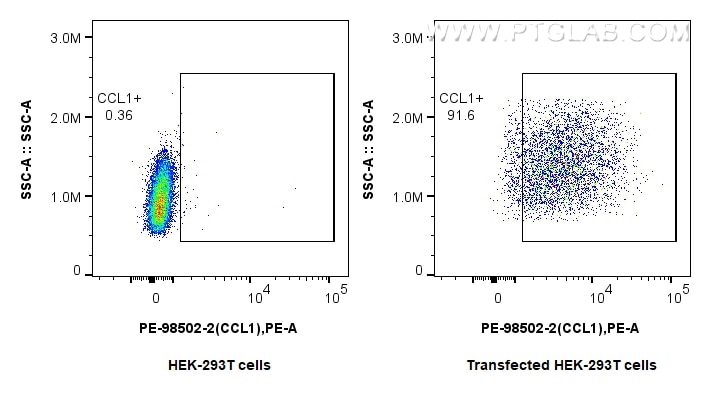
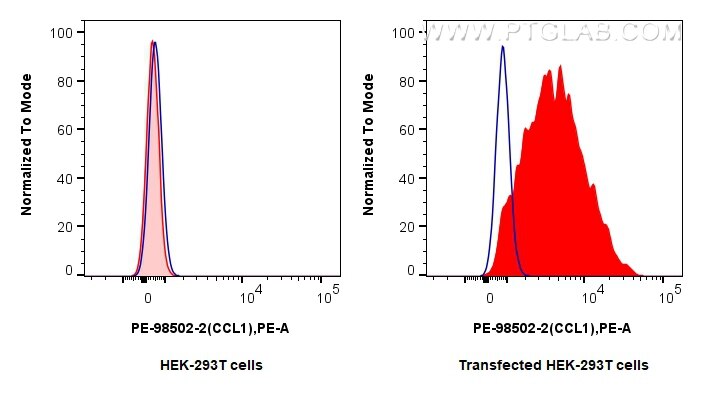
| Positive FC (Intra) detected in | Transfected HEK-293T cells |
Recommended dilution
| Application | Dilution |
|---|---|
| Flow Cytometry (FC) (INTRA) | FC (INTRA) : 0.1 ug per 10^6 cells in a 100 µl suspension |
| This reagent has been tested for flow cytometric analysis. It is recommended that this reagent should be titrated in each testing system to obtain optimal results. | |
| Sample-dependent, Check data in validation data gallery. | |
Product Information
PE-98502-2 targets CCL1 in FC (Intra) applications and shows reactivity with mouse samples.
| Tested Reactivity | mouse |
| Host / Isotype | Rabbit / IgG |
| Class | Recombinant |
| Type | Antibody |
| Immunogen |
CatNo: Eg3293 Product name: Recombinant Mouse CCL1 protein (rFc Tag) Source: mammalian cells-derived, pHZ-KIsec-N-rFc Tag: N-rFc Domain: 24-92 aa of NM_011329.3 Sequence: KSMLTVSNSCCLNTLKKELPLKFIQCYRKMGSSCPDPPAVVFRLNKGRESCASTNKTWVQNHLKKVNPC Predict reactive species |
| Full Name | chemokine (C-C motif) ligand 1 |
| Calculated Molecular Weight | 10KD |
| GenBank Accession Number | NM_011329.3 |
| Gene Symbol | Ccl1 |
| Gene ID (NCBI) | 20290 |
| RRID | AB_3749614 |
| Conjugate | PE Fluorescent Dye |
| Excitation/Emission Maxima Wavelengths | 496 nm, 565 nm / 578 nm |
| Excitation Laser | Blue Laser (488 nm), Green Laser (532 nm), Yellow-Green Laser (561 nm) |
| Form | Liquid |
| Purification Method | Protein A purification |
| UNIPROT ID | P10146-1 |
| Storage Buffer | PBS with 0.09% sodium azide and 0.5% BSA, pH 7.3. |
| Storage Conditions | Store at 2-8°C. Avoid exposure to light. Stable for one year after shipment. |
Background Information
CCL1, also known as I-309 in human or TCA-3 in mice, is a small glycoprotein belonging to the CC chemokine family. It is predominantly expressed by activated T cells, monocytes, and endothelial cells, and primarily acts as a chemoattractant for monocytes and T cells. CCL1 binds to the receptor CCR8, which is expressed on monocytes, neutrophils, and T cells, including within the thymus. This chemokine may perform dual functions: as an inflammatory chemokine during leukocyte migration into inflammatory sites and as a constitutive chemokine during T cell selection in the thymus. Furthermore, CCL1 has been associated with allergic inflammation and the recruitment of Th2 cells, suggesting a role in allergic diseases such as asthma.
Protocols
| Product Specific Protocols | |
|---|---|
| FC protocol for PE CCL1 antibody PE-98502-2 | Download protocol |
| Standard Protocols | |
|---|---|
| Click here to view our Standard Protocols |



