

Tested Applications
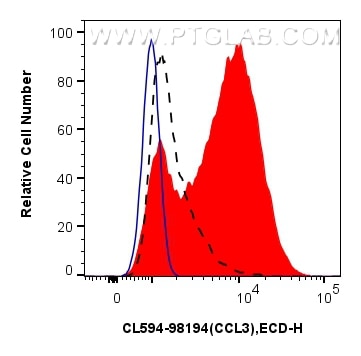
| Positive FC (Intra) detected in | LPS and Brefeldin A treated J774A.1 cells |
Recommended dilution
| Application | Dilution |
|---|---|
| Flow Cytometry (FC) (INTRA) | FC (INTRA) : 0.25 ug per 10^6 cells in a 100 µl suspension |
| This reagent has been tested for flow cytometric analysis. It is recommended that this reagent should be titrated in each testing system to obtain optimal results. | |
| Sample-dependent, Check data in validation data gallery. | |
Product Information
CL594-98194 targets CCL3/MIP-1 alpha in FC (Intra) applications and shows reactivity with mouse samples.
| Tested Reactivity | mouse |
| Host / Isotype | Rabbit / IgG |
| Class | Recombinant |
| Type | Antibody |
| Immunogen |
CatNo: Eg2170 Product name: Recombinant Mouse CCL3 protein (rFc Tag) Source: mammalian cells-derived, pHZ-KIsec-N-rFc Tag: N-rFc Domain: 24-92 aa of NM_011337 Sequence: APYGADTPTACCFSYSRKIPRQFIVDYFETSSLCSQPGVIFLTKRNRQICADSKETWVQEYITDLELNA Predict reactive species |
| Full Name | chemokine (C-C motif) ligand 3 |
| Calculated Molecular Weight | 10kd |
| GenBank Accession Number | NM_011337 |
| Gene Symbol | Ccl3 |
| Gene ID (NCBI) | 20302 |
| RRID | AB_3748370 |
| Conjugate | CoraLite®594 Fluorescent Dye |
| Excitation/Emission Maxima Wavelengths | 588 nm / 604 nm |
| Excitation Laser | Yellow-Green Laser (561 nm) |
| Form | Liquid |
| Purification Method | Protein A purification |
| UNIPROT ID | P10855 |
| Storage Buffer | PBS with 0.09% sodium azide, pH 7.3. |
| Storage Conditions | Store at 2-8°C. Avoid exposure to light. Stable for one year after shipment. |
Background Information
Chemokine (C-C motif) ligand 3 (CCL3), also known as MIP-1α, belongs to the family of chemokines. CCL3 has been found in the central nervous system and its cognate receptors, CCR1 and CCR5, have been reported to be expressed by astrocytes, microglia and neurons. CCL3 and its receptors, CCR1 and CCR5, also contribute to the development of bone disease in multiple myeloma by supporting tumor growth and regulating osteoclast differentiation. CCL3 is also associated with the regulation of cell growth, angiogenesis, and metastasis of different tumors such as melanoma, renal cell carcinoma, and colorectal cancer. Moreover, CCL3 enhances cell migration and metastasis by up-regulating matrix metalloproteinase-2 (MMP)-2 expression in chondrosarcoma cells.
Protocols
| Product Specific Protocols | |
|---|---|
| FC protocol for CL594 CCL3/MIP-1 alpha antibody CL594-98194 | Download protocol |
| Standard Protocols | |
|---|---|
| Click here to view our Standard Protocols |


