
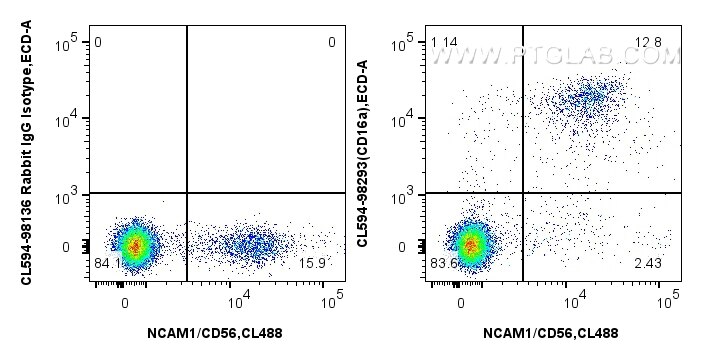
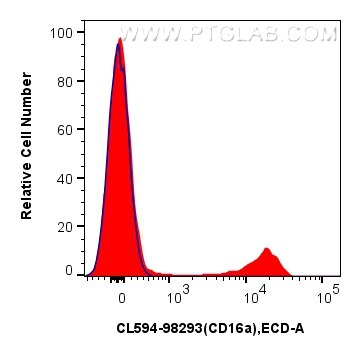

Tested Applications
| Positive FC detected in | human PBMCs |
Recommended dilution
| Application | Dilution |
|---|---|
| Flow Cytometry (FC) | FC : 5 ul per 10^6 cells in a 100 µl suspension |
| This reagent has been pre-titrated and tested for flow cytometric analysis. The suggested use of this reagent is 5 ul per 10^6 cells in a 100 µl suspension or 5 ul per 100 µl of whole blood. | |
| Sample-dependent, Check data in validation data gallery. | |
Product Information
CL594-98293 targets CD16a in FC applications and shows reactivity with human samples.
| Tested Reactivity | human |
| Host / Isotype | Rabbit / IgG |
| Class | Recombinant |
| Type | Antibody |
| Immunogen |
CatNo: Eg2488 Product name: recombinant human CD16a protein Source: mammalian cells-derived, pHZ-KIsec-C-6*HIS Tag: C-6*HIS Sequence: Predict reactive species |
| Full Name | Fc fragment of IgG, low affinity IIIa, receptor (CD16a) |
| Calculated Molecular Weight | 29 kDa |
| Gene Symbol | CD16a |
| Gene ID (NCBI) | 2214 |
| ENSEMBL Gene ID | ENSG00000203747 |
| RRID | AB_3748431 |
| Conjugate | CoraLite®594 Fluorescent Dye |
| Excitation/Emission Maxima Wavelengths | 588 nm / 604 nm |
| Excitation Laser | Yellow-Green Laser (561 nm) |
| Form | Liquid |
| Purification Method | Protein A purification |
| Storage Buffer | PBS with 0.09% sodium azide and 0.5% BSA, pH 7.3. |
| Storage Conditions | Store at 2-8°C. Avoid exposure to light. Stable for one year after shipment. |
Background Information
CD16 is a 50-70-kDa low affinity Fc receptor found on the surface of natural killer cells, neutrophil polymorphonuclear leukocytes, monocytes and macrophages. CD16 mediates antibody-dependent cellular cytotoxicity (ADCC) and other antibody-dependent responses, such as phagocytosis. CD16 has been identified as Fc receptors FcγRIIIa (CD16a) and FcγRIIIb (CD16b), encoded by two nearly identical genes, FCGR3A and FCGR3B. This antibody is specific for CD16a and does not recognize CD16b.
Protocols
| Product Specific Protocols | |
|---|---|
| FC protocol for CL594 CD16a antibody CL594-98293 | Download protocol |
| Standard Protocols | |
|---|---|
| Click here to view our Standard Protocols |



