

Tested Applications
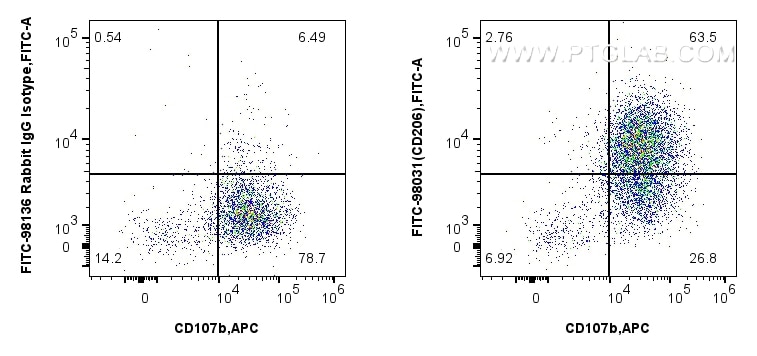
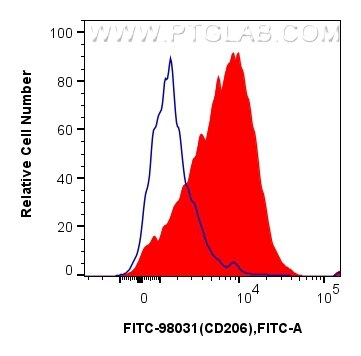
| Positive FC detected in | mouse peritoneal macrophages |
Recommended dilution
| Application | Dilution |
|---|---|
| Flow Cytometry (FC) | FC : 0.25 ug per 10^6 cells in a 100 µl suspension |
| This reagent has been tested for flow cytometric analysis. It is recommended that this reagent should be titrated in each testing system to obtain optimal results. | |
| Sample-dependent, Check data in validation data gallery. | |
Product Information
FITC-98031 targets CD206 in IF, FC applications and shows reactivity with mouse samples.
| Tested Reactivity | mouse |
| Cited Reactivity | human, mouse |
| Host / Isotype | Rabbit / IgG |
| Class | Recombinant |
| Type | Antibody |
| Immunogen |
CatNo: Eg0790 Product name: Recombinant mouse MMR/CD206 protein Source: mammalian cells-derived, pHZ-KIsec-C-6*HIS Tag: C-6*HIS Domain: 23-1388 aa of NM_008625.2 Sequence: RQFLIYNEDHKRCVDALSAISVQTATCNPEAESQKFRWVSDSQIMSVAFKLCLGVPSKTDWASVTLYACDSKSEYQKWECKNDTLFGIKGTELYFNYGNRQEKNIKLYKGSGLWSRWKVYGTTDDLCSRGYEAMYSLLGNANGAVCAFPFKFENKWYADCTSAGRSDGWLWCGTTTDYDKDKLFGFCPLHFEGSERLWNKDPLTGILYQINSKSALTWHQARASCKQQNADLLSVTEIHEQMYLTGLTSSLSSGLWIGLNSLSVRSGWQWAGGSPFRYLNWLPGSPSSEPGKSCVSLNPGKNAKWENLECVQKLGYICKKGNNTLNPFIIPSASDVPTGCPNQWWPYAGHCYRIHREEKKIQKYALQACRKEGGDLASIHSIEEFDFIFSQLGYEPNDELWIGLNDIKIQMYFEWSDGTPVTFTKWLPGEPSHENNRQEDCVVMKGKDGYWADRACEQPLGYICKMVSQSHAVVPEGADKGCRKGWKRHGFYCYLIGSTLSTFTDANHTCTNEKAYLTTVEDRYEQAFLTSLVGLRPEKYFWTGLSDVQNKGTFRWTVDEQVQFTHWNADMPGRKAGCVAMKTGVAGGLWDVLSCEEKAKFVCKHWAEGVTRPPEPTTTPEPKCPENWGTTSKTSMCFKLYAKGKHEKKTWFESRDFCKAIGGELASIKSKDEQQVIWRLITSSGSYHELFWLGLTYGSPSEGFTWSDGSPVSYENWAYGEPNNYQNVEYCGELKGDPGMSWNDINCEHLNNWICQIQKGKTLLPEPTPAPQDNPPVTADGWVIYKDYQYYFSKEKETMDNARAFCKKNFGDLATIKSESEKKFLWKYINKNGGQSPYFIGMLISMDKKFIWMDGSKVDFVAWATGEPNFANDDENCVTMYTNSGFWNDINCGYPNNFICQRHNSSINATAMPTTPTTPGGCKEGWHLYKNKCFKIFGFANEEKKSWQDARQACKGLKGNLVSIENAQEQAFVTYHMRDSTFNAWTGLNDINAEHMFLWTAGQGVHYTNWGKGYPGGRRSSLSYEDADCVVVIGGNSREAGTWMDDTCDSKQGYICQTQTDPSLPVSPTTTPKDGFVTYGKSSYSLMKLKLPWHEAETYCKDHTSLLASILDPYSNAFAWMKMHPFNVPIWIALNSNLTNNEYTWTDRWRVRYTNWGADEPKLKSACVYMDVDGYWRTSYCNESFYFLCKKSDEIPATEPPQLPGKCPESEQTAWIPFYGHCYYFESSFTRSWGQASLECLRMGASLVSIETAAESSFLSYRVEPLKSKTNFWIGMFRNVEGKWLWLNDNPVSFVNWKTGDPSGERNDCVVLASSSGLWNNIHCSSYKGFICKMPKIIDPVTTHSSITTKADQRKMDPQPKGSSKA Predict reactive species |
| Full Name | mannose receptor, C type 1 |
| Calculated Molecular Weight | 165 kDa |
| GenBank Accession Number | NM_008625.2 |
| Gene Symbol | CD206 |
| Gene ID (NCBI) | 17533 |
| RRID | AB_3749321 |
| Conjugate | FITC Plus Fluorescent Dye |
| Excitation/Emission Maxima Wavelengths | 495 nm / 524 nm |
| Excitation Laser | Blue laser (488 nm) |
| Form | Liquid |
| Purification Method | Protein A purification |
| UNIPROT ID | Q2HZ94 |
| Storage Buffer | PBS with 0.09% sodium azide, pH 7.3. |
| Storage Conditions | Store at 2-8°C. Avoid exposure to light. Stable for one year after shipment. |
Background Information
CD206, also named as MMR, CLEC13D and MRC1, is a type I membrane receptor that mediates the endocytosis of glycoproteins by macrophages. CD206 has been shown to bind high-mannose structures on the surface of potentially pathogenic viruses, bacteria, and fungi so that they can be neutralized by phagocytic engulfment. CD206 is a 170 kDa transmembrane protein which contains 5 domains: an amino-terminal cysteine-rich region, a fibronectin type II repeat, a series of eight tandem lectin-like carbohydrate recognition domains (responsible for the recognition of mannose and fucose), a transmembrane domain, and an intracellular carboxy-terminal tail. It is expressed on most tissue macrophages, in vitro derived dendritic cells, lymphatic and sinusoidal endothelia.
Protocols
| Product Specific Protocols | |
|---|---|
| FC protocol for FITC Plus CD206 antibody FITC-98031 | Download protocol |
| Standard Protocols | |
|---|---|
| Click here to view our Standard Protocols |
Publications
What published studies show
FITC-98031 is the Anti-Mouse CD206 Rabbit Recombinant Antibody (clone 240344D12). It has 6 total citations published in Advanced Science, International Journal of Biological Macromolecules, Annals of Medicine, Immunobiology, Frontiers in Genetics, and Biomaterials. The research fields span wound healing and infection treatment, macrophage polarization (M1/M2), tumor microenvironment immunosuppression in esophageal and liver cancers, and bone repair immunomodulation. Applications cited include flow cytometry and immunofluorescence.
| Species | Application | Title |
|---|---|---|
Adv Sci (Weinh) SMart Nanoparticle-Hydrogel Hybrid System for Synergistic Eradication of Infection and Promotion of Wound Healing. | ||
Int J Biol Macromol Metal polyphenol double-network hydrogels based on chitosan/hyaluronic acid loaded with rosmarinic acid promote the healing and repair of infected wounds. | ||
Ann Med Exosomal delivery of METTL3 promotes M1 macrophage polarization by inducing miR-155-5p maturation via m6A modification. | ||
Immunobiology BCL3 drives an immunosuppressive tumor microenvironment in esophageal cancer by promoting M2 macrophage polarization via STAT3 activation. | ||
Front Genet FOXP1 transcriptionally activates NUSAP1 to induce M2 polarization of tumor-associated macrophages via glycolysis in hepatocellular carcinoma. | ||
Biomaterials Triple gene-knockout xenogeneic bone repair material achieves synergistic optimization of bone repair immunomicroenvironment and bone regeneration via antigen-immunity-inflammation axis modulation. |



