
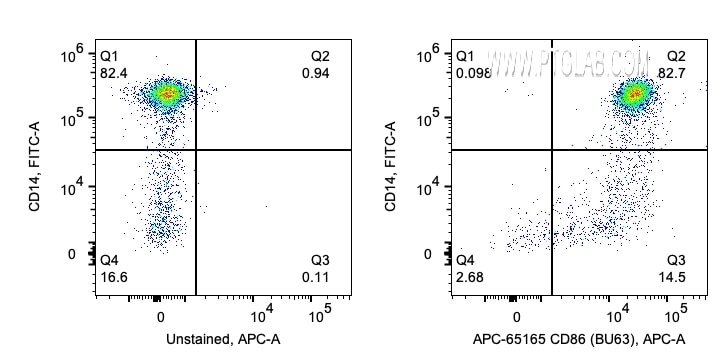
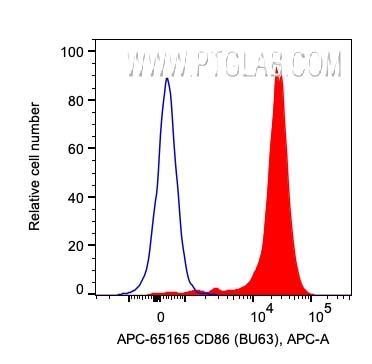

Tested Applications
| Positive FC detected in | human PBMCs |
Recommended dilution
| Application | Dilution |
|---|---|
| Flow Cytometry (FC) | FC : 5 ul per 10^6 cells in 100 μl suspension |
| This reagent has been pre-titrated and tested for flow cytometric analysis. The suggested use of this reagent is 5 µl per 10^6 cells in a 100 µl suspension or 5 µl per 100 µl of whole blood. | |
| Sample-dependent, Check data in validation data gallery. | |
Product Information
APC-65165 targets CD86 in IF, FC applications and shows reactivity with human samples.
| Tested Reactivity | human |
| Cited Reactivity | human |
| Host / Isotype | Mouse / IgG1, kappa |
| Class | Monoclonal |
| Type | Antibody |
| Immunogen |
B-lymphoblastoid cell line ARH 77 Predict reactive species |
| Full Name | CD86 molecule |
| Calculated Molecular Weight | 329 aa, 38 kDa |
| GenBank Accession Number | BC040261 |
| Gene Symbol | CD86 |
| Gene ID (NCBI) | 942 |
| ENSEMBL Gene ID | ENSG00000114013 |
| RRID | AB_2883037 |
| Conjugate | APC Fluorescent Dye |
| Excitation/Emission Maxima Wavelengths | 650 nm / 660 nm |
| Excitation Laser | Red Laser (633 nm) |
| Form | Liquid |
| Purification Method | The purified antibody is conjugated with allophycocyanin (APC) under optimum conditions. The conjugate is purified by size-exclusion chromatography. |
| UNIPROT ID | P42081 |
| Storage Buffer | PBS with 0.09% sodium azide, pH 7.3. |
| Storage Conditions | Store at 2-8°C. Avoid exposure to light. Stable for one year after shipment. |
Background Information
CD86 (also known as B7.2) is a costimulatory molecule belonging to the immunoglobulin superfamily. Primarily expressed on antigen-presenting cells (APCs), including B cells, dendritic cells, and macrophages, CD86 is the ligand for two proteins at the cell surface of T cells, CD28 antigen and cytotoxic T-lymphocyte-associated protein 4. Binding of CD86 with CD28 antigen is a costimulatory signal for activation of the T-cell. Binding of CD86 with cytotoxic T-lymphocyte-associated protein 4 negatively regulates T-cell activation and diminishes the immune response.
Protocols
| Product Specific Protocols | |
|---|---|
| FC protocol for APC CD86 antibody APC-65165 | Download protocol |
| Standard Protocols | |
|---|---|
| Click here to view our Standard Protocols |
Publications
What published studies show
The Anti-Human CD86 (BU63) antibody (APC-65165) has 10 citations. They appear in journals including Advanced Science, Cell Death & Disease, Cancer Letters, Materials Today Bio, Cell Death Discovery, Frontiers in Immunology, Journal of Ethnopharmacology, Journal of Agricultural and Food Chemistry, Inflammation, and Clinical and Experimental Pharmacology and Physiology. Research fields span periodontitis, cancer (pancreatic, colorectal, breast, hepatocellular), macrophage polarization, immunotherapy, and rheumatoid arthritis.
| Species | Application | Title |
|---|---|---|
Adv Sci (Weinh) Senescent Fibroblasts Drive FAP/OLN Imbalance Through mTOR Signaling to Exacerbate Inflammation and Bone Resorption in Periodontitis | ||
Cell Death Dis Tumor-derived exosomal CCT6A serves as a matchmaker introducing chemokines to tumor-associated macrophages in pancreatic ductal adenocarcinoma | ||
Cancer Lett Targeting C/EBPβ/SCD1/C16:1 loop-driven macrophage M2 polarization by Bruceine D improves anti-PD-1 immunotherapy in colorectal cancer. | ||
Mater Today Bio A MnO2-based tumor-seeking nanoplatform for enhanced chemoimmunotherapy against 4T1 breast cancer | ||
Cell Death Discov A positive feedback loop: RAD18-YAP-TGF-β between triple-negative breast cancer and macrophages regulates cancer stemness and progression. | ||
Front Immunol Identification of a distinct cluster of GDF15high macrophages induced by in vitro differentiation exhibiting anti-inflammatory activities |
Reviews
What customers say
One customer rated this antibody 5 stars for flow cytometry on THP-1 cells. They used 5 µL per 100 µL sample (approximately 4–5 × 10⁵ cells) and reported consistent, reliable performance across multiple runs. The antibody worked well as a single stain, and samples could be analyzed within one hour without fixation. Overall, the reviewer found the product to be dependable and easy to use in their workflow.
The reviews below have been submitted by verified Proteintech customers who received an incentive for providing their feedback.
Julie (Verified Customer) (08-26-2025) | Used at 5uL per 100uL sample containing approximately 4-5 x 10^5 cells, has worked well every time. Used as a single stain and samples ran within one hour without fixing.
|



