
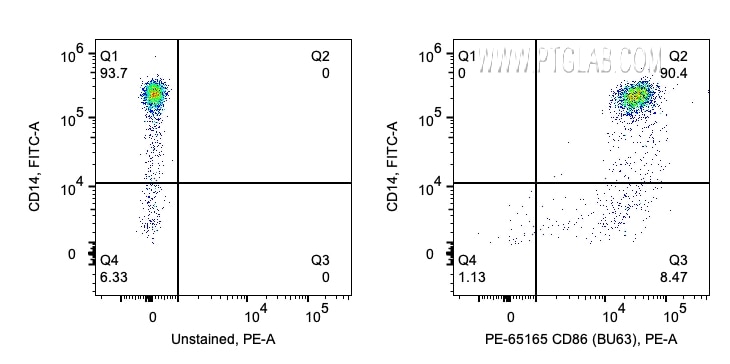
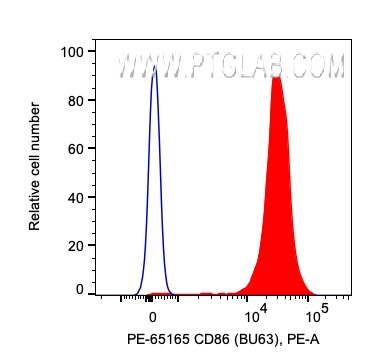

Tested Applications
| Positive FC detected in | human PBMCs |
Recommended dilution
| Application | Dilution |
|---|---|
| Flow Cytometry (FC) | FC : 5 ul per 10^6 cells in 100 μl suspension |
| This reagent has been pre-titrated and tested for flow cytometric analysis. The suggested use of this reagent is 5 µl per 10^6 cells in a 100 µl suspension or 5 µl per 100 µl of whole blood. | |
| Sample-dependent, Check data in validation data gallery. | |
Product Information
PE-65165 targets CD86 in FC applications and shows reactivity with Human samples.
| Tested Reactivity | Human |
| Cited Reactivity | human, mouse |
| Host / Isotype | Mouse / IgG1, kappa |
| Class | Monoclonal |
| Type | Antibody |
| Immunogen |
B-lymphoblastoid cell line ARH 77 Predict reactive species |
| Full Name | CD86 molecule |
| Calculated Molecular Weight | 329 aa, 38 kDa |
| GenBank Accession Number | BC040261 |
| Gene Symbol | CD86 |
| Gene ID (NCBI) | 942 |
| ENSEMBL Gene ID | ENSG00000114013 |
| RRID | AB_2883943 |
| Conjugate | PE Fluorescent Dye |
| Excitation/Emission Maxima Wavelengths | 496 nm, 565 nm / 578 nm |
| Excitation Laser | Blue Laser (488 nm), Green Laser (532 nm), Yellow-Green Laser (561 nm) |
| Form | Liquid |
| Purification Method | The purified antibody is conjugated with R-phycoerythrin (PE) under optimum conditions. The conjugate is purified by size-exclusion chromatography. |
| UNIPROT ID | P42081 |
| Storage Buffer | PBS with 0.09% sodium azide and 0.5% BSA, pH 7.3. |
| Storage Conditions | Store at 2-8°C. Avoid exposure to light. Stable for one year after shipment. |
Background Information
CD86 (also known as B7.2) is a costimulatory molecule belonging to the immunoglobulin superfamily. Primarily expressed on antigen-presenting cells (APCs), including B cells, dendritic cells, and macrophages, CD86 is the ligand for two proteins at the cell surface of T cells, CD28 antigen and cytotoxic T-lymphocyte-associated protein 4. Binding of CD86 with CD28 antigen is a costimulatory signal for activation of the T-cell. Binding of CD86 with cytotoxic T-lymphocyte-associated protein 4 negatively regulates T-cell activation and diminishes the immune response.
Protocols
| Product Specific Protocols | |
|---|---|
| FC protocol for PE CD86 antibody PE-65165 | Download protocol |
| Standard Protocols | |
|---|---|
| Click here to view our Standard Protocols |
Publications
What published studies show
PE-65165 is an Anti-Human CD86 (BU63) monoclonal antibody with 11 citations. These appear in journals including Advanced Materials, Research, Materials Today Bio, International Journal of Biological Macromolecules, ACS Applied Materials & Interfaces, Translational Oncology, Scientific Reports, Journal of Biochemical and Molecular Toxicology, Frontiers in Oncology, Discover Oncology, and In Vitro Cell & Developmental Biology – Animal. The research fields span cancer immunotherapy, tumor-associated macrophage polarization, chemoimmunotherapy, and tissue repair.
| Species | Application | Title |
|---|---|---|
Adv Mater Eliminating Radioresistance With a Magnetic Ion-Generator by Simultaneously Augmenting DNA Damage and Diminishing Immunosuppression | ||
Research (Wash D C) Altered Atlas of Exercise-Responsive MicroRNAs Revealing miR-29a-3p Attacks Armored and Cold Tumors and Boosts Anti-B7-H3 Therapy | ||
Mater Today Bio A MnO2-based tumor-seeking nanoplatform for enhanced chemoimmunotherapy against 4T1 breast cancer | ||
Int J Biol Macromol Polyhedral oligomeric silsesquioxane-functionalized carboxymethyl chitin microspheres via irradiation-induced grafting for hemostasis and tissue repair in post-extraction sockets. | ||
ACS Appl Mater Interfaces Tumor-Oriented Delivery of a Dimeric STING Agonist Using an H-Ferritin Nanocage Widens the Therapeutic Window for Cancer Immunotherapy. | ||
Sci Rep CCL8 suppresses ovarian cancer progression via M1 macrophage polarization and NF-κB-mediated apoptosis. |



