
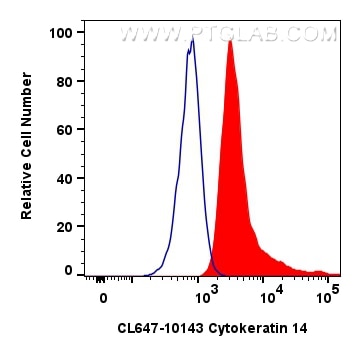

Tested Applications
| Positive FC (Intra) detected in | A431 cells |
Recommended dilution
| Application | Dilution |
|---|---|
| Flow Cytometry (FC) (INTRA) | FC (INTRA) : 0.80 ug per 10^6 cells in a 100 ul suspension |
| It is recommended that this reagent should be titrated in each testing system to obtain optimal results. | |
| Sample-dependent, Check data in validation data gallery. | |
Product Information
CL647-10143 targets Cytokeratin 14 in FC (Intra) applications and shows reactivity with human, mouse, rat samples.
| Tested Reactivity | human, mouse, rat |
| Cited Reactivity | human, mouse |
| Host / Isotype | Rabbit / IgG |
| Class | Polyclonal |
| Type | Antibody |
| Immunogen |
CatNo: Ag0188 Product name: Recombinant human KRT14 protein Source: e coli.-derived, PGEX-4T Tag: GST Domain: 262-472 aa of BC002690 Sequence: GQVGGDVNVEMDAAPGVDLSRILNEMRDQYEKMAEKNRKDAEEWFFTKTEELNREVATNSELVQSGKSEISELRRTMQNLEIELQSQLSMKASLENSLEETKGRYCMQLAQIQEMIGSVEEQLAQLRCEMEQQNQEYKILLDVKTRLEQEIATYRRLLEGEDAHLSSSQFSSGSQSSRDVTSSSRQIRTKVMDVHDGKVVSTHEQVLRTKN Predict reactive species |
| Full Name | keratin 14 |
| Calculated Molecular Weight | 472 aa, 52 kDa |
| Observed Molecular Weight | 47-50 kDa |
| GenBank Accession Number | BC002690 |
| Gene Symbol | Cytokeratin 14 |
| Gene ID (NCBI) | 3861 |
| RRID | AB_2934808 |
| Conjugate | CoraLite® Plus 647 Fluorescent Dye |
| Excitation/Emission Maxima Wavelengths | 654 nm / 674 nm |
| Excitation Laser | Red Laser (633 nm) |
| Form | Liquid |
| Purification Method | Antigen affinity purification |
| UNIPROT ID | P02533 |
| Storage Buffer | PBS with 50% glycerol, 0.05% Proclin300, 0.5% BSA, pH 7.3. |
| Storage Conditions | Store at -20°C. Avoid exposure to light. Stable for one year after shipment. Aliquoting is unnecessary for -20oC storage. |
Background Information
Keratins are a large family of proteins that form the intermediate filament cytoskeleton of epithelial cells, which are classified into two major sequence types. Type I keratins are a group of acidic intermediate filament proteins, including K9-K23, and the hair keratins Ha1-Ha8. Type II keratins are the basic or neutral courterparts to the acidic type I keratins, including K1-K8, and the hair keratins, Hb1-Hb6. Keratin 14 is a type I cytokeratin. It is usually found as a heterotetramer with keratin 5. Keratins K14 and K5 have long been considered to be biochemical markers of the stratified squamous epithelia, including epidermis.
Protocols
| Product Specific Protocols | |
|---|---|
| FC protocol for CL Plus 647 Cytokeratin 14 antibody CL647-10143 | Download protocol |
| Standard Protocols | |
|---|---|
| Click here to view our Standard Protocols |
Publications
What published studies show
Here is a summary of the citations for the CoraLite® Plus 647-conjugated Cytokeratin 14 Polyclonal antibody (Cat. No. CL647-10143):
The antibody has a total of 2 citations. The journals in which they appear are Nature Communications and the International Journal of Molecular Sciences (IJMS). The research fields covered are tongue squamous cell carcinoma, specifically investigating transdifferentiation of tongue muscle cells into cancer-associated fibroblasts, and the role of a truncated TP53 mutation in promoting chemoresistance. Applications cited include immunofluorescence and intracellular flow cytometry.
| Species | Application | Title |
|---|---|---|
Nat Commun Transdifferentiation of tongue muscle cells into cancer-associated fibroblasts in response to tongue squamous cell carcinoma. | ||
Int J Mol Sci A Truncated Mutation of TP53 Promotes Chemoresistance in Tongue Squamous Cell Carcinoma |


