
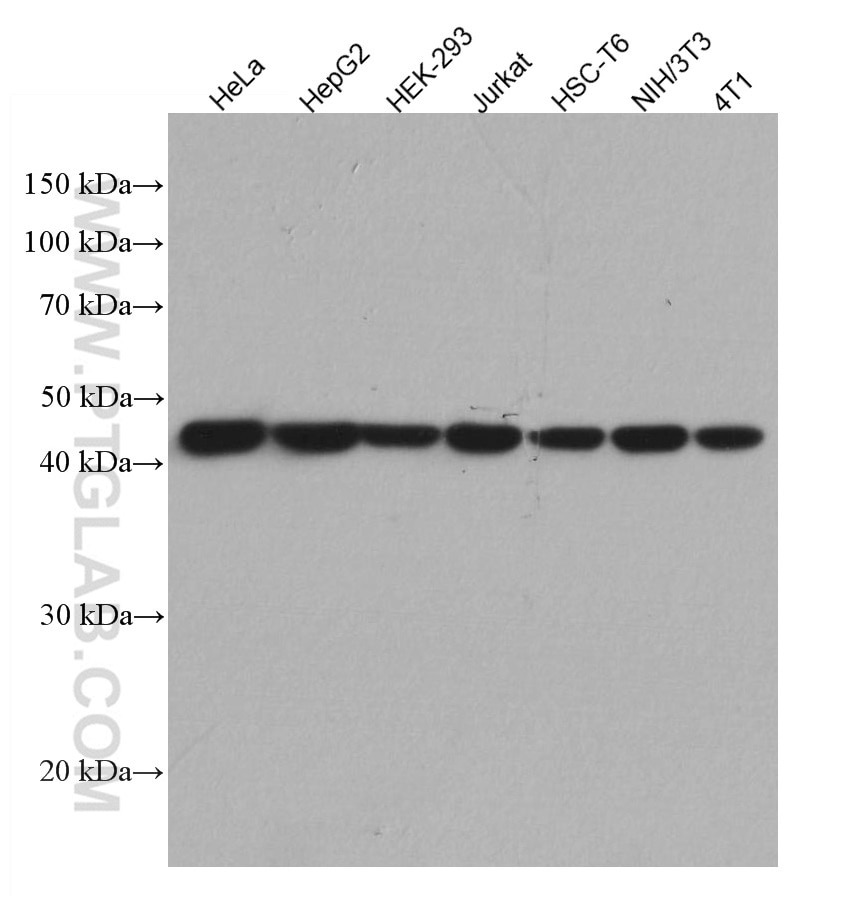
Tested Applications
| Positive WB detected in | Jurkat cells, HeLa cells, HepG2 cells, HEK-293 cells, HSC-T6 cells, NIH/3T3 cells, 4T1 cells |
Recommended dilution
| Application | Dilution |
|---|---|
| Western Blot (WB) | WB : 1:2000-1:50000 |
| It is recommended that this reagent should be titrated in each testing system to obtain optimal results. | |
| Sample-dependent, Check data in validation data gallery. | |
Product Information
HRP-66009 targets Beta Actin in WB applications and shows reactivity with human, mouse, rat, monkey, zebrafish, hamster samples.
| Tested Reactivity | human, mouse, rat, monkey, zebrafish, hamster |
| Cited Reactivity | human, mouse, rat, pig, monkey |
| Host / Isotype | Mouse / IgG2b |
| Class | Monoclonal |
| Type | Antibody |
| Immunogen |
Recombinant protein Predict reactive species |
| Full Name | actin, beta |
| Calculated Molecular Weight | 42 kDa |
| Observed Molecular Weight | 42 kDa |
| GenBank Accession Number | NM_001101 |
| Gene Symbol | Beta Actin |
| Gene ID (NCBI) | 60 |
| RRID | AB_2883836 |
| Conjugate | HRP |
| Form | Liquid |
| Purification Method | Protein A purification |
| UNIPROT ID | P60709 |
| Storage Buffer | PBS with 50% glycerol, 0.05% Proclin300, 0.5% BSA, pH 7.3. |
| Storage Conditions | Store at -20°C. Avoid exposure to light. Stable for one year after shipment. Aliquoting is unnecessary for -20oC storage. |
Background Information
Actins are highly conserved globular proteins that are involved in various types of cell motility and are ubiquitously expressed in all eukaryotic cells. At least six isoforms of actins are known in mammals and other vertebrates. Beta-actin (or β-actin) is a cytoskeletal actin isoform, highly conserved and ubiquitously expressed in eukaryotic organisms, making it a commonly used "housekeeping gene" in many laboratory techniques. It has been widely used as the internal control in RT-PCR and Western Blotting. The isotype of this antibody is IgG2b.
What is the molecular weight of beta-actin?
42 kDa
What is the function of beta-actin?
Actins are a key part of the cytoskeleton and are involved in cell motility, structure, and signaling, with beta-actin as part of the contractile apparatus. Beta-actin is located in the cytoplasm of non-muscle cells, particularly where the plasma membrane meets the cytoskeleton (PMID: 1993736) and is found co-distributed with alpha-actin (PMID: 9490838).
What are the applications for beta-actin?
As it is ubiquitously and constitutively expressed, beta-actin is a useful loading control in techniques such as RT-PCR and Western Blots to measure baseline expression and degradation. Beta-actin can be used as a reference gene to normalize mRNA or protein levels in quantitative studies of expression. Although some evidence suggests variation in tissue types and developing embryos (PMID: 23099774) if expression is stable across conditions, beta-actin is still considered by many to be a suitable gene for normalization.
Beyond its role as a housekeeping gene, it has been shown that beta-actin associates with endothelial nitric-oxide synthase (eNOS) and can therefore regulate nitric oxide activity in endothelial cells (PMID: 12734108).
What are the post-transcriptional modifications (PTMs) to beta actin?
Alterations to actin proteins can modulate their properties and function. While small molecules are known to alter actin, post-translational modifications such as phosphorylation and acetylation can also affect actin (PMID: 23195437). Modifications to actin have been associated with diseases including but not limited to age-related macular degeneration (PMID: 17652714), cardiovascular disease (PMID: 21232667), and Alzheimer's disease (PMID: 11246152).
For murine tissue sample, conjugated antibody (HRP-66009) or rabbit antibody (20536-1-AP) is preferable.
Protocols
| Product Specific Protocols | |
|---|---|
| WB protocol for HRP Beta Actin antibody HRP-66009 | Download protocol |
| Standard Protocols | |
|---|---|
| Click here to view our Standard Protocols |
Publications
What published studies show
| Species | Application | Title |
|---|---|---|
Protein Cell Bilineage embryo-like structure from EPS cells can produce live mice with tetraploid trophectoderm | ||
Nat Commun Cytosine base editors induce off-target mutations and adverse phenotypic effects in transgenic mice | ||
Theranostics Platelets camouflaged nanovehicle improved bladder cancer immunotherapy by triggering pyroptosis | ||
Nat Commun Targeting USP47 overcomes tyrosine kinase inhibitor resistance and eradicates leukemia stem/progenitor cells in chronic myelogenous leukemia. | ||
Bone Res Restoring the dampened expression of the core clock molecule BMAL1 protects against compression-induced intervertebral disc degeneration. |


