

Tested Applications
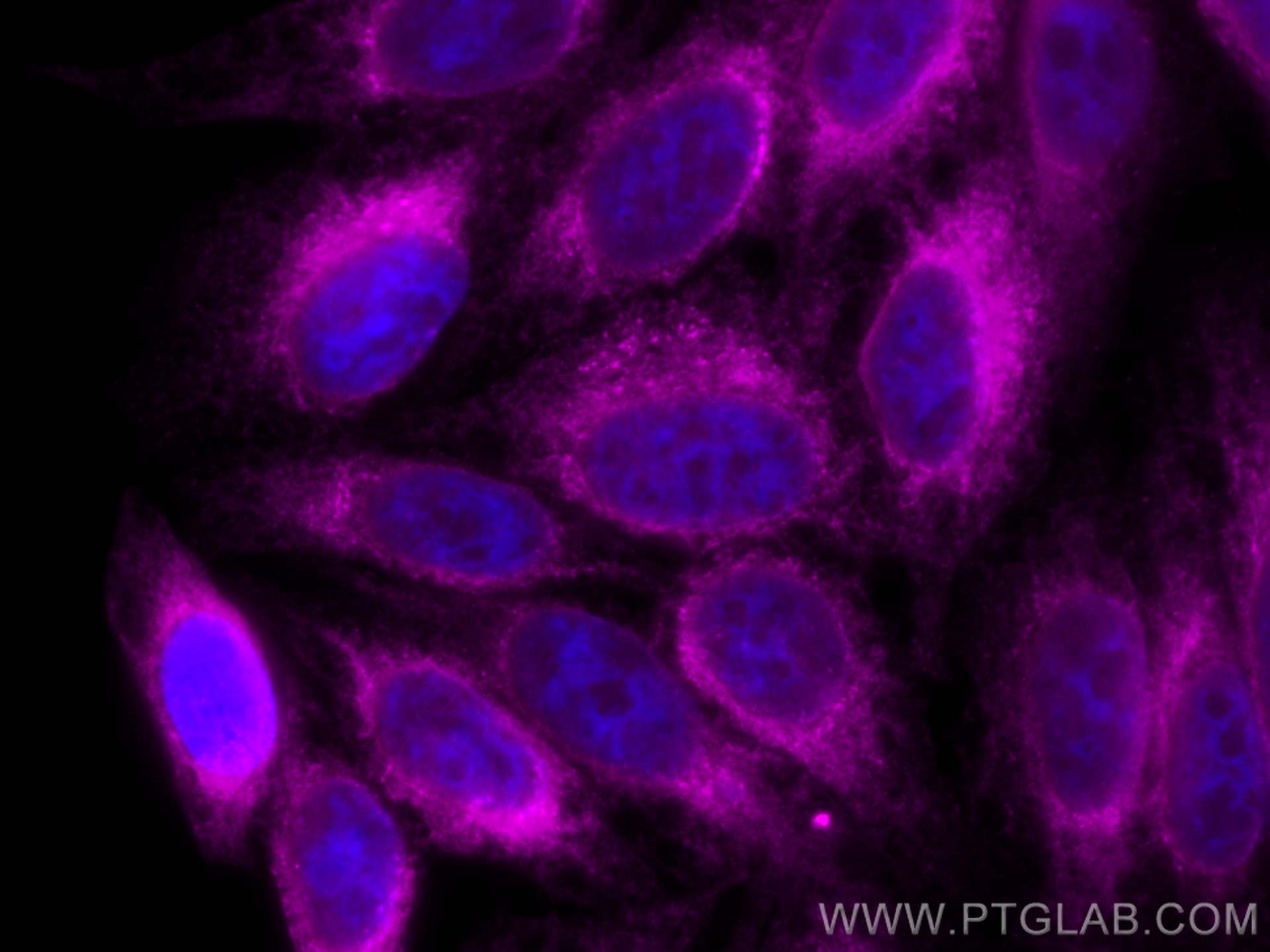
| Positive IF/ICC detected in | HepG2 cells |
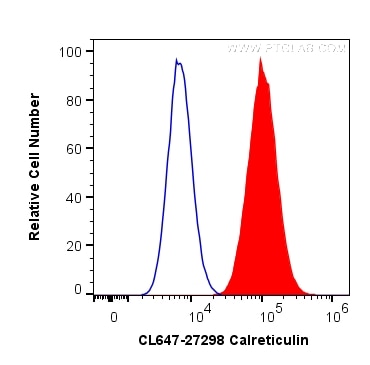
| Positive FC (Intra) detected in | HeLa cells |
Recommended dilution
| Application | Dilution |
|---|---|
| Immunofluorescence (IF)/ICC | IF/ICC : 1:50-1:500 |
| Flow Cytometry (FC) (INTRA) | FC (INTRA) : 0.20 ug per 10^6 cells in a 100 ul suspension |
| It is recommended that this reagent should be titrated in each testing system to obtain optimal results. | |
| Sample-dependent, Check data in validation data gallery. | |
Product Information
CL647-27298 targets calreticulin in IF/ICC, FC (Intra) applications and shows reactivity with human, mouse, rat samples.
| Tested Reactivity | human, mouse, rat |
| Cited Reactivity | human, mouse |
| Host / Isotype | Rabbit / IgG |
| Class | Polyclonal |
| Type | Antibody |
| Immunogen |
CatNo: Ag26064 Product name: Recombinant human calreticulin protein Source: e coli.-derived, PGEX-4T Tag: GST Domain: 248-417 aa of BC002500 Sequence: KKPEDWDEEMDGEWEPPVIQNPEYKGEWKPRQIDNPDYKGTWIHPEIDNPEYSPDPSIYAYDNFGVLGLDLWQVKSGTIFDNFLITNDEAYAEEFGNETWGVTKAAEKQMKDKQDEEQRLKEEEEDKKRKEEEEAEDKEDDEDKDEDEEDEEDKEEDEEEDVPGQAKDEL Predict reactive species |
| Full Name | calreticulin |
| Calculated Molecular Weight | 60 kDa |
| Observed Molecular Weight | 55 kDa |
| GenBank Accession Number | BC002500 |
| Gene Symbol | Calreticulin |
| Gene ID (NCBI) | 811 |
| RRID | AB_2934966 |
| Conjugate | CoraLite® Plus 647 Fluorescent Dye |
| Excitation/Emission Maxima Wavelengths | 654 nm / 674 nm |
| Excitation Laser | Red Laser (633 nm) |
| Form | Liquid |
| Purification Method | Antigen affinity purification |
| UNIPROT ID | P27797 |
| Storage Buffer | PBS with 50% glycerol, 0.05% Proclin300, 0.5% BSA, pH 7.3. |
| Storage Conditions | Store at -20°C. Avoid exposure to light. Stable for one year after shipment. Aliquoting is unnecessary for -20oC storage. |
Background Information
CALR,also named as grp60, ERp60, HACBP, CRP55, CRTC and Calregulin, belongs to the calreticulin family. It is a molecular calcium-binding chaperone promoting folding, oligomeric assembly and quality control in the ER via the calreticulin/calnexin cycle. CALR is a ER marker. It interacts transiently with almost all of the monoglucosylated glycoproteins that are synthesized in the ER. CALR interacts with the DNA-binding domain of NR3C1 and mediates its nuclear export. The MW of CALR migrates aberrantly at 60 kD by SDS-PAGE. Some study provided that it's a new possibility for CRT-mediated tumor immune prevention and treatment.
Protocols
| Product Specific Protocols | |
|---|---|
| FC protocol for CL Plus 647 calreticulin antibody CL647-27298 | Download protocol |
| IF protocol for CL Plus 647 calreticulin antibody CL647-27298 | Download protocol |
| Standard Protocols | |
|---|---|
| Click here to view our Standard Protocols |
Publications
What published studies show
The CoraLite® Plus 647-conjugated calreticulin (CALR) polyclonal antibody (CL647-27298) has 197 citations (based on its parent clone 27298-1-AP). Citations appear in leading journals such as Nature Communications, Signal Transduction & Targeted Therapy, Cell Metabolism, Cell Research, Immunity, Advanced Materials, ACS Nano, Advanced Science, Biomaterials, and the Journal of Nanobiotechnology. Research fields center largely on cancer immunotherapy—immunogenic cell death, ferroptosis, pyroptosis, and cuproptosis—plus nanomedicine/drug delivery, ER stress and calcium signaling, autophagy, and immunogenic tumor-vaccination in mouse and human models.
| Species | Application | Title |
|---|---|---|
ACS Appl Mater Interfaces Coordination Self-Assembly of a Carrier-Free Hyaluronic Acid-Modified Nanoplatform for Augmented Photothermal/Chemodynamic Therapy and Robust Antimetastatic Immunity. | ||
Biomater Adv Localized chemo-immunotherapy for HNSCC via CpG-synergized doxorubicin release from injectable TPGS/Na₂CO₃ hydrogel remodeling tumor immunity. | ||
iScience Ubiquitination and degradation of CD47 enhances macrophage phagocytosis of hemolytic erythrocytes. | ||
Curr Biol BLTP2 bridges the ER and MVB for exosome biogenesis at SCAMP3-dependent ER contacts. |



