
"Rabbit anti-Mouse IgG Antibodies" Comparison
View side-by-side comparison of Rabbit anti-Mouse IgG antibodies from other vendors to find the one that best suits your research needs.

Tested Applications
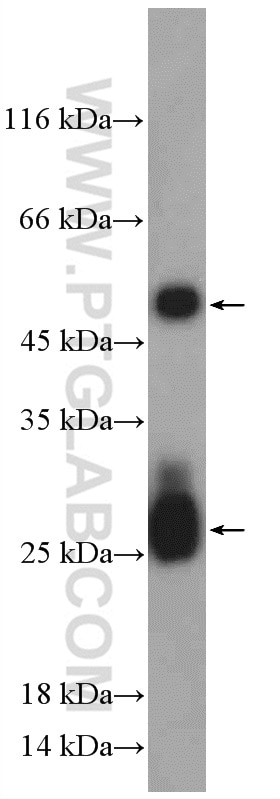
| Positive WB detected in | mouse serum tissue |
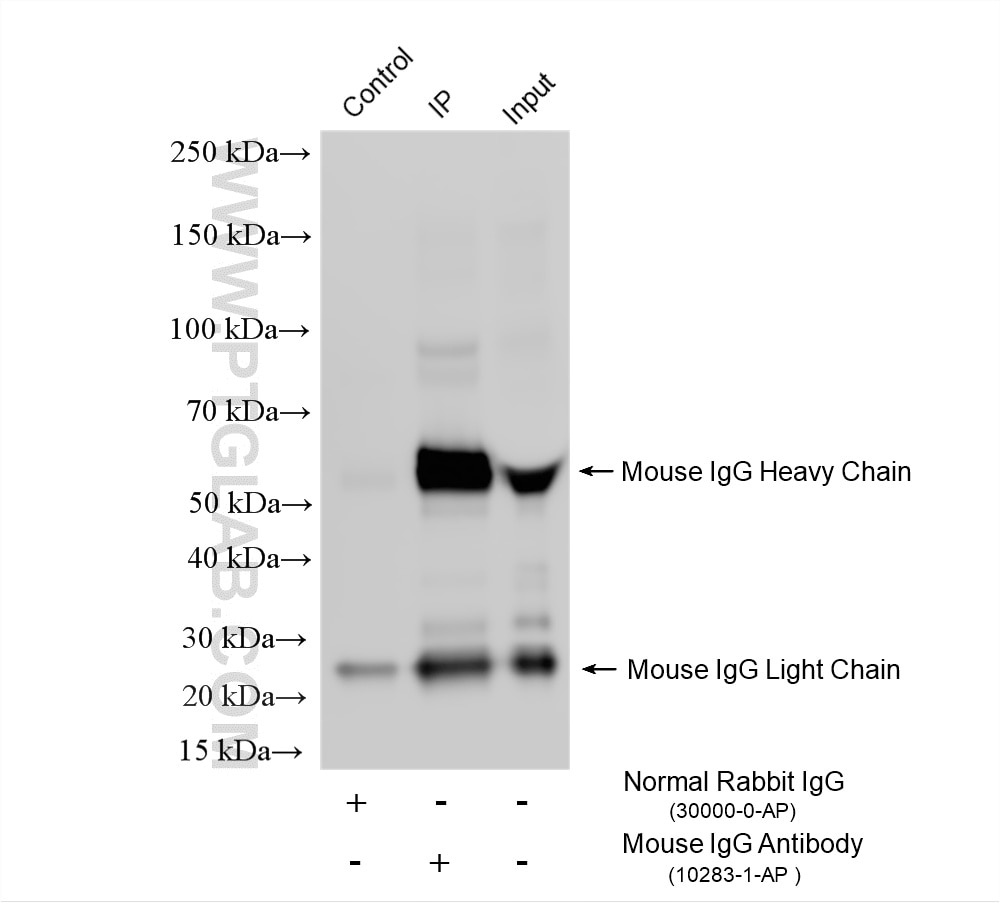
| Positive IP detected in | mouse serum |
Recommended dilution
| Application | Dilution |
|---|---|
| Western Blot (WB) | WB : 1:2000-1:12000 |
| Immunoprecipitation (IP) | IP : 0.5-4.0 ug for 1.0-3.0 mg of total protein lysate |
| It is recommended that this reagent should be titrated in each testing system to obtain optimal results. | |
| Sample-dependent, Check data in validation data gallery. | |
Product Information
10283-1-AP targets Rabbit anti-Mouse IgG in WB, IHC, IP, CoIP, ChIP, RIP, ELISA applications and shows reactivity with mouse samples.
| Tested Reactivity | mouse |
| Cited Reactivity | mouse |
| Host / Isotype | Rabbit / IgG |
| Class | Polyclonal |
| Type | Antibody |
| Immunogen |
Peptide Predict reactive species |
| Full Name | Rabbit anti-Mouse IgG |
| Calculated Molecular Weight | 155 kDa |
| Observed Molecular Weight | 25 kDa, 50-55 kDa |
| Gene Symbol | |
| Gene ID (NCBI) | |
| RRID | AB_2877728 |
| Conjugate | Unconjugated |
| Form | Liquid |
| Purification Method | Antigen affinity purification |
| Storage Buffer | PBS with 0.02% sodium azide and 50% glycerol, pH 7.3. |
| Storage Conditions | Store at -20°C. Stable for one year after shipment. Aliquoting is unnecessary for -20oC storage. 20ul sizes contain 0.1% BSA. |
Background Information
This antibody detectes all the heavy and light chains total mouse IgG.
Protocols
| Product Specific Protocols | |
|---|---|
| WB protocol for Rabbit anti-Mouse IgG antibody 10283-1-AP | Download protocol |
| IP protocol for Rabbit anti-Mouse IgG antibody 10283-1-AP | Download protocol |
| Standard Protocols | |
|---|---|
| Click here to view our Standard Protocols |
Publications
What published studies show
The Rabbit anti-Mouse IgG Polyclonal antibody (Cat# 10283-1-AP) has 44 citations published in journals including Nucleic Acids Research, Journal of Clinical Investigation, Cell Death & Differentiation, Cell Reports, Advanced Science, Journal of Biological Chemistry, and Cancer Science. Research fields span cancer biology (lung, breast, ovarian, colorectal, prostate), epigenetics and chromatin biology, non-coding RNA regulation, fibrosis, circadian biology, immunology, neurology, toxicology, and virology.
| Species | Application | Title |
|---|---|---|
Nucleic Acids Res SCRE serves as a unique synaptonemal complex fastener and is essential for progression of meiosis prophase I in mice. | ||
Nucleic Acids Res An H3K4me3 reader, BAP18 as an adaptor of COMPASS-like core subunits co-activates ERα action and associates with the sensitivity of antiestrogen in breast cancer. | ||
J Clin Invest Excessive collagen type VII mediates pleural fibrosis via increasing extracellular matrix stiffness. | ||
Adv Sci (Weinh) The Circadian Transcription Factor CLOCK Modulates Oxidative Stress Resistance via the ACHL-Relish Axis in Drosophila. | ||
Cell Death Differ KMT2D loss drives adeno-to-squamous transition and sensitizes TKI-resistant lung cancer to AURKA inhibition | ||
Cell Death Dis CDCA8 promotes bladder cancer survival by stabilizing HIF1α expression under hypoxia |



