ChromoTek Nano-Traps
The gold standard in immunoprecipitation
Nano-Traps are the ready-to-use affinity beads for IP that allow for fast and reliable, single-band pulldowns of even low abundance proteins.
-
 No contaminating heavy & light antibody chains or binding proteins
-
High affinity pulldowns of even low abundance proteins
-
Stable under stringent washing conditions
-
Short Incubation Time (30-60 mins)
-
Lowest background in class
-
Recombinant expression
All Nano-Traps
Browse the full Nano-Trap portfolio by target, including fluorescence tags, peptide and epitope tags, solubility tags, and endogenous proteins, with available formats for immunoprecipitation.
Fluorescence Tags
Peptide/Epitope Tags
Solubility Tags
| Nano-Traps | Formats |
|---|---|
| GST-Trap | Agarose |
| MBP-Trap | Agarose |
Endogenous Proteins
Why Nano-Traps outperform conventional antibodies for immunoprecipitation
See how Nano-Traps deliver cleaner results than conventional antibody-based methods — Higher specificity, lower background, no heavy or light chain contamination, and compatibility with stringent washing conditions for immunoprecipitation.
Low background, no extra bands & high specificity will improve your pulldown assay significantly.
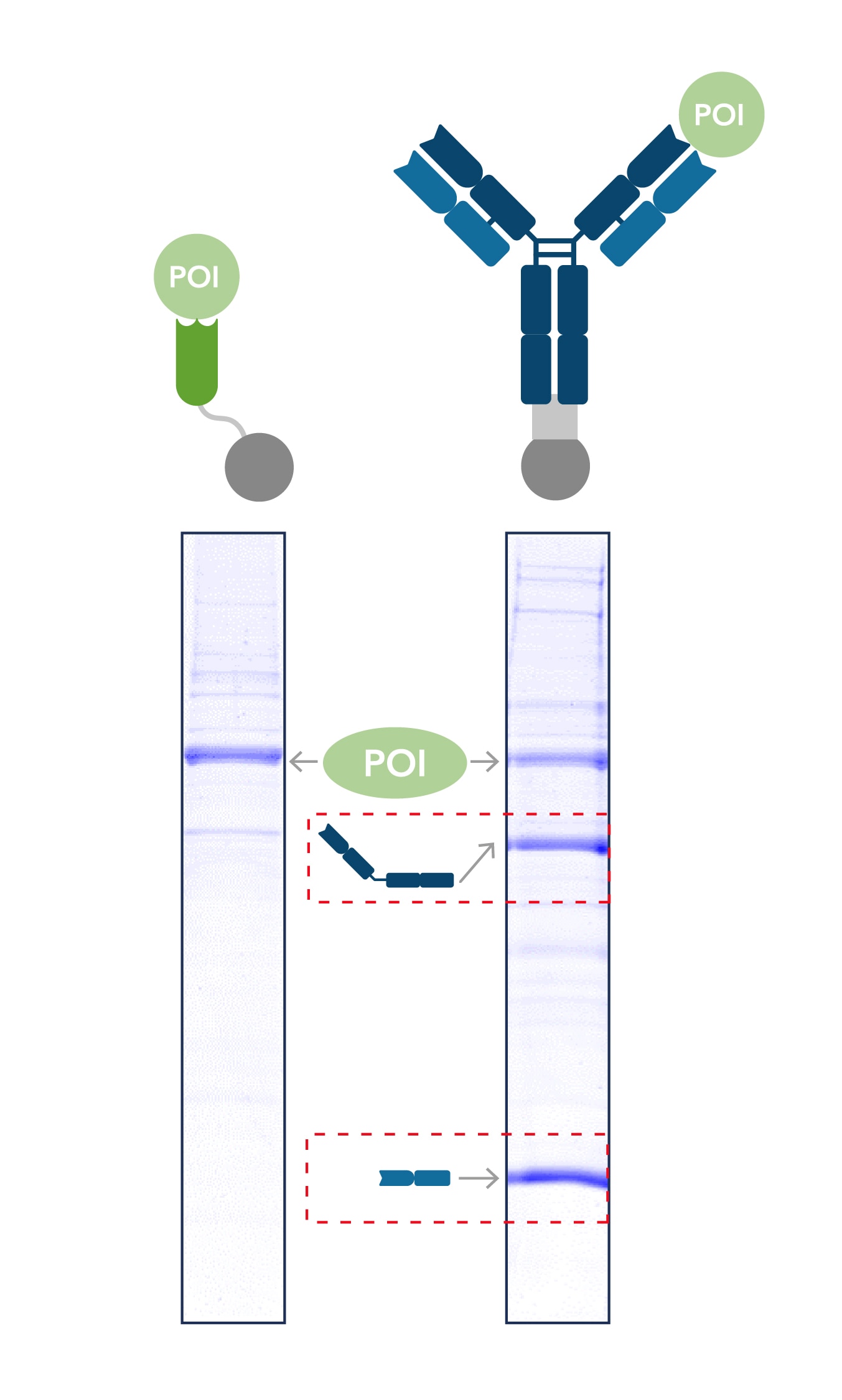
Immunoprecipitation (IP) of a protein of interest (POI) using Nano-Traps (left) compared with a conventional antibodies coupled to Protein A/G beads (right). When using Nano-Traps, the amount of immunoprecipitated POI is higher and the background is reduced in comparison to an IP conducted with the conventional antibody. Nano-Traps also provide pure fractions of immunoprecipitated POI without contamination of heavy and light antibody chains.
Nano-Traps are highly stable in contrast to conventional antibodies. Once bound to their target proteins, very stringent washing conditions can be applied to remove any unwanted proteins as well as reduce background. Additionally, Nano-Traps can also be used in the presence of virtually any lysis buffer, such more specialized ones needed for ubiquitination assays or phosphorylation studies.
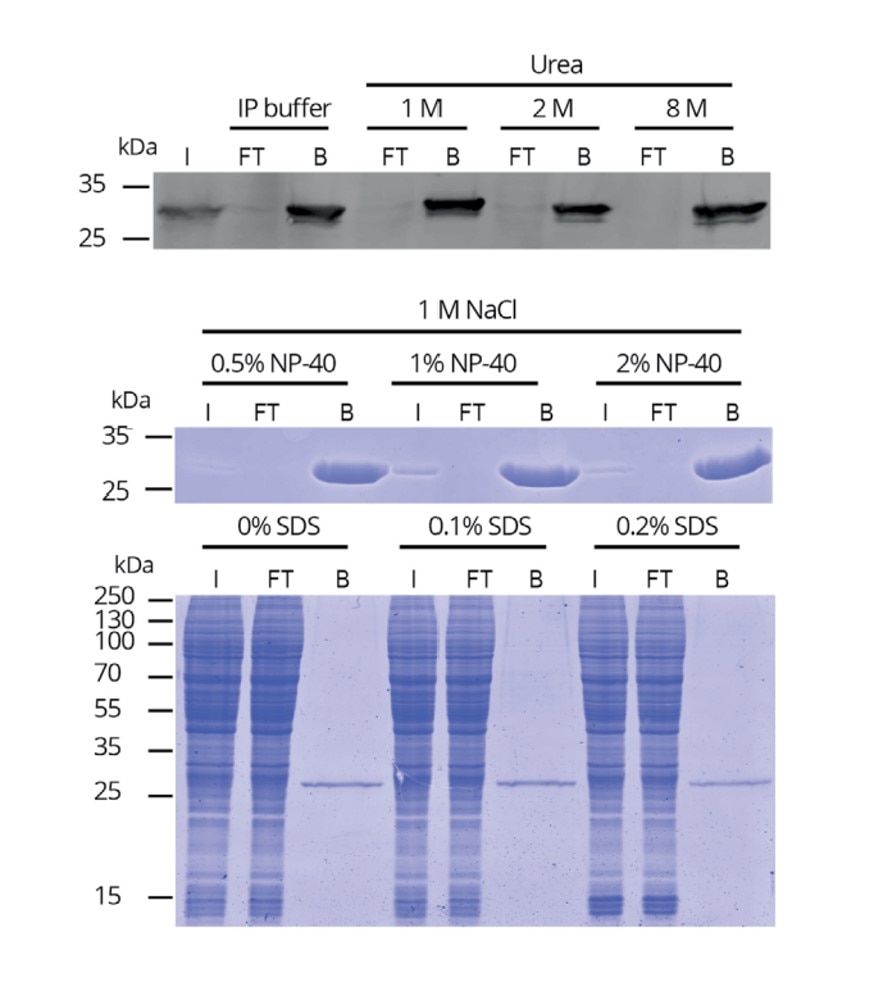
Analysis of GFP-Trap buffer compatibility. The GFP-Trap is compatible with common wash and lysis buffers, including those with high concentrations of NaCl, NP-40, SDS, and Urea. No matter the wash condition, GFP-tagged proteins remain bound to trap, which no protein remaining in the flow-through fraction.
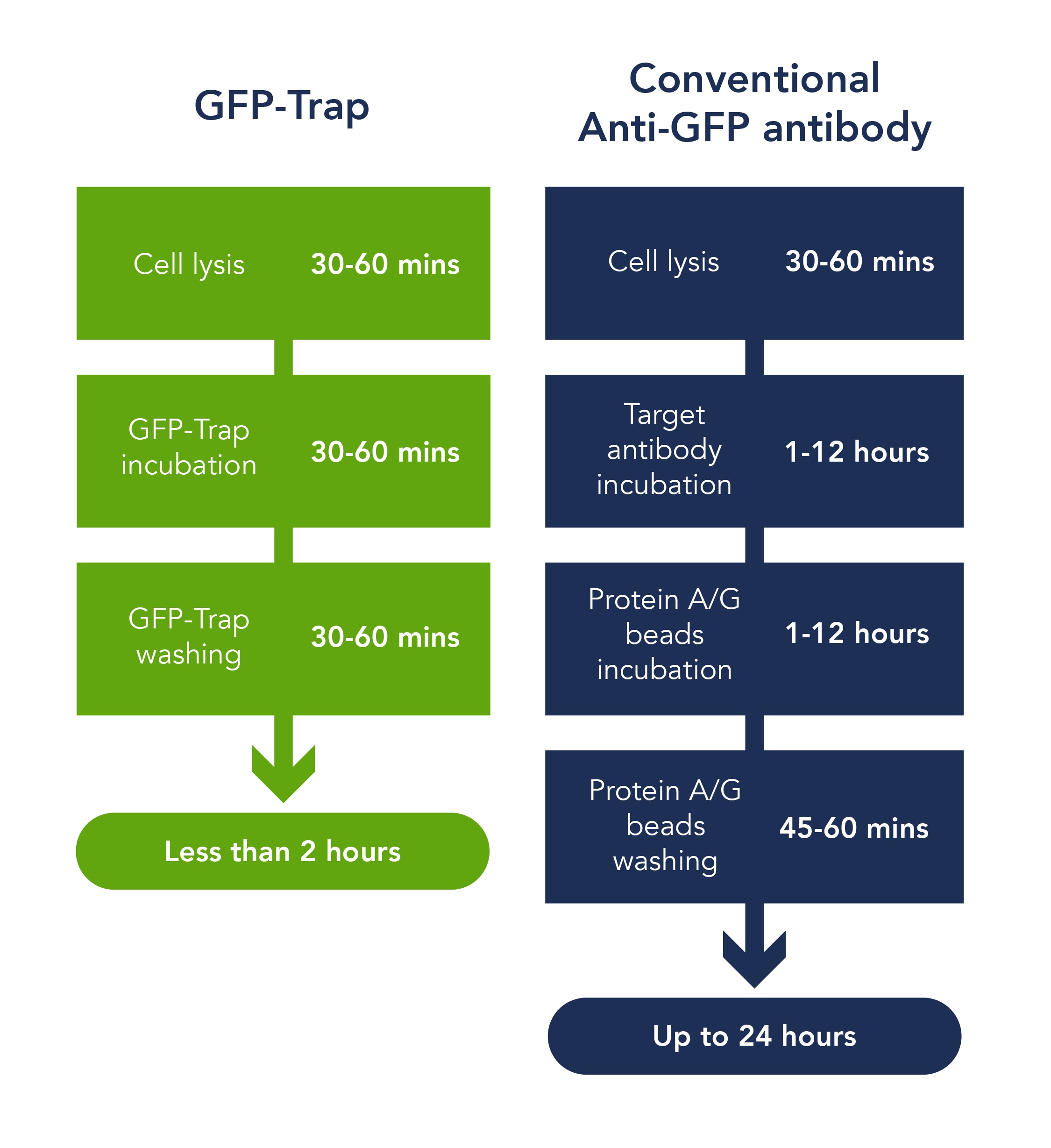
Nano-Traps are ready-to-use, with the nanobody VHHs pre-conjugated to beads. This significantly speeds up the IP workflow with no pre-incubation necessary and pulldowns completed within 60 minutes
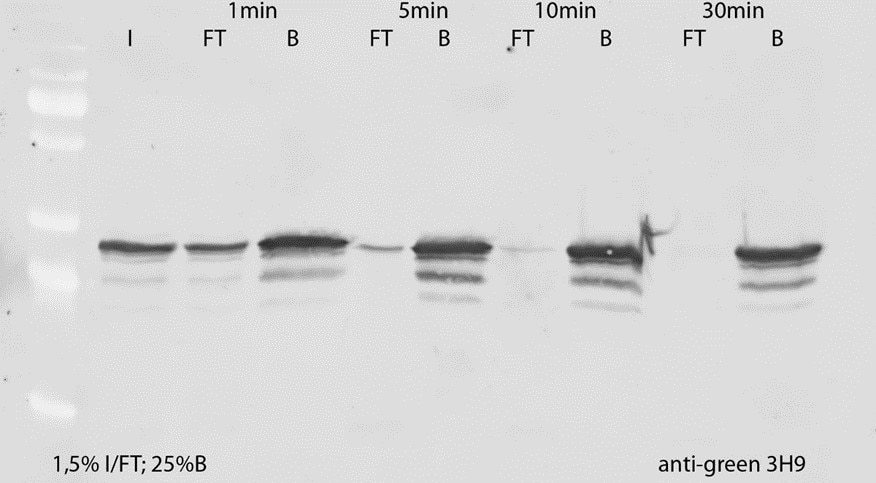
Time-course pulldown of GFP-tagged proteins using GFP-Trap. Most tagged-proteins are bound by the trap within 5 minutes with all protein being captured by 30 mins.
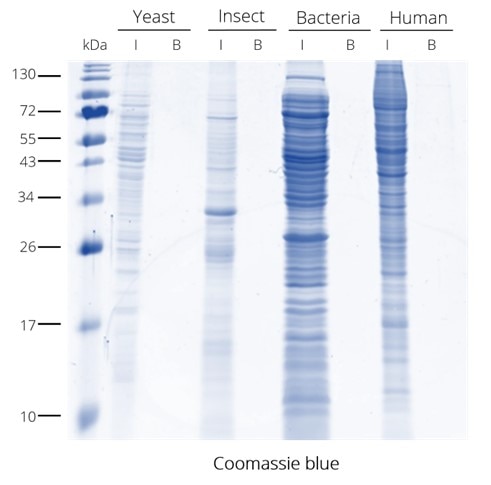
IP from different cell lysates without V5-tagged proteins using V5-Trap. The V5-Trap has remarkably low background with no non-specific binding seen in the bound fraction.
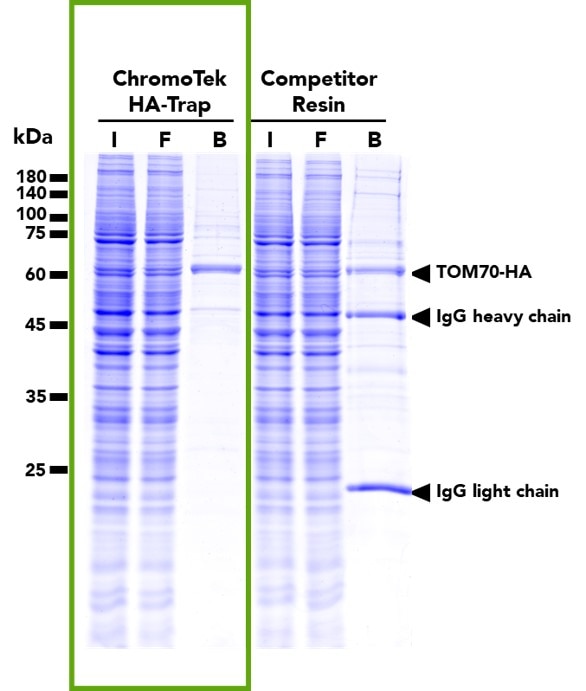
Pulldown of TOM70-HA fusion protein from transfected HEK293T cells using either HA-Trap (left) or a competitor resin (right). Pulldowns with HA-Trap result in far cleaner, single-band pulldowns with significantly less artifact binding compared to the competitor product.
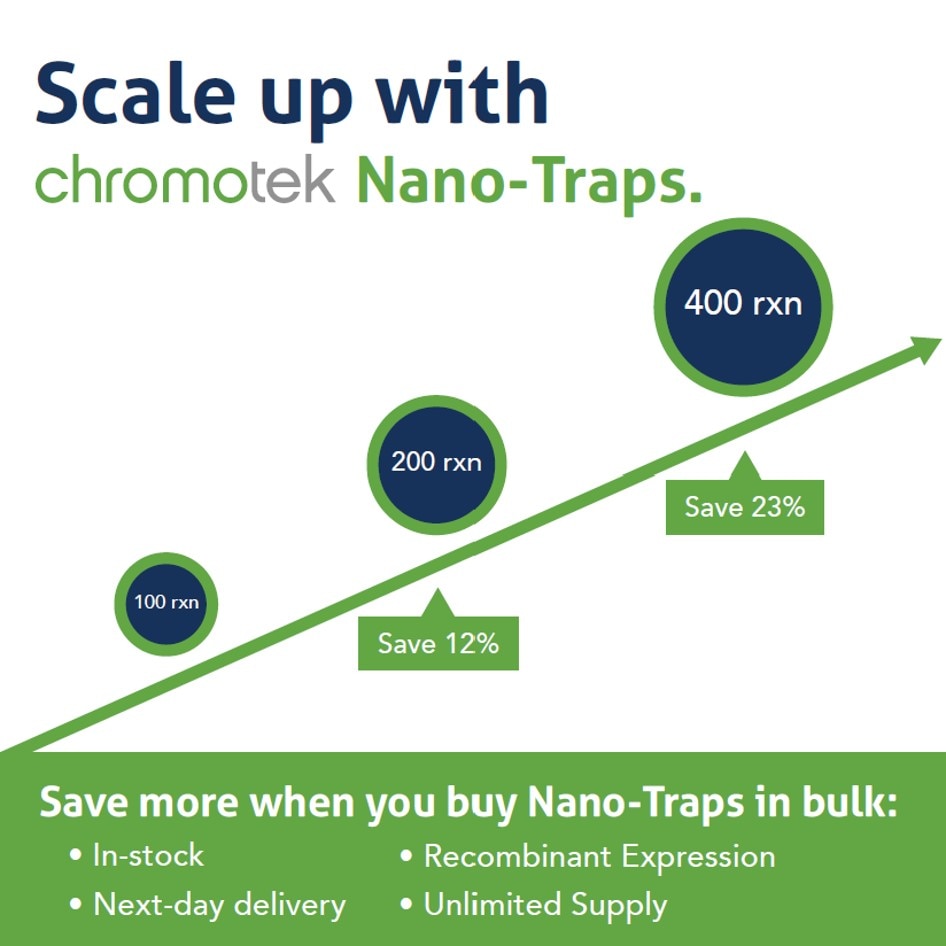
There is a built-in discount when scaling up to our 200- and 400- reaction sizes. You can save nearly 25% when purchasing in bulk. Our recombinant expression system ensures the supply of even larger quantities upon request.
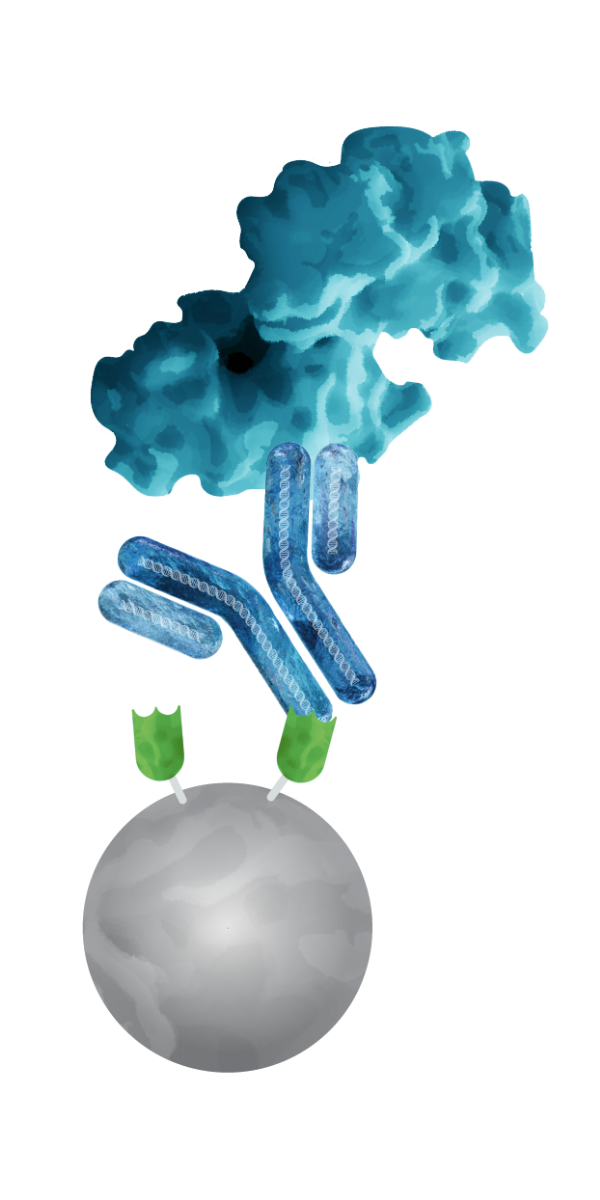
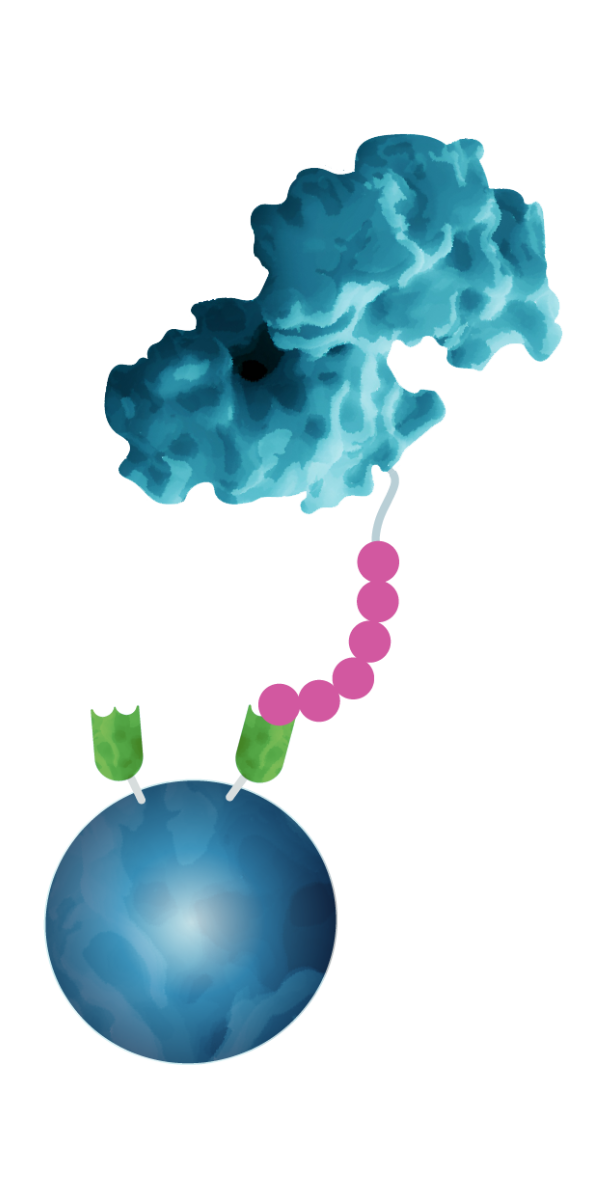
How Nano-Traps compare with anti-IgG VHH Beads and Protein A/G
Compare Nano-Traps with anti-IgG VHH Beads and Protein A/G to see when Nano-Traps offers the best balance of specificity, background reduction, and workflow compatibility.
| Protein A/G | Anti-IgG VHH Beads | Nano-Traps | |
|---|---|---|---|
 |
 |
 |
|
| Binding via | Bacterial Protein A or G | Recombinant Secondary VHH | Recombinant Primary VHH |
| Binding target | IgG | IgG | Protein or peptide tag Endogenous proteins |
| Species-specific IgG recognition? | No | Yes | Binds directly to target |
| Background in SDS-PAGE and Western Blot |
High Protein A/G leaching into IP fraction and unspecific binding of detection antibodies; Heavy and light chain antibody bands possible. |
Low Heavy and light chain antibody bands possible. You can use SpeedAb Kits or conformation-specific secondary antibodies to avoid recognition of your pulldown antibody. |
Ultra-low |
| Duration | > 3h | > 3h | < 2h |
| Binding affinity to IgG or tag? |
Very low to high (depending on IgG species) |
High (optimized for the respective IgG subtype) |
High to very high |
| Ready-to-use? | Depends on vendor | Yes | Yes |
| Use for | Standard IPs if background is not critical | Standard IPs where clean, efficient, and consistent performance is required, especially when working with antibody species that have low affinity for Protein A/G. | IPs of tagged proteins, especially for low abundant targets and workflows requiring stringent washing (e.g., IP-MS), or for applications where speed and reproducibility are key. |
| Learn more about anti-IgG VHH Beads |
Articles
Explore articles on Nano-Trap applications, immunoprecipitation workflows, and related research topics.
Which GFP-Trap should I use for my immunoprecipitation?
The GFP-Trap consists of the ChromoTek anti-GFP Nanobody VHH that is coupled to 3 different types of beads or is immobilized in a 96 multiwell plate.
Non visible textThe best anti-GFP antibody for immunoprecipitation
GFP-Trap consists of an anti-GFP VHH (green circle), derived from camelidae (alpaca, llama, camel, dromedaries, etc.) heavy chain antibodies. The anti-GFP...
Non visible textWhy is the Fab-Trap™ so Fab-ulous?
The Fab-Trap™ is an IP reagent based on a Fab-fragment of a conventional antibody that is covalently coupled to Agarose beads. Fab-Traps™ offer several advantages in IP...
Non visible textGreen fluorescent protein (GFP) in plant research
GFP is increasingly being used as a universal reporter in plant biology from the cellular to whole plant level:...
Non visible textMyc-Trap for IP and affinity purification
Myc-Trap’s performance has been optimized for immunoprecipitation (IP/Co-IP) and affinity purification of Myc-tagged proteins...
Non visible textVirus research using GFP
The interaction between the Nanobody VHHs and GFP is extraordinarily stable and efficient. This allows using cell lysate originating from many different organisms that require a multitude of different IP conditions...
Non visible textWhich GFP-Trap should I use for my immunoprecipitation?
The GFP-Trap consists of the ChromoTek anti-GFP Nanobody VHH that is coupled to 3 different types of beads or is immobilized in a 96 multiwell plate.
Non visible textThe best anti-GFP antibody for immunoprecipitation
GFP-Trap consists of an anti-GFP VHH (green circle), derived from camelidae (alpaca, llama, camel, dromedaries, etc.) heavy chain antibodies. The anti-GFP...
Non visible textWhy is the Fab-Trap™ so Fab-ulous?
The Fab-Trap™ is an IP reagent based on a Fab-fragment of a conventional antibody that is covalently coupled to Agarose beads. Fab-Traps™ offer several advantages in IP...
Non visible textGreen fluorescent protein (GFP) in plant research
GFP is increasingly being used as a universal reporter in plant biology from the cellular to whole plant level:...
Myc-Trap for IP and affinity purification
Myc-Trap’s performance has been optimized for immunoprecipitation (IP/Co-IP) and affinity purification of Myc-tagged proteins...
Virus research using GFP
The interaction between the Nanobody VHHs and GFP is extraordinarily stable and efficient. This allows using cell lysate originating from many different organisms that require a multitude of different IP conditions...
Non visible textFAQs
Need help choosing the right immunoprecipitation reagent? Explore when to use Nano-Traps for your experiments.
When are Nano-Traps a better choice than Protein A/G?
Nano-Traps use primary VHHs coupled to (magnetic) agarose beads or magnetic particles and are the preferred choice for immunoprecipitation of proteins that carry an affinity tag such as GFP, Myc, HA, or V5. They are also available for selected endogenous targets, including Ubiquitin, SUMO, NEDD8, and ISG15.
Compared to Protein A/G-based IPs, Nano-Trap-based IPs are cleaner and more efficient. Because Nano-Traps do not rely on antibodies for target capture, they eliminate heavy and light chain antibody contamination in downstream analysis. They also enable faster, one-step pulldowns that can be completed in under 2 hours, whereas Protein A/G protocols typically take at least 3 hours since they require an additional incubation step with the IgG or a pre-assembly of beads.
What is the affinity of Nano-Traps?
The binding affinities (KD) of ChromoTek Nano-Traps are exceptionally high, typically ranging between 1 pM and 200 nM. Affinities can vary depending on whether the protein or peptide tag has been attached to the target protein's N- or C-terminus. Detailed information regarding the exact binding affinity of each specific Nano-Trap can be found on its respective product page.
What lysis and wash buffers are compatible with Nano-Traps?
Since nanobodies are very small and have a compact structure, they show increased thermostability and robustness under stringent washing and lysis buffer conditions. ChromoTek Nano-Traps maintain high binding affinity and remain fully functional in environments that would typically denature traditional antibodies, including high concentrations of:
- Salt: Allows for high-salt (e.g., NaCl) washes to eliminate non-specific background binding.
- Detergents: Compatible with common ionic and non-ionic detergents (e.g., SDS, Triton X-100, NP-40).
- Reducing Agents: Compatible with DTT, β-mercaptoethanol, TCEP.
- Chaotropic Agents: Resistant against high concentrations of urea.
Detailed information for the specific buffer compatibility of each Nano-Trap can be found on its respective product page.
How do I avoid antibody heavy (55 kDa) and light chain (25 kDa) bands masking my target protein in my Western Blot after immunoprecipitation?
To avoid antibody heavy (55 kDa) and light chain (25 kDa) bands masking your protein of interest, we recommend the following strategies:
- Use different antibody species for capture and detection, so your Western Blot secondary antibody does not bind to both.
- Use SpeedAb kits: If switching species is not feasible, we recommend our SpeedAb Kits. They include FlexAble HRP, a solution to label primary antibodies with HRP. This enables 1-step detection without a secondary antibody completely circumventing the problem. Note: SpeedAb kits additionally contain our Blotting Accelerator, a solution with special organic compounds that lets you skip the blocking step and speed up antibody incubation when antibodies are diluted in it.
- Use conformation-specific secondaries: Use a secondary antibody that only binds native, but not denatured IgG, such as the HRP-Goat anti-rabbit IgG conformation-specific recombinant secondary antibody.
- Cross-link your antibody: Covalently cross-link your IP antibody to the bead, so it does not elute with your sample.
- Avoid antibody contamination altogether: Our Nano-Traps rely on primary nanobodies that bind directly to their target (e.g., a tag or endogenous protein) without requiring a traditional capture antibody, entirely eliminating antibody contamination of your eluate.
Can I use Nano-Traps to pull down untagged, endogenous proteins?
Yes, we offer a range of Nano-Traps designed to directly pull down untagged, endogenous proteins. These specialized tools allow you to perform immunoprecipitation without an expression tag by targeting the native protein itself. Our current portfolio includes Nano-Traps targeting:
- Members and regulators of the ubiquitin pathway: Such as Ubiquitin-Trap, SUMO1-Trap, SUMO3-Trap, NEDD8-Trap, and ISG15-Trap.
- Key endogenous nuclear and signaling proteins: Such as DNMT1-Trap, PARP1-Trap, and MK2-Trap.
If you cannot find a specific Nano-Trap for your target in our catalog, we recommend using anti-IgG VHH Beads. These beads also provide highly specific, clean results with minimal background. Please note that, unlike Nano-Traps, anti-IgG VHH beads do require the use of a primary capture antibody targeting your specific protein of interest for the pulldown.
Can I use Nano-Trap for protein purification?
Yes, protein purification is possible with all of our protein- or peptide-tag-targeting Nano-Traps in the agarose format, which is fully compatible with batch, gravity-flow, and FPLC-based affinity purification protocols. Depending on the type of tag the Nano-Trap is targeting, we recommend different elution methods to maximize your yield:
- For peptide tags (e.g., His-tag, V5-tag, Myc-tag, Strep-tag, Flag-tag, HA-tag): You can conveniently use competitive peptide elution for a gentle, native recovery.
- For protein tags (e.g., GFP, RFP): We recommend inserting a protease recognition site between the tag and your protein of interest, allowing you to cleave and release your target.
Our tools are thoroughly validated for demanding purification workflows. An example protocol demonstrates that membrane protein purification using GFP-Trap® yields material of sufficient quantity and purity for biochemical, pharmacological, and structural analyses within a day. For high-capacity purifications, we recommend using our specialized Spot-Cap® system or contacting us to request our GFP-Trap® high-capacity version.
How do I elute my protein of interest from the Nano-Trap (for IP)?
There are several options for eluting your protein of interest from the Nano-Trap:
- Denaturing elution with SDS sample buffer: This method will elute and at the same time denature your protein of interest preparing it for downstream Western blotting.
- Acidic elution with glycine at pH 2.5: Very important: Don’t forget to neutralize proteins immediately after elution.
- Proteolytic elution: You may consider introducing a protease cleavage site between your tag and the fusion protein. This option is recommended if you are dealing with less stable proteins.
- Native elution using a competitive peptide: We recommend this elution for our Nano-Traps targeting peptide tags (e.g., His-tag, V5-tag, Myc-tag, Strep-tag, Flag-tag, HA-tag). Be aware that this does not work for Nano-Traps targeting protein-tags (e.g., GFP-trap®).
- On-bead digestion: The protein of interest can also be digested directly on the bead for downstream mass spectrometry analysis (IP-MS / AP-MS). View our on-bead digestion protocol for IP-MS and AP-MS
Are Nano-Traps compatible with plant samples like Arabidopsis, tobacco, or crop species?
Yes, Nano-Traps are highly recommended for use with plant samples and are frequently cited across the plant research field. Because commercial antibodies targeting endogenous plant proteins are often limited, plant researchers frequently rely on engineered fusion tags to isolate their targets. GFP remains one of the most widely used choices for plant cell extracts, making our GFP-Trap an ideal solution for these pull-downs. Watch our video on optimizing immunoprecipitation of FP-tagged proteins in plant cell extracts.
Where can I find an immunoprecipitation protocol for my application?
Protocols are available in the following places:
- Standard immunoprecipitation protocol.
- Protocols for Nano-Traps can be found on each respective product page under the product information section.
- Find out more about our immunoprecipitation tools, workflow guidance, and FAQs.
- A protocol for on-bead digestion using Nano-Traps for IP followed by mass spectrometry (MS) analysis (IP-MS / AP-MS).